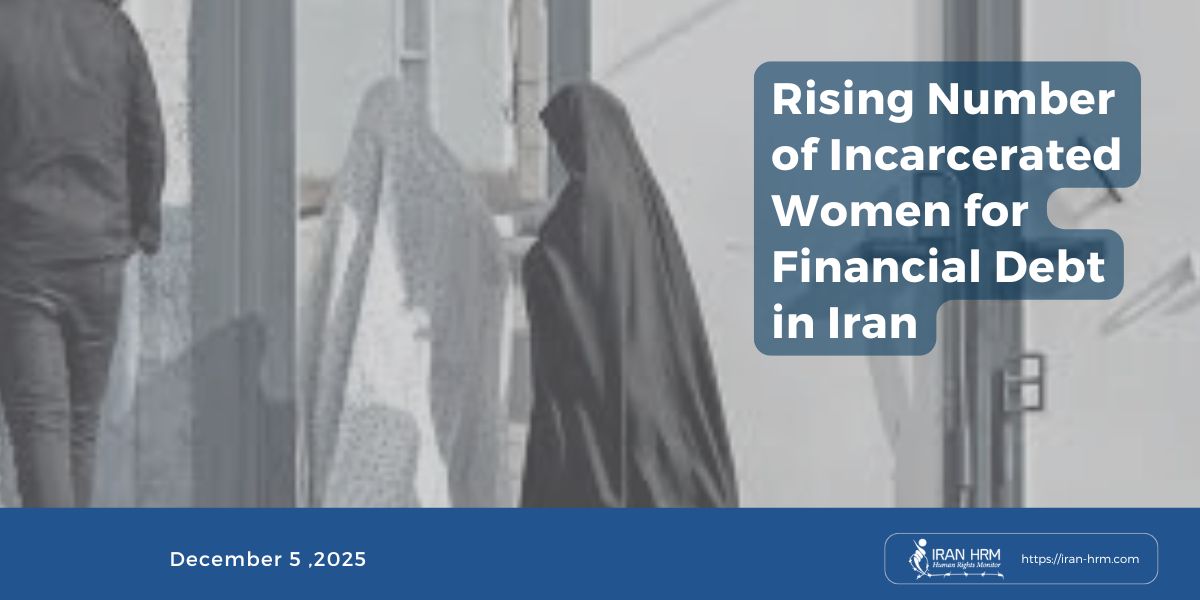
Recent data from prisons across Iran offers a stark picture of the unprecedented rise in women imprisoned for financial debt; women detained not for committing crimes but due to overwhelming economic pressure and the erosion of financial security. Reports indicate that this growing wave of debt; related incarceration, especially among mothers and female heads of household, has reached an alarming level with profound consequences for thousands of families across Iran.

Background of the Crisis: An Unstable Economy and Debts that Lead Directly to Prison
Findings show that in recent years—amid soaring inflation, the sharp devaluation of the national currency, and a widespread employment crisis; the number of women imprisoned for failing to repay small personal debts has steadily increased. These debts typically include guarantees undertaken for relatives, medical expenses, rent, or minor loans. However, in the current economic collapse, such small obligations have rapidly turned into unmanageable liabilities.
Tehran remains the province with the highest number of female financial inmates; reflecting the extreme cost of living and the absence of social safety nets for women. Many of these women report that they sought short; term loans simply to cover basic family needs and were ultimately detained when they could not meet repayment deadlines.
Human Impact: Mothers Behind Bars
One of the most troubling findings is the high proportion of mothers among these incarcerated women. According to available statistics, 73 percent of imprisoned women in financial cases have children, many of them with three or more. The detention of mothers has a direct and damaging impact on children’s safety and future leaving many without caregivers and exposing them to severe economic hardship, school dropout, and social vulnerability.
Additionally, the age distribution of inmates shows that the economic crisis has affected women across all generations. The youngest imprisoned woman for financial debt is 20 years old, while the oldest; born in 1935 is spending her final years behind bars. This wide age range, from the youngest adults to the elderly, reflects the pervasive reach of economic hardship.
The Fall of Social Status: 24 Women with Doctoral Degrees in Prison
Another striking reality is the presence of 24 women holding doctoral degrees among financial; debt inmates. These women previously worked as educators, physicians, researchers, pharmacists, and professionals in leadership roles. Their imprisonment illustrates that economic pressure is not confined to low; income households; even well; educated, experienced women with stable careers have become financially vulnerable.
Social analysts note that the growing incarceration of highly educated women points to the deterioration of Iran’s economic structure and the accelerated loss of professional talent, as even those with consistent income streams can no longer withstand prolonged financial instability.
Economic Analysis: Inflation, Recession, and Failing Institutional Structures
A review of economic trends in recent years shows that the rise in imprisoned debtors is not incidental; it stems from deeply rooted structural problems:
- Record; breaking inflation and rising everyday expenses
- Erosion of purchasing power and the collapse of the middle class
- Loss of stable employment and expansion of precarious jobs
- Absence of effective social protection policies for women and mothers
- Predatory lending practices and widespread nonregulated financial institutions
- Limited access to formal loans with reasonable and supportive conditions
Experts emphasize that the lack of alternative mechanisms for debtors; such as monitored repayment programs or state; backed support means that even minor debts can lead directly to incarceration. In contrast, imprisoning individuals for financial incapacity has been abolished in many countries, where structured financial assistance and social support systems are provided instead.
Human Rights Dimensions: Violations of International Standards
The rise in women imprisoned for financial debt is not solely an economic issue; it represents a direct violation of Iran’s international human rights obligations. Under international law:
- Imprisoning a person for failing to fulfill financial obligations violates Article 11 of the International Covenant on Civil and Political Rights (ICCPR).
- Article 9 prohibits arbitrary arrest and detention.
- Article 10 mandates humane treatment and protection of dignity for all detainees.
- Article 17 requires the protection of family life and the welfare of children.
- Article 26 ensures equality and nondiscrimination, including in socio;economic conditions.
Additionally, reports show that many imprisoned women face limited access to medical care, inadequate prison conditions, and heightened psychological and physical risks; issues that intensify concerns over widespread rights violations. These conditions are in clear contradiction with the UN Standard Minimum Rules for the Treatment of Prisoners (Nelson Mandela Rules).
Social Consequences: A Growing but Silent Crisis
The repercussions extend far beyond prison walls:
- A rising number of children left without parental care
- Increased poverty and instability among affected families
- Higher rates of child labor and reduced access to education
- Growing psychological and social strain on communities
- Deepening inequality and the ongoing erosion of the middle class
Social researchers warn that if the current trend of incarcerating debtors continues, Iranian society will face escalating long-term social crises with irreversible consequences.
Conclusion
The growing number of women imprisoned for financial debt reflects a profound economic crisis, the collapse of social protections, and systemic failures within judicial and welfare institutions. Women, children, and families bear the heaviest burden of this multifaceted crisis.
Beyond its economic causes, the current situation represents a serious human rights concern requiring urgent action. Creating alternative noncustodial mechanisms for financial debt cases, reforming economic structures, and restoring social protection systems are essential steps to preventing this crisis from expanding further.