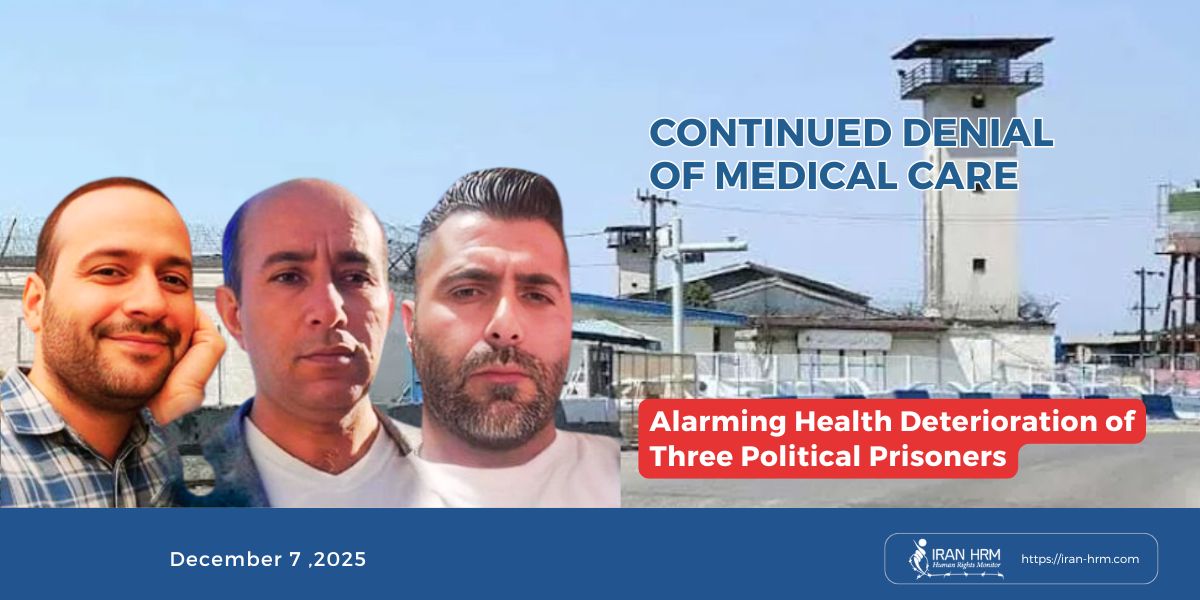
Reports from Lakan Prison in Rasht indicate a serious decline in the health of three political prisoners—Manouchehr Fallah, Peyman Farahavar, and Yaghoub Derakhshan. According to informed sources inside the prison, all three prisoners are experiencing escalating pain and worsening medical symptoms. Despite repeated warnings from fellow inmates and medical staff, authorities continue to prevent their transfer to specialized medical centers, reflecting a systematic pattern of medical neglect targeting political detainees.

Progressive Illness and Systemic Neglect
Manouchehr Fallah
According to multiple accounts, Manouchehr Fallah suffers from severe and persistent stomach pain that wakes him at night and disrupts his daily functioning. Although he has repeatedly sought help from the prison infirmary, the facility lacks the equipment necessary to diagnose or treat his condition. Prison doctors have stated that diagnostic procedures—such as endoscopy—can only be carried out in a hospital outside the prison.
In addition to digestive complications, several masses have developed in different parts of his body. One mass on his left hand has grown to the size of a walnut and continues to enlarge. The combination of abdominal pain and these growing lesions requires immediate evaluation by specialists, yet no transfer has been authorized.
Peyman Farahavar
Peyman Farahavar, who underwent gallbladder removal surgery before his arrest, is now suffering from severe abdominal pain, general physical weakness, and a significant reduction in vision. Medical staff have recommended that he be transferred to a hospital for an ophthalmological assessment and additional testing, but this has not occurred.
Sources report that both Fallah and Farahavar have developed more than twenty unidentified masses, some as large as a walnut, which have increased in size over recent months. Despite these concerning symptoms, no imaging, biopsy, or specialized diagnostic procedures have been carried out, and their treatment has been effectively halted.
According to relatives, Farahavar has lost more than 15 kilograms due to his inability to eat the prison food and is now in a state of severe weakness. His worsening pain and visual impairment have severely disrupted daily life, while repeated requests for specialized care remain unanswered.
Yaghoub Derakhshan
Yaghoub Derakhshan, the third political prisoner referenced in the reports, suffers from serious prostate and kidney conditions. Prison sources state that he is unable to sleep at night due to persistent pain and urinary complications. Medical personnel have confirmed that his treatment cannot be provided inside the prison and requires immediate transfer to an external medical facility. His transfer requests have also gone unanswered.
Security Interference and the Use of Medical Deprivation as a Tool of Pressure
Sources inside Lakan Prison report that the refusal to authorize medical transfers is not merely an administrative decision but, in some cases, explicitly ordered by security agencies. These actions appear to be used as a method of pressure and punishment against political prisoners.
Human rights advocates describe the deliberate denial of medical treatment as a form of “white torture”—a method of inflicting harm through prolonged physical suffering, anxiety, and psychological erosion without visible physical violence.
Conditions Inside the “Misaq” Ward
The “Misaq” ward, where Fallah and Farahavar are held, is described as deeply inadequate and degrading. According to informed sources, the ward:
- lacks any outdoor access,
- has no natural light,
- severely restricts physical movement,
- provides minimal access to basic hygiene,
- maintains an environment resembling long-term solitary confinement.
Experts on detention conditions note that the absence of natural light and ventilation has direct consequences for both physical and mental health and can exacerbate existing illnesses. Reports also highlight shortages of essential cleaning supplies, resulting in accumulated unsanitary conditions and increased exposure to environmental health risks.
Families Kept in the Dark
The families of the three prisoners report complete lack of information regarding their medical status. Phone calls are limited, and prison authorities have not provided any updates about their health or treatment. Families warn that the situation poses an immediate threat to the lives of their loved ones.
Broader Pattern of Violations in Lakan Prison
Accounts from former detainees and available documentation indicate that medical deprivation and unlawful pressure tactics constitute a broader pattern of abuse at Lakan Prison. These practices reportedly include violent or punitive conduct by guards, severe restrictions on visitation, and limited access to essential necessities—all of which deeply affect the well-being of political prisoners.
Conclusion
The collected information demonstrates that the health of the three political prisoners; Manouchehr Fallah, Peyman Farahavar, and Yaghoub Derakhshan; has reached a critical stage. Persistent denial of medical care, combined with inadequate infrastructure and security interference, places their lives in acute danger.
Despite clear obligations under domestic regulations and international human rights standards requiring adequate medical care for detainees, the documented conditions at Lakan Prison show a consistent failure to meet these obligations. The continuation of these circumstances’ risks causing irreversible harm.