Gender-Based Violence and Structural Discrimination against Women in Iran (2025)
From Prisons and Executions to Society
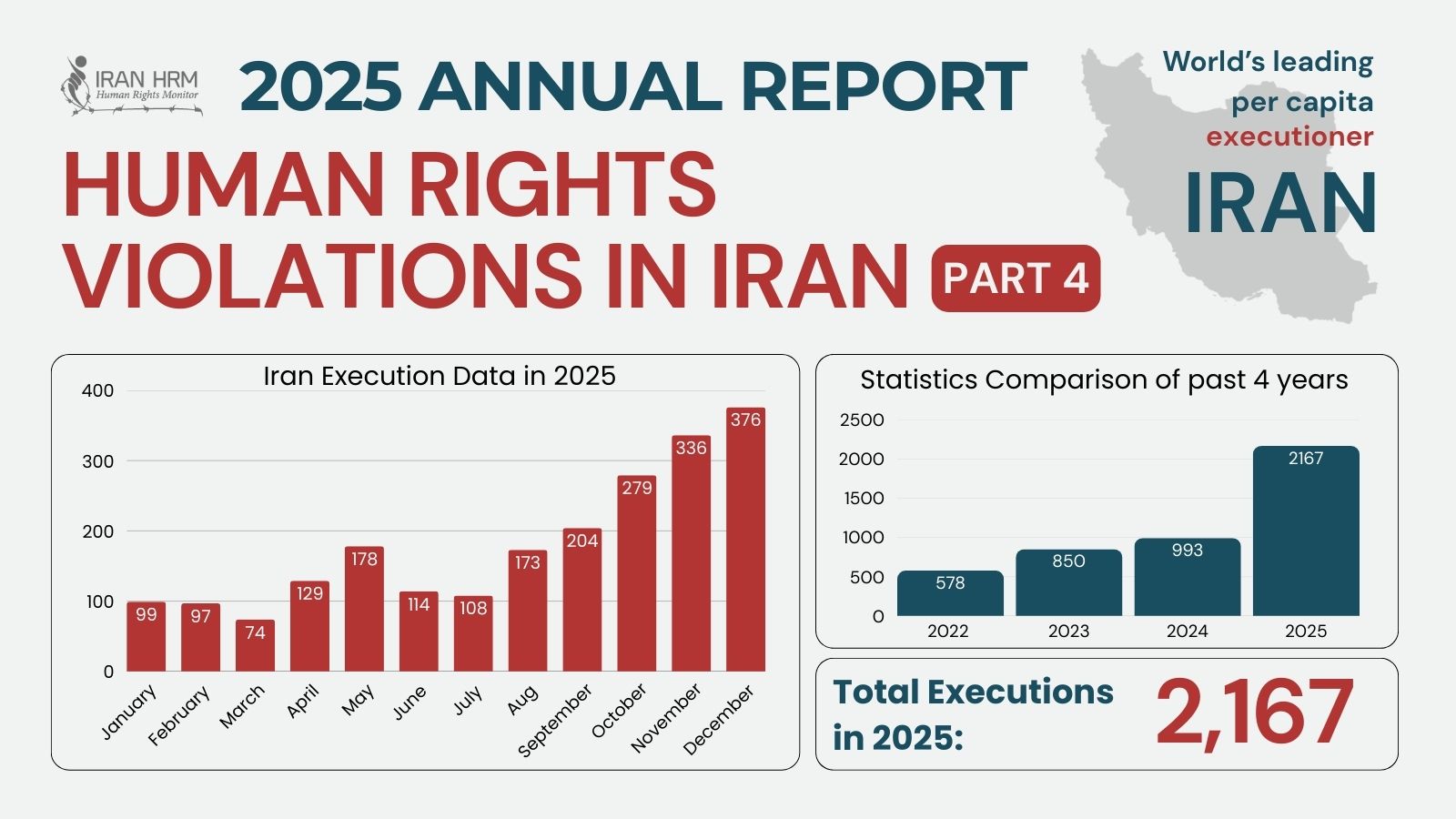
This section constitutes the fourth part of the annual report on human rights violations in Iran in 2025. Previous sections examined, first, the violation of the right to life and the unprecedented increase in executions, followed by the systematic escalation of violations against prisoners’ rights. What follows is a continuation of the same logic of repression exercised within prisons and through death sentences—this time focusing on violations of women’s rights across all levels, from detention and the judicial system to everyday life in society.

In 2025, violence against women in Iran did not manifest as isolated incidents, but rather as an integrated legal and administrative order. Laws, public policies, and executive practices collectively functioned to render gender discrimination not an exception, but the governing norm of women’s social existence. Within this framework, women’s lives and public presence became arenas for simultaneous control, punishment, and state surveillance.
At the international level, this situation has been formally documented. In its resolution adopted on 19 December 2025, the United Nations General Assembly expressed deep concern over the continued systematic human rights violations in Iran, explicitly highlighting the repression of women’s rights, discriminatory gender-based laws, the rise in feticide and so-called “honor killings,” and called on Iranian authorities to repeal discriminatory legislation and ensure accountability for perpetrators of gender-based violence.
Law as Violence | When Legal Texts Inflict Harm
One of the defining characteristics of women’s situation in 2025 was the legalization of violence. The so-called “Chastity and Hijab Law,” rather than protecting human dignity, became an instrument for multilayered coercion against women. Through vague and undefined concepts such as “improper dress” or “nudity,” the law grants extensive discretionary power to enforcement agents while significantly expanding the scope of punishments.
Sanctions extend beyond warnings and fines to include denial of public services, restrictions on employment and education, and, in cases of repetition, criminal prosecution. Furthermore, responsibility for enforcement is deliberately shifted to third parties. Employers, business owners, educational and medical administrators face fines or closure if deemed non-compliant.
Throughout 2025, numerous cases documented the implementation of these policies—from the closure of businesses due to women’s “non-compliant” appearance to economic pressure exerted on workplaces and educational institutions. In this structure, violence is not limited to individuals; it produces a network of social and economic coercion whose ultimate objective is the gradual exclusion of women from public space.
Mandatory Veiling | Everyday, Technological, and Erosive Violence
By 2025, mandatory veiling was no longer merely a cultural or ideological issue; it had become a daily experience of state violence for millions of women. This violence is not always loud or physical, but it is continuous, erosive, and deeply impactful.
Enforcement increasingly relied on digital tools, including urban surveillance cameras, identification systems, and automated warning and fine notifications via text messages, resulting in administrative and social deprivation. This demonstrated that control over women was increasingly exercised remotely and through data-driven mechanisms.
Confirming this trend, the Independent International Fact-Finding Mission on Iran warned in its report of 30 October 2025 that Iranian authorities extensively employed modern technologies, including artificial intelligence, surveillance cameras, and facial recognition systems to identify and punish women opposing mandatory hijab. Referring specifically to the “Noor Plan,” the report noted that in 2025 these technologies intensified sanctions such as denial of social services, heavy fines, and arbitrary detention.
Official statements by authorities further indicate that this policy was deliberate and systematic. Mandatory veiling was framed as a “legal obligation,” sending a clear message regarding the state’s legitimization of repression.
From Law to Home | The Nexus of State and Domestic Violence
Separating state violence from domestic violence fails to reflect reality. In 2025, institutional inaction and legal gaps enabled domestic violence to be reproduced within a framework of legal discrimination. When the law fails to protect women, the home becomes unsafe.
The absence of a comprehensive and enforceable law addressing domestic violence resulted in many women being urged to “reconcile” or return to abusive environments—even after reporting violence. Such forced returns significantly increased the risk of continued and escalated abuse, creating cycles from which escape became increasingly difficult.
Femicide | The Point of Violent Convergence
Femicide in 2025 represented the culmination of accumulated violence rather than sudden acts. Aggregated data indicate that more than 175 cases of femicide were recorded in Iran during the year. In a significant number of cases, the perpetrators were husbands, fathers, or other close family members.
In many instances, victims had previously experienced or reported domestic violence. The absence of effective protection and institutional response normalized abuse and rendered lethal outcomes foreseeable.
Supporting this pattern, UN Special Rapporteur Mai Sato reported to the Human Rights Council on 18 March 2025 that 179 femicides were recorded in 2024, an increase of approximately 180 percent compared to the previous year. The report emphasized that Iran’s judicial system, by ignoring the context of violence and providing de facto impunity for perpetrators of so-called honor killings, legitimizes deadly violence against women.
Gender Gap | Economic Violence and Social Exclusion
Violence against women in 2025 extended beyond detention and killing. One of its most enduring forms manifested in economic marginalization and restricted social participation. Women’s labor force participation remained below 15 percent, reflecting a profound gender gap.
Women’s minimal representation in managerial positions, concentration in informal and insecure employment, and discrimination in recruitment and promotion demonstrate a persistent pattern of exclusion. Mandatory veiling requirements further contributed to informal dismissals and workplace exclusion.
The situation of female-headed households illustrates this structural violence. Hundreds of thousands of such women faced chronic poverty, inadequate insurance coverage, and insufficient social protection, placing them at the intersection of multiple vulnerabilities.
Judicial System | The Reproduction of Violence through Justice
In 2025, judicial practices frequently reproduced violence against women. Field reports indicate that domestic violence contexts were often disregarded, while gender stereotypes influenced judicial decisions. In some cases, women who acted in self-defense were subjected to severe sentences.
These practices restricted women’s access to effective justice and conveyed a clear message of unequal legal protection.
Executions of Women | Ultimate Violence within Inequality
The execution of women in 2025 must be analyzed within the broader context of gender-based discrimination and violence. In several cases, documented histories of domestic abuse or familial coercion were ignored during judicial proceedings.
In late-2025 reports, Mai Sato noted an approximately 70 percent increase in women’s executions compared to the previous year. She emphasized that many of these women were sentenced to death for acts of self-defense against domestic violence or under vague security charges, describing this trend as part of a broader strategy to instill fear among protesters and women activists.
The case of Zahra Tabari exemplifies the systematic disregard for gender-based violence in the issuance of death sentences.
Conclusion | Women as the Mirror of Structural Repression
The cumulative data, documented cases, and official positions demonstrate that violence against women in Iran in 2025 was legalistic, structural, and organized. Mandatory veiling, femicide, domestic violence, gender gaps, unequal judicial practices, and executions within contexts of abuse form interconnected components of a single pattern.
This pattern reveals that, in many instances, the law functions not as a mechanism of protection, but as a tool for violence and social control.