Thursday, January 29, 2026
Iran HRM
  • Home
  • Latest News
    • Uprisings
    • Arrests
    • Arbitrary Murders
    • Prisons
    • Torture
    • Death Sentence
    • Political prisoners
    • Right to Peaceful Protest
    • Religious and Ethnic Minorities
    • 1988 massacre
  • Executions
    • No to Execution Tuesdays
    • Women
    • Political prisoners
    • Public execution
    • Mass execution
  • Publications
    • Articles
    • Documents
    • Monthlies
    • Infographics
  • International Reactions
    • UNHRC Resolutions
    • UN Special Rapporteur on Iran Reports
    • UN Fact Finding Mission on Iran
    • UN Expert Statements
    • European Parliament
    • Amnesty International
  • Campaigns
    • No to Execution Tuesdays Statement
  • Fallen for Freedom
    • January 2026 Iran Nationwide Uprising
    • November 2019 Protests
    • Iran Protests
    • 1988 Massacre Victims
  • About Us
  • فارسی
No Result
View All Result
  • Home
  • Latest News
    • Uprisings
    • Arrests
    • Arbitrary Murders
    • Prisons
    • Torture
    • Death Sentence
    • Political prisoners
    • Right to Peaceful Protest
    • Religious and Ethnic Minorities
    • 1988 massacre
  • Executions
    • No to Execution Tuesdays
    • Women
    • Political prisoners
    • Public execution
    • Mass execution
  • Publications
    • Articles
    • Documents
    • Monthlies
    • Infographics
  • International Reactions
    • UNHRC Resolutions
    • UN Special Rapporteur on Iran Reports
    • UN Fact Finding Mission on Iran
    • UN Expert Statements
    • European Parliament
    • Amnesty International
  • Campaigns
    • No to Execution Tuesdays Statement
  • Fallen for Freedom
    • January 2026 Iran Nationwide Uprising
    • November 2019 Protests
    • Iran Protests
    • 1988 Massacre Victims
  • About Us
  • فارسی
No Result
View All Result
Iran HRM
No Result
View All Result
Home LATEST NEWS

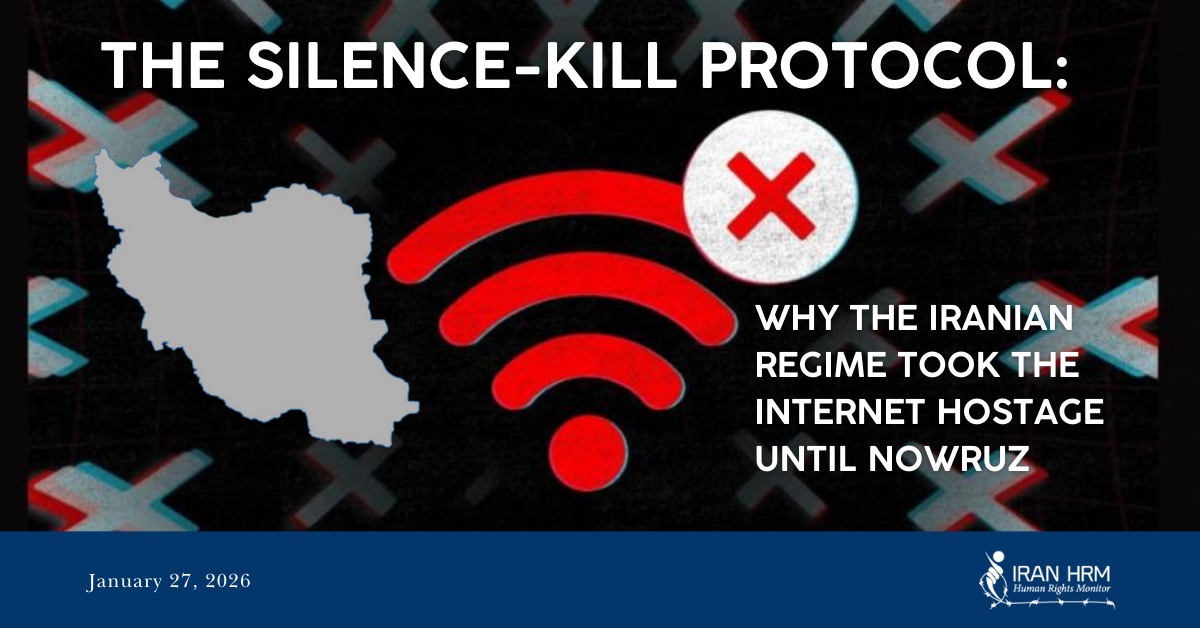
The Silence-Kill Protocol

Why the Iranian Regime Took the Internet Hostage Until Nowruz

January 28, 2026
FacebookTwitterEmail

While it has become a consistent pattern for Iran’s religious dictatorship to cut off the internet to cover up widespread suppression, it must be noted that in the recent uprising—the internet has yet to return to normal. According to Fatemeh Mohajerani, the spokesperson for the Iranian government, international internet access will not be restored until at least Nowruz (late March).

This prolonged internet blackout indicates that the massacre has not ended; rather, its form may have shifted from street killings to executions within prisons. This Information Blackout serves as a tool to create an isolated “darkroom,” allowing the regime to carry out the second phase of its atrocity without witnesses.

In the month of Day of Persian calender of this year (from December 22, 2025, to January 20, 2026), coinciding with the nationwide uprising, at least 345 prisoners were hanged in 57 cities across Iran. The highest number of these executions occurred in the provinces of Razavi Khorasan, Khuzestan, Isfahan, Lorestan, Fars, and Kerman. This execution rate is three times higher than the same period last year and five times higher than two years ago. It is worth noting that executions in 2025 had already seen a 118.2% surge compared to the previous year. These statistics demonstrate that the regime has turned prisons into an extension of the streets; every execution is an act of retaliation for the defeat suffered in controlling “400 cities” and an attempt to shift the balance of terror in favor of the ruling power.

This data proves that the 3-to-5-fold increase in executions during this period is not coincidental, but a continuation of the suppression of the January uprising—this time behind bars—to intimidate society and coerce it into silence and refrain from further protest. Looking at the admissions of regime officials regarding the scale of the protests, it becomes clear why the regime has resorted to such horrific “Crimes Against Humanity” to prevent its downfall and why it refuses to stop.

On January 21, Ali Akbar Pourjamshidian, Secretary-General of the regime’s Security Council, admitted that the uprising was ignited in 400 cities across the country, adding that in Tehran alone, security forces were engaged in 100 locations simultaneously. According to local reports, the scale of the killing was so immense that, for instance, in the city of Mashhad, the regime has resorted to creating mass graves. A credible source reported that in the Behesht-e Rezvan cemetery in this city, pits have been dug, each containing approximately 200 bodies. A local stonemason revealed that in a single day, he was requested to prepare 148 tombstones—all for youths born between 2000 and 2007. This shocking fact is evidence of the targeted killing of the younger generation—those born at the start of the 21st century— who, as the driving force of the uprising, have become the targets of the most vindictive phase of suppression.

As evidence clearly shows, this massacre has not ended but continues with intensity within prisons. The world is duty-bound to stand against such a blatant violation of human rights and such an egregious crime against humanity. The international community must compel this regime to stop the suppression, killings, and executions, force the immediate release of all detained protesters and political prisoners, and demand the immediate admission of international fact-finding missions to determine the dimensions of this massacre.

ShareTweetSend
Previous Post

Iran: From Execution Shots to Night Burials in Mass Graves

Related Posts

Uprisings

Iran: From Execution Shots to Night Burials in Mass Graves

January 27, 2026
Uprisings

The Revolutionary Guards targeted the heads, faces, and hearts of brave women and girls of the uprising

January 26, 2026
Uprisings

The Killing Protocol in Information Quarantine

January 26, 2026

Iran HRM white

ABOUT US

Iran Human Rights Monitor website is dedicated to support the Iranian people’s struggle for human rights and amplifies their voices on the international stage. Its purpose is to cover executions, arbitrary arrests, torture and amputation, prison’s conditions, women, social, ethnic and religious minorities oppression news in Iran and fill the gaps in information and knowledge caused by lack of access and freedom to Iran. The information provided by Iran Human Rights Monitor are in collaboration with the NCRI (National Council of Resistance of Iran)

[email protected]

  • Iran HRM Home
  • About Us

© 2021 Iran Human Rights Monitor - All rights reserved.

Welcome Back!

Login to your account below

Forgotten Password?

Retrieve your password

Please enter your username or email address to reset your password.

Log In

Add New Playlist

No Result
View All Result
  • About Us
  • Global Campaign for “No to Executions” in Iran
  • Iran HRM Home
  • Iran Prisons Information
  • Iranian Protesters Killed in November 2019 Protests
  • January 2026 Iran Nationwide Uprising
  • What will the regime of murderers do to Iran protests after Ebrahim Raisi takes office?

© 2025 Iran HRM