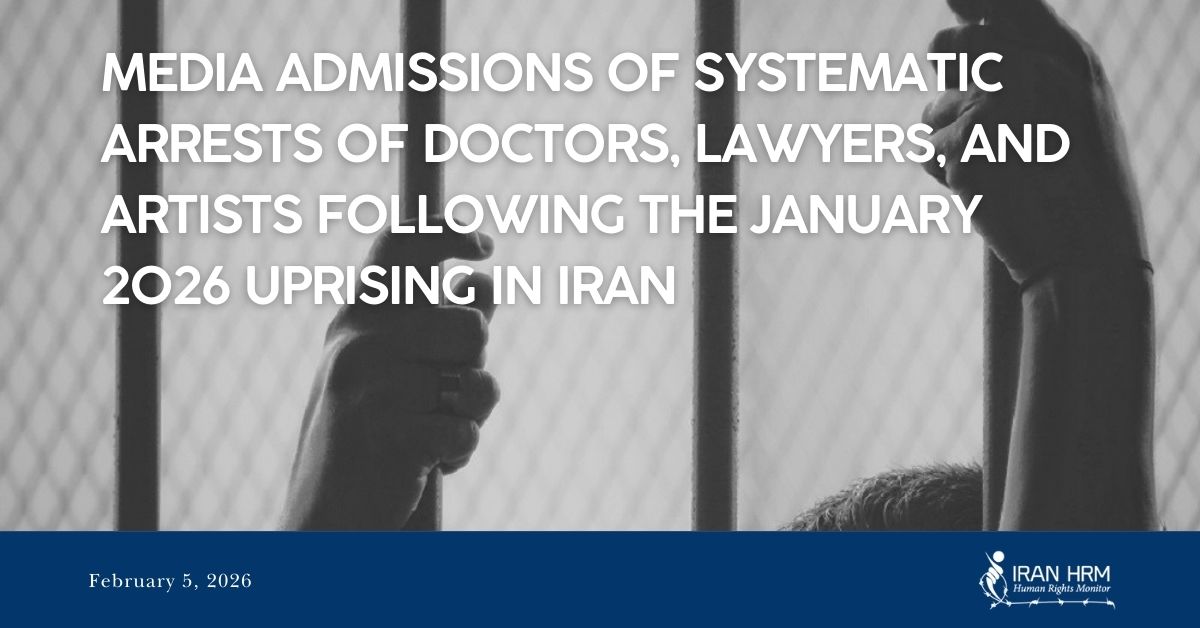
The nationwide uprising of January 2026 has propelled the Iranian regime into a new paradigm of repression, which can be defined as the “absolute criminalization of the right to protest.” By employing hostile rhetoric and “security labeling” against citizens, the Iranian regime has effectively transformed the “inherent right to protest” into “action against national security” to pave the way for the physical elimination of dissidents.

Based on explicit admissions by domestic media (such as Jahan-e Sanat newspaper), this report reveals that the state, in a “systematic survival strategy,” has extended arbitrary arrests to the heart of civil society—including doctors, lawyers, and artists—to sever the people’s support networks. Simultaneously, the execution of 72 individuals in less than a week and the threat of a “digital siege” through internet shutdowns indicate a state-sponsored campaign of intimidation. These actions are not mere law enforcement measures but an organized violation of the “International Covenant on Civil and Political Rights (ICCPR)” and an illegal attempt to maintain power through the arbitrary deprivation of the right to life and the judicial security of citizens.
Methodological Note: A significant portion of this report includes excerpts from Jahan-e Sanat (dated February 3, 2026) regarding the arrests following the bloody crackdown of the January 2026 protests. This article cites reports from official state news agencies (IRNA, ISNA, and ILNA), highlighting the undeniable scale of the crimes that even state-monitored media were compelled to reflect. All content from this source is enclosed in quotation marks.
The Scenario of Legitimizing Killing
“For years, officials at various levels have spoken of the ‘right to protest’ for all citizens. Yet, every time a group of citizens exercises this right, they not only become targets of crackdowns but are also prevented from accessing this ‘legitimate right’ through actions such as blocking all internet and non-internet communications… This recurring premise has always been accompanied by a rider: whenever officials speak of this legitimate ‘right to protest,’ they immediately interpret it through the lens of what they call ‘rioting’ (eghteshash), effectively halting the protests. These protests, which in the not-so-distant past were met with harsh crackdowns for being labeled as ‘sedition’ (fetneh), are today being repelled because they are believed to be instances of ‘terrorism’.”
Admission of Countless Arrests Following the Crackdown
Medical Professionals:
“Why, as domestic news agencies like IRNA, ISNA, and ILNA have been reporting in recent days, are we witnessing the arrest of lawyers who mostly did not even participate in the protests?! Why, at the same time, have a number of doctors and nurses—who gave their hearts and souls during the bloody January to save young lives—been arrested?! What is the reason for the arrest of athletes and artists who, at most, supported the protesters with an Instagram post or a Twitter message?! How is it that students and university professors are being arrested in their homes days after the protests subsided?!… Homayoun Sameyeh Najafabadi, a member of the Parliament’s Health and Treatment Commission, also reported seeing a list that, according to him, ‘pertained to a specific group of arrested doctors across the country.’ Referring to this list, the MP told ILNA: ‘In those few seconds that I glanced at the list, the number of individuals was not small.'”
Artists:
“It is not only members of the medical community and healthcare workers who have witnessed the arrest of their colleagues; similar reports regarding artists and athletes have also surfaced. Last weekend, IRNA confirmed that the Iran Music House, referring to the ‘formation of a special committee to follow up on the status of arrested musicians,’ validated the news circulated on social media… Alireza Hosseini (member of the board of directors and representative of the Legal and Judicial Support Committee of the House of Cinema) confirmed: ‘Three of the detainees were arrested at their homes with judicial warrants, and three others were arrested in public places.’ Hosseini added: ‘A number of colleagues and members of the House of Cinema, including two board members, have been summoned by the security system for hours of interrogation, and some have been contacted by phone.’ Hosseini also reported: ‘Regrettably, our dear colleagues Mr. Javad Gangi (Assistant Director) and Ms. Sahba Rashtian (Painter and Animator) lost their precious lives in recent events.'”
Lawyers:
“Perhaps the most peculiar case of crackdowns concerns the legal community; reports indicate that at least nine licensed lawyers (Payeh-yek) have been arrested. According to the Shargh newspaper, citing the representatives of the detainees, Shima Ghousheh, Mohammad Hadi Jafarpour, Mahdi Ansari, Jafar Zarei, Mehran Ansari, Jafar Keshavarz, Nazanin Baradaran, Enayatullah Keramati, and Omid Darabi have been arrested—six of whom reside and practice in Shiraz.
Interestingly, following the publication of this report, while news circulated regarding the release of one of the six detained lawyers in Shiraz, Ali Shayan-manesh, a board member of the Fars and Kohgiluyeh & Boyer-Ahmad Bar Association, provided further clarification to ILNA, stating: ‘The arrest of that single lawyer who was recently released had actually taken place back in October (Aban), [not during the recent uprising].'”
Admission of Violating the Regime’s Own Laws
“Najafi Tavana (Jurist and Professor of Criminal Law) states, referring to Article 35 of the Constitution as a ‘covenant between the state and the nation’: ‘Article 35 defines a fundamental right for the people and a heavy obligation for the state.’ Emphasizing that ‘the exercise of this right strictly requires the freedom of the lawyer to perform their duties,’ he says: ‘A lawyer must be able to perform their duty without fear… just as doctors must be free to treat patients without worrying about potential consequences or the duty to investigate why a patient sought medical care.'”
The Killings Continue
Between Wednesday, January 28, and Tuesday, February 3, the ruling regime in Iran hanged at least 72 prisoners.
- Tuesday, Feb 3 (15 prisoners): Khalil Hemmati (Shiraz), Pouya Lashni (Sabzevar), Moradbeig Haghighat (Birjand), one prisoner (Bam), Ishaq Miri (Jiroft), Kourosh Nayeri (Yazd), Majid Sohrabi (Malayer), Hirman Sadri (Mahabad), Ali Haghighat-doost (Lahijan), Tahmaseb Mehrjou (Khaf), Afshin Maleki (Ilam), Hedayat Mirzayi (Borazjan), Bahram Bani-Asad (Ahvaz), Ayyoob Lashkari (Rasht), and Saeed Rouhani (Sirjan).
- Monday, Feb 2 (10 prisoners): Arman Koushki in Nowshahr, Sattar Khalvand in Isfahan, Sharif Mardanpour in Kerman, Sohrab Rafati in Saveh, Yashar Rezaei in Kashan, Mahdi Pourshahbaz in Zanjan, Mohammad Jameh-Shourani in Dorud, Arian Shoukhi in Qaemshahr, Bagher Mohebbi in Nishapur, and Hossein Najjar in Gorgan.
- Sunday, Feb 1 (11 prisoners): Mostafa Minavand in Semnan, Hekmat Daryayi in Bandar Abbas, Peyman Shiri in Tabriz, Sajjad Dousti in Nowshahr, Amin Nasiri in Sanandaj, Mohammad Ali Moridan in Borujerd, Fardin Kalami in Qom, Behrouz Hazrati in Ardabil, Nasser Hosseini in Qazvin, Manouchehr Mehrabi in Nain, and Shahriar Farahani in Arak.
- Saturday, Jan 31 (11 prisoners): Samad Bahrami in Yasuj, Hossein Dolatshahi in Nahavand, Hadi Lashani in Iranshahr, Mokhtar Nouri in Zahedan, Delavar Ashraf-Abadi in Hamedan, Jahan Azadbakht in Dezful, Mohammad Javad Namdari in Kermanshah, Shahab Boroujerdi in Aligudarz, Kiarash Zakipour in Karaj, Hatam Shamshiri and Ahmadreza Darikvand in Khorramabad.
- Thursday, Jan 29 (9 prisoners): Ardeshir Molaei in Kerman, Yaser Babakouhi in Taybad, Gol-Morad Aghaei in Gonabad, Nosrat Asadi in Bojnurd, Hamed Cheraghi in Mahshahr, Touraj Nourafkan in Sari, Younes Salami in Ferdows, Houshang Khalesi in Behbahan, and Souran Ahmadi in Bukan.
- Wednesday, Jan 28 (16 prisoners): Political execution: Hamidreza Sabet-Esmailpour, son of Gholamhossein, who was arrested on April 29, 2025, was executed on charges of “espionage and intelligence cooperation for the benefit of a hostile intelligence service” (Mizan – Jan 28, 2026). The other victims on this day include: Saeed Malikan in Qezel Hesar, Fouad Amini in Mahabad, Sajjad Khani in Esfarayen, Farhad Namazi in Sabzevar, Arshia Chegini in Shiraz, Nima Afshari in Malayer, Khosrow Pezeshki in Damghan, Armin Aghapour in Mashhad, one prisoner in Chabahar, Darvish-Abbas Yadegari in Kashmar, Hossein Mousavi in Shahr-e Kord, Mokhtar Hassani in Bushehr, Hashem Abbasi in Ahar, Amir Rouhi in Kerman, and Amir Hossein Tavakoli Zaniyan in Shahr-e Kord.
The number of recorded executions in January 2026 exceeded 300 for the fourth consecutive month. This trend clearly demonstrates that a regime besieged by incurable crises believes that if it stops the killing of protesters and the execution of prisoners for even one day, it will fall.
Summary Table of Executions:
| Date (2026) | Number of Executions | Key Cities |
| Jan 28 | 16 | Tehran, Mashhad, Shiraz |
| Jan 29 | 9 | Kerman, Taybad, Sari |
| Jan 31 | 11 | Zahedan, Karaj, Khorramabad |
| Feb 1 | 11 | Tabriz, Sanandaj, Ardabil |
| Feb 2 | 10 | Isfahan, Zanjan, Nishapur |
| Feb 3 | 15 | Shiraz, Ilam, Ahvaz, Rasht |
| Total | 72 | Avg: 1 execution every 2 hours |
Continued Social Response and the Threat of Internet Shutdowns
Students at Shiraz University of Medical Sciences held sit-ins and protests against the killing of their classmates, chanting: “Our silence is our death,” and “Students die but will not accept humiliation.” Furthermore, documentation obtained by Iran Human Rights Monitoring shows that during the funerals of the martyrs, especially the “Mothers of the Uprising,” have warned that they will not overlook the wrongful shedding of their children’s blood.
In response, the government has again threatened to cut off the internet. It is now clear to the world that an internet shutdown under the Iranian regime serves as a precursor to a bloody crackdown. Eghtesad News (Januayr 31, 2026) quoted the Minister of Communications, Sattar Hashemi: “The return of internet status to pre-protest conditions depends on the country’s situation,” adding that “this matter is not within the jurisdiction of this ministry.”
What Must Be Done?
It is evident that arrests and killings continue unabated under the clerical regime. The international community must move beyond symbolic condemnations and recognize these repressions as “Crimes Against Humanity,” activating immediate punitive mechanisms against the architects and perpetrators. Silence in the face of a regime that conditions its survival on daily executions and severing citizens’ communication is an encouragement for the repetition of human catastrophes. The case of the January 2026 executions and the arbitrary detention of the intelligentsia must be placed on the emergency agenda of the UN Human Rights Council as evidence of gross and systematic violations of the ICCPR.