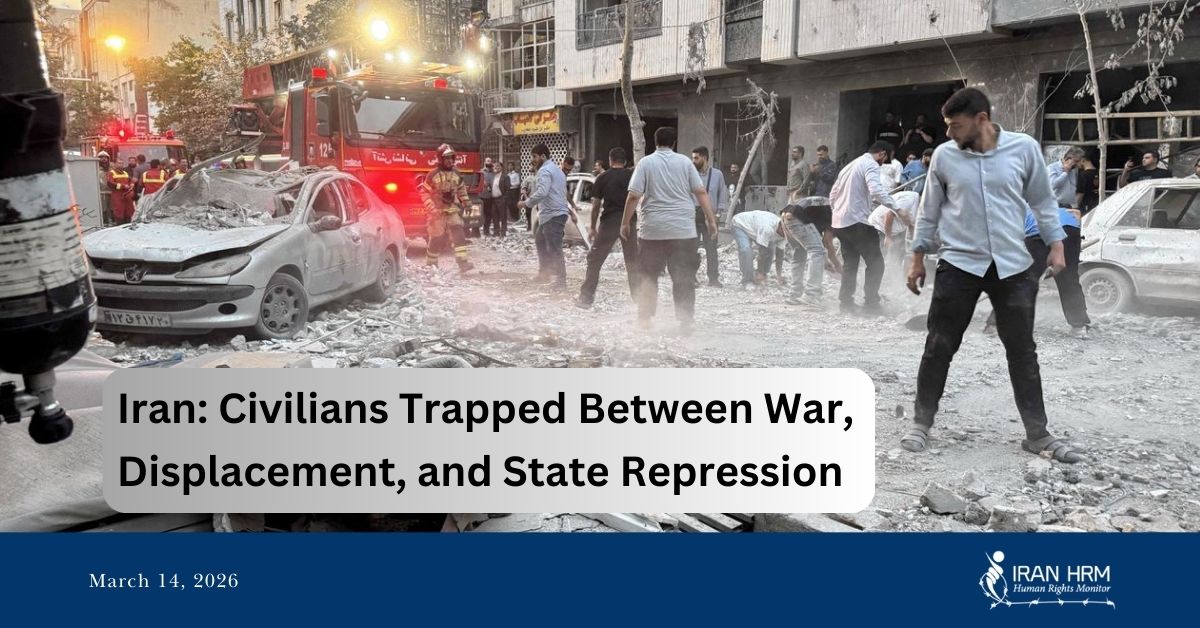
Reports of widespread civilian casualties, mass displacement, and escalating security pressures indicate that civilians in Iran are facing a simultaneous military and human rights crisis. As armed hostilities expand across different regions of the country, many families have been forced to abandon their homes in search of safety.

International human rights bodies have recently described the situation of the Iranian population with a stark warning. Civilians in Iran are now trapped “between bombardment and state repression.” The Independent International Fact-Finding Mission on Iran has warned that the population is facing the combined consequences of a large-scale military campaign and a governing structure with a longstanding record of serious human rights violations.
Alongside the direct consequences of the conflict, reports indicate an escalation of internal security pressure. Widespread internet shutdowns, arrests of citizens for sharing images of attacks, and judicial threats against dissenting voices have raised serious concerns regarding the protection of fundamental rights. As a result, many Iranian citizens now face a situation in which the dangers of war intersect with the risks of domestic repression.
One of the most immediate humanitarian consequences of the ongoing hostilities has been the large-scale displacement of civilians inside the country.
Internal Displacement Crisis in Iran
One of the most urgent humanitarian consequences of the conflict has been the widespread internal displacement of civilians. As attacks intensified and insecurity spread across multiple cities, many families were forced to abandon their homes and seek refuge in other regions.
According to the United Nations High Commissioner for Refugees (UNHCR), recent hostilities have displaced between 600,000 and one million households within Iran. This figure corresponds to approximately 1.9 to 3.2 million people.
The agency has warned that continued hostilities could further expand the scale of displacement and place additional pressure on humanitarian resources and essential services across different parts of the country. Large movements of people from major urban centers toward northern provinces and rural areas indicate growing insecurity in densely populated cities.
Among the most vulnerable groups affected by displacement are low-income families, elderly individuals, and children. Afghan refugees already living in difficult economic and social conditions are also considered particularly exposed to the humanitarian consequences of the conflict.
Civilian Casualties and Damage to Critical Infrastructure
Alongside large-scale displacement, rising civilian casualties and damage to civilian infrastructure have become major consequences of the ongoing hostilities.
Reports indicate that during the first twelve days of the war in Iran, more than 1,255 civilians were killed, while approximately 12,000 people were injured.
Military strikes have also placed severe pressure on Iran’s healthcare system. More than 25 hospitals have reportedly been damaged during the attacks, and at least nine medical facilities have been completely forced out of service.
One of the most disturbing incidents reported during the conflict involved an attack on Shajareh Tayyebeh Girls’ School in Minab, located in Hormozgan Province. The strike occurred during school hours and resulted in the deaths of more than one hundred students and dozens of teachers and school staff. Most of the victims were girls between seven and twelve years old.
In response to such incidents, Amnesty International has warned that attacks affecting civilian infrastructure can cause widespread and foreseeable harm to civilian populations and may constitute violations of international humanitarian law. The organization has emphasized that the protection of civilians must remain a central obligation in all armed conflicts.
Alongside these humanitarian consequences, recent developments have also been accompanied by severe restrictions on access to information.
Internet Shutdown and Information Blackout
In addition to the direct humanitarian impact of the conflict, severe restrictions on communications and information access have become another major concern.
Reports indicate that shortly after the beginning of the military attacks, internet access across Iran was widely restricted. At certain points, internet traffic reportedly dropped by as much as 98 percent, effectively limiting communication across large parts of the country.
The UN Fact-Finding Mission on Iran has called on the ruling authorities to restore internet access and emphasized that access to information during wartime is critical for civilian safety. The mission warned that such restrictions may prevent citizens from receiving essential information about attacks and may also disrupt communication between families during emergencies.
The restriction of information flows has occurred simultaneously with an escalation of internal security pressure.
Escalating Domestic Repression During Wartime
While large segments of the population are dealing with the direct consequences of war and insecurity, senior judicial and security officials have issued statements indicating readiness to respond harshly to dissent.
Asghar Jahangir, spokesperson for the judiciary, declared during the ongoing hostilities that any action interpreted as “cooperation with the enemy” could lead to severe punishment. He stated that penalties in such cases could include capital punishment and added that confiscation of property could also be applied.
Jahangir stated that:
“If individuals take practical action in cooperation with the enemy, the necessary legal measures and punishments prescribed by law will be applied.”
He added that such punishments could include execution and property confiscation.
The judiciary spokesperson also warned several domestic media outlets that publishing images or information related to security-sensitive locations could result in legal action.
At the same time, similar statements have been made by law enforcement authorities.
Ahmadreza Radan, Commander-in-Chief of the national police, announced on 10 March 2026 that security forces were prepared to confront potential street protests. Speaking during a televised program, he declared that police forces would have their “finger on the trigger” if demonstrations occur.
Radan further stated that individuals appearing in the streets under current circumstances would not be treated as protesters but as enemies.
Growing Risks for Prisoners
Amid displacement, civilian casualties, and escalating security measures, the situation of detainees and prisoners has emerged as another serious concern.
Reports indicate that thousands of prisoners are currently being held in facilities across the country, some of which are located close to areas affected by military attacks.
The UN Independent International Fact-Finding Mission on Iran has expressed concern about the situation of detainees during the conflict. According to the mission, tens of thousands of individuals have been arrested in connection with nationwide protests that began in late December 2025.
Many detainees, the mission warned, may face the risk of torture, ill-treatment, or enforced disappearance. The mission has also expressed concern regarding fast-track judicial procedures and the possible implementation of severe punishments, including the death penalty.
These developments raise serious questions regarding compliance with international human rights obligations and humanitarian law.
Legal Implications Under International Law
Recent developments in Iran raise serious concerns regarding compliance with international human rights law and international humanitarian law.
Violation of the Right to Life and Security
Article 3 of the Universal Declaration of Human Rights
Ongoing hostilities, large-scale civilian casualties, and internal displacement place the lives and safety of millions of civilians at risk. Article 3 of the Universal Declaration of Human Rights states that every individual has the right to life, liberty, and personal security. In times of war, the protection of civilians must remain a fundamental obligation.
Violation of the Right to Liberty and Personal Security
Article 9 of the International Covenant on Civil and Political Rights
The arrest of citizens for sharing images or reporting on attacks, along with official threats of execution or property confiscation against opponents, may jeopardize the right to personal liberty and security. Article 9 of the Covenant prohibits arbitrary arrest or detention.
Violation of Freedom of Expression and Access to Information
Article 19 of the International Covenant on Civil and Political Rights
The widespread restriction of internet access and warnings issued to media outlets regarding the publication of information about military attacks may undermine freedom of expression and access to information, rights protected under Article 19 of the Covenant.
Violation of Civilian Protection Principles
International Humanitarian Law
Under international humanitarian law, parties to armed conflicts must distinguish between military and civilian targets and avoid actions that may cause disproportionate harm to civilians. Conducting military operations in densely populated areas significantly increases risks for civilian populations and may violate the principle of civilian protection.
Conclusion and Urgent Call for International Action
Recent developments in Iran demonstrate that the current crisis is not merely a military confrontation. It has evolved into a broader humanitarian and human rights emergency.
Rising civilian casualties, damage to vital infrastructure, large-scale internal displacement, and severe restrictions on information access are only part of the war’s impact on millions of civilians. At the same time, reports indicate an intensification of internal repression, including arrests, judicial threats, and warnings directed at citizens and media outlets.
In such circumstances, Iranian civilians are facing a situation in which the consequences of war intersect with the risk of state repression.
Silence or delay from the international community may further worsen the humanitarian consequences of this crisis. The UN Human Rights Council, the Independent International Fact-Finding Mission on Iran, and relevant UN Special Rapporteurs must place the situation of civilians, detainees, and vulnerable populations in Iran among their immediate priorities.
International human rights organizations should intensify monitoring and documentation of human rights violations during the conflict and draw global attention to the humanitarian consequences of war and domestic repression in Iran.
The situation in Iran serves as a stark reminder of a fundamental principle of international law: civilians living under the shadow of war must not simultaneously face repression and the denial of their basic rights.