According to the latest consolidated data, at least 1,791 people were executed in Iran from the beginning of 2025 through the end of November 2025. This represents a shocking and unprecedented increase compared to 993 executions recorded throughout the entirety of 2024. With these figures, Iran remains the world’s leading executioner on a per capita basis.

In November 2025 alone, 336 executions were carried out; the highest monthly figure recorded during the year. This pace indicates that the use of capital punishment has entered a phase of accelerated, routine, and crisis-level implementation.
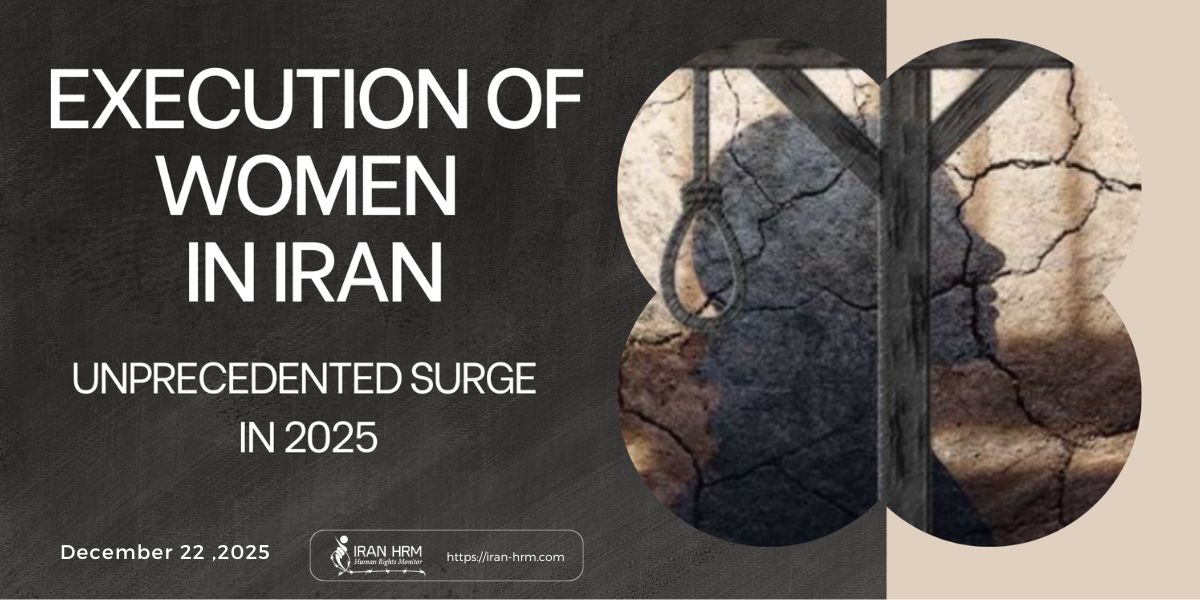
Within this broader wave of executions, at least 61 women were executed between January 2025 and 13 December 2025 (22 Azar 1404). This figure reflects an approximately 70 percent increase compared to the total number of women executed in the previous year.
In less than five months, from 30 July to 13 December 2025, at least 35 women were executed. In practical terms, this means that nearly one woman was executed every four days during this short period.
List of Executed Women
The consolidated list of women executed in Iran, which forms the factual basis of this report, is available here:
- English version: https://wncri.org/2023/09/07/executions-of-women/
Shocking Individual Cases from 2025
Behind these stark statistics are cases that expose the human cost and severity of Iran’s execution policy:
- Marzieh Esmaili, 39, a mother of one daughter;
Executed on 15 April 2025 (26 Farvardin 1404) for transporting 600 grams of narcotics in exchange for only 10 million tomans (approximately 100 USD). Her case exemplifies the execution of impoverished women occupying the lowest levels of drug-related offenses. - Zahra Mirghaffari, mother of two daughters aged 9 and 13;
Executed on 8 November 2025 (17 Aban 1404). Her execution left two children without parental support, in complete silence and without any protective mechanisms. - Mina Sadoughi, mother of three children aged 7, 9, and 11;
Executed on 26 November 2025 (5 Azar 1404) alongside her husband, without notifying the family and without a final visit with her children. Her case demonstrates the systematic denial of family rights and human dignity in the execution process.
Principal Patterns of Women’s Executions in Iran in 2025
1. Qisas and Murder Cases
A significant proportion of executed women were sentenced under murder charges, often involving the killing of a husband or a close male relative. Many of these cases occurred in contexts marked by prolonged domestic violence, forced marriage, threats, or denial of divorce rights. These structural factors were largely disregarded during judicial proceedings.
Documented examples include:
- Hamideh Jabbari; accused of killing her husband; executed in Qom Central Prison on 13 December 2025.
- Sedigheh Ghorbani; convicted of murder; executed in Urmia Central Prison on 13 December 2025.
- Elnaz Azizi; convicted of murder; executed in Vakilabad Prison, Mashhad, on 10 December 2025.
2. Drug-Related Offenses
The largest share of women executed in 2025 were sentenced for drug-related charges. These women predominantly came from impoverished backgrounds and were often sole caregivers or family breadwinners. Their involvement was typically marginal and non-managerial, yet they faced the harshest possible punishment.
3. Child Marriage
Several executed women were victims of child marriage, a practice that deprives girls of education, economic independence, and legal protection, trapping them in cycles of abuse.
A documented case:
- Rana Faraj-Oghli, 24; executed in Tabriz Central Prison on 3 December 2025. She had been forcibly married at age 16 to a man 19 years older and endured years of domestic violence.
4. Security-Related Cases
In 2025, women activists were also targeted with death sentences on security-related charges:
- Pakhshan Azizi, sentenced to death on the charge of “baghi.”
- Varisheh Moradi, sentenced to death in the context of security-related prosecutions.
These cases were handled primarily by Revolutionary Courts, without basic fair-trial guarantees.
5. Ideological Retribution
- Zahra Shahbaz Tabari, 67; sentenced to death following a brief trial conducted without access to a lawyer of her choosing. Her case illustrates the use of capital punishment as a tool of ideological retaliation.
 Legal Analysis: Systematic Violations of the Right to Life and Iran’s International Obligations
An examination of women’s executions in Iran during 2025 reveals multiple, concurrent violations of international human rights law. These violations are not isolated; they are systematic, structural, and recurrent.
1. Violation of the Right to Life
The right to life, enshrined in Article 6 of the International Covenant on Civil and Political Rights, is a fundamental and non-derogable right. Even in retentionist states, the death penalty must be limited to the “most serious crimes” and imposed only following strict fair-trial guarantees.
Iran’s execution of women for:
- Drug-related offenses, which do not meet the threshold of “most serious crimes”;
- Cases linked to domestic violence, forced marriage, and self-defense;
- Broad and vague security charges;
Constitutes a direct violation of the right to life under international law.
2. Absence of Fair Trial Guarantees
Article 14 of the ICCPR guarantees the right to a fair trial, access to independent legal counsel, and adjudication by a competent and impartial tribunal. In many women’s cases, these guarantees were gravely violated, including:
- Proceedings before Revolutionary Courts lacking judicial independence;
- Denial of access to a lawyer of one’s choosing, particularly during early detention;
- Failure to investigate allegations of coercion or prior abuse;
- Executions carried out without notifying families or allowing final visits.
Such conditions render death sentences legally invalid under international standards.
3. Gender Discrimination and Inequality before the Law
Women’s executions occur within a framework of institutionalized gender discrimination. Domestic laws restrict divorce rights, fail to protect against domestic violence, and permit child marriage. These legal inequalities place women in positions of heightened vulnerability that directly contribute to criminalization and death sentences.
Executing women under such conditions violates the principle of equality before the law and the obligation to prevent discrimination.
4. Failure to Protect Women from Gender-Based Violence
States have a duty to prevent, investigate, and remedy violence against women. In many of the documented cases, the authorities failed to provide protection and instead punished the victims of violence through execution. This represents a compounded violation of state responsibility.
5. Use of the Death Penalty as a Tool of Political Repression
In security-related cases, charges such as “baghi” are applied through vague and expansive interpretations, undermining the principle of legality. Death sentences imposed on women activists function as tools of intimidation rather than justice.
From an international legal perspective, these executions amount to state killings, as they are imposed following unfair trials, politically motivated charges, and discriminatory laws.
Legal Conclusion
The pattern of women’s executions in Iran constitutes simultaneous violations of:
- The right to life;
- The right to a fair trial;
- The prohibition of discrimination.
- The duty to protect women from violence.
These violations impose clear obligations on the international community to move beyond expressions of concern and pursue effective measures to halt executions and ensure accountability.
Conclusion and International Call to Action
Given the execution of at least 61 women in 2025 up to mid-December, alongside 1,791 total executions by the end of November, the international community must:
- Demand an immediate halt to executions and the establishment of a moratorium on the death penalty in Iran;
- Insist on full transparency, including the disclosure of names, dates, locations, and judicial procedures in all execution cases;
- Urgently pursue international mechanisms to protect women sentenced to death, particularly in security-related cases, and to hold perpetrators accountable.