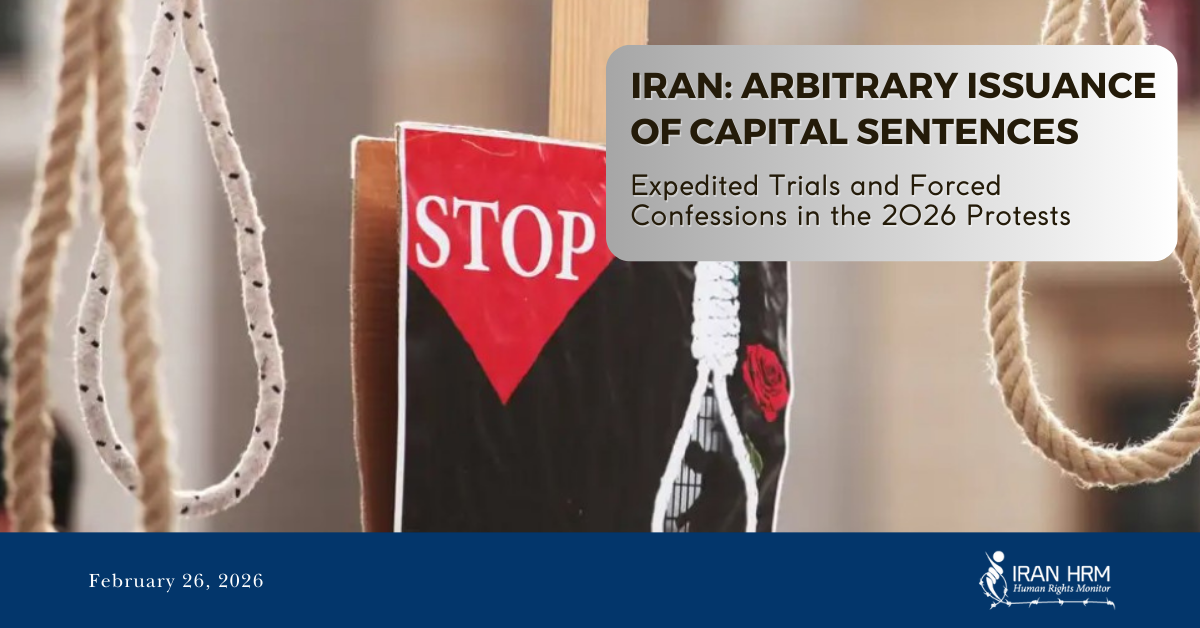
An Analysis of Expedited Trials and Forced Confessions in the 2026 Protests
The repeated emphasis by Iran’s judicial and security authorities on “expediting the trial process” for those detained during the January 2026 nationwide protests is a clear manifestation of replacing “judicial justice” with “political vengeance.” The issuance of indictments in extremely short timeframes—sometimes less than 24 hours—while defendants are kept in total isolation and deprived of access to independent legal counsel, has decimated all standards of due process.

The official announcement of verdicts using keywords such as “decisiveness” and “speed” indicates a pattern of summary trials, where final outcomes are dictated by security apparatuses long before court sessions convene. In this process, the court functions not as an independent trier of fact, but as a Procedural Facade to legitimize sentences based on torture-tainted confessions. This trend has utterly compromised the Presumption of Innocence and transformed the judicial system into a tool for public intimidation.
The following is a documented review of several cases who have fallen victim to these sham proceedings:
Case Study: Danial Niazi (18 years old) – Torture for Confession and Capital Sentence
Danial Niazi, 18, is a protester from the January 2026 demonstrations. Following his arrest, he was subjected to immense pressure to confess and was denied access to a lawyer of his choice during interrogation. Danial, son of Ali and a resident of Shirvan, was arrested at his home by security forces on January 12 and immediately transferred to an undisclosed location. Sources emphasize that during the first 24 hours of detention, the youth was subjected to severe physical torture to extract forced confessions.
The charges leveled against him include: “Moharebeh” (Enmity against God), “participation in attempted willful murder,” “participation in intentional assault,” “membership in a gathering of more than three people against public order,” “disruption of public order,” and “propaganda against the state”—charges that carry the death penalty. Branch 103 of the Criminal Court II of Shirvan rejected Niazi’s objection to his temporary detention. According to court documents, the formal charges were registered on January 13, 2026—only one day after his arrest.
International Law Violations in the Case of Danial Niazi:
- Violation of Article 7 of the ICCPR: Absolute prohibition of physical torture to extract confessions.
- Violation of Article 14, Paragraph 3(b): Deprivation of adequate time and facilities for the preparation of a defense and lack of access to counsel during the interrogation phase.
- Violation of Article 14, Paragraph 2: Violation of the Presumption of Innocence by issuing severe charges only 24 hours after arrest, precluding any possibility of independent evidence review.
- Violation of the Convention on the Rights of the Child (CRC): Given his age (18) and the likelihood that the alleged acts occurred while he was a minor or on the threshold, sentencing youth to death violates international treaties.

Case Study: Mohammad Abbasi and Fatemeh Abbasi – Expedited Trial and Death Sentence
Mohammad Abbasi (55) and his daughter Fatemeh Abbasi (34)—who is a mother to a 13-year-old girl—were arrested during the January 2026 protests. Their family emphasizes that the case against them is based on “scenario-building” by the prosecution, with no physical evidence placing them at the scene of the incident.
Branch 15 of the Tehran Revolutionary Court, presided over by Abolqasem Salavati, sentenced Mohammad Abbasi to death on charges of “participation in the murder of a State Security Force officer.” His daughter, Fatemeh, was sentenced to 25 years in prison for “complicity.” These sentences were issued amidst deprivation of independent counsel and forced confessions.
According to Iran Human Rights Monitor source, Mohammad Abbasi was subjected to extreme pressure. Agents utilized threats of sexual violence against his daughter and severe physical torture to coerce a confession. Branch 15 of the Revolutionary Court denied the family’s chosen lawyer entry into the case. Furthermore, the court-appointed lawyer acted under the judge’s directives, lacking the independence required for an effective defense. Even after the verdict, the court has prevented the chosen lawyer from accessing the case file to file an appeal.

International Law Violations in the Case of Mohammad and Fatima Abbasi:
- Severe Psychological Torture and Gender-Based Crimes (Violation of Article 7 ICCPR and CAT): Utilizing threats of sexual assault against a family member to break a defendant’s resistance constitutes Severe Psychological Torture under UN Committee Against Torture (CAT) jurisprudence. Such confessions are legally void under Article 15 of the CAT.
- Deprivation of Independent Counsel (Violation of Article 14, Para 3-b & d of the ICCPR): The forced imposition of a state-aligned lawyer in capital cases renders the entire trial null and void.
- Deprivation of the Right to Appeal (Violation of Article 14, Para 5 of the ICCPR): Preventing access to case files to block an appeal is a deliberate tactic to finalize death sentences in total informational darkness.
- Arbitrary Deprivation of Life and Violation of the Presumption of Innocence (Violation of Article 6 and Article 14, Para 2 of the ICCPR): Issuing a death sentence based on prosecution fabrications without material evidence constitutes Arbitrary Deprivation of Life and is categorized as a state-sanctioned killing.
Case Study: Armin Noormohammadi – Death Sentence for ATM Damage

Armin Noormohammadi, born in 1998, is an architecture student and was previously detained during the 2022 “Mahsa Amini” protests. He was re-arrested on March 30, 2023, and held for 20 days in solitary confinement and 20 days in the high-security Ward 209. His trial was held on December 29, 2025, during the January 2026 protest wave, with the charge of “Moharebeh” listed in the indictment.
On January 18, 2026, Branch 15 of the Tehran Revolutionary Court confirmed the charge and issued a death sentence. According to Armin’s father, the case stems from “minor and brief” fire damage to a Bank Sepah ATM. Although the family has already paid 184 million Tomans (the determined damage amount) to the bank as a private complainant, the judiciary persists with the “Moharebeh” charge and the death penalty.
International Law Violations in the Case of Armin Noormohammadi:
- Violation of the Principle of Proportionality (Article 6, Para 2 of the ICCPR): Under international law, the death penalty must be reserved only for the “Most Serious Crimes” (intentional killing). A death sentence for minor property damage is a gross violation of the right to life.
- Abuse of Security Charges and Violation of the Principle of Legality (Article 15 of the ICCPR): Using the vague charge of “Moharebeh” for an act of vandalism violates the Legal Certainty doctrine. Continuing the case after full financial restitution proves the court’s intent is terror, not justice.
- Torture through Prolonged Solitary Confinement (Article 7 ICCPR and Mandela Rules): Holding a detainee for more than 15 days in solitary confinement is classified by the UN as Long-term Solitary Confinement, equivalent to torture.
- Violation of the Right to a Fair Trial by an Incompetent Court (Article 14, Para 1 of the ICCPR): Referring the case to Branch 15 of the Revolutionary Court—a court known for predetermined verdicts—violates the right to an “independent, impartial, and competent tribunal.”
Case Study: Ashkan Maleki, Mehrdad Mohammadinia, and Arman Ma’refati – Absence of Independent Counsel

These individuals were were tried on charges including acting against national security, destruction of public property, and participation in the arson of Jafari Mosque and the Imam Hadi Seminary in Kouy-e Nasr, Tehran.
In reading the indictment, the prosecutor’s representative raised charges such as operational action on behalf of ‘hostile states and groups,’ creating fear and intimidation, and assembly and collusion against internal security. However, the official report provides no details about how the evidence was collected, the conditions of interrogation, or whether the defendants had access to an independent lawyer. The published text only mentions the presence of ‘lawyers,’ but it is unclear whether these lawyers were chosen by the defendants or court‑appointed, and at what stage of the proceedings they were involved in the case. A substantial portion of the indictment is based on the defendants’ confessions. The lack of transparency regarding the interrogation process—especially in cases involving serious security‑related charges—raises concerns about the possibility of coerced confessions obtained under pressure or torture.
International Law Violations in the Case of Ashkan Maleki, Mehrdad Mohammadinia, and Arman Ma’refati
- Violation of the Right to Counsel of Choice and Effective Defense (Article 14, Para 3-b & d of the ICCPR): The lack of transparency regarding the identity and role of the lawyers, combined with the deprivation of the defendants’ right to freely choose their counsel, renders the proceedings a hollow formality. The presence of “ceremonial” or court-appointed lawyers who lack independence constitutes a total denial of the “Right to an Effective Defense.”
- Violation of the Principle of Legality (Article 15 of the ICCPR): The use of broad and elastic charges, such as “operational actions for hostile states,” without presenting specific material evidence, violates the doctrine of Legal Certainty. Such ambiguity allows for arbitrary and politically motivated adjudications.
- Reliance on Inadmissible Confessions (Violation of Article 14, Para 3-g of the ICCPR): Drafting an indictment based solely on the “confessions” of defendants held in secret and unsupervised interrogation environments violates the prohibition against Self-Incrimination. Under international standards, any confession extracted in the absence of a lawyer and under isolated conditions is presumed to be coerced and must be excluded as evidence.
- Violation of the Right to a Fair and Public Trial (Article 14, Para 1 of the ICCPR): The absence of transparency in evidence collection and detention conditions destroys the principle of “Equality of Arms” in the trial. This reduces the court to a mere administrative tool for validating the unsubstantiated reports of security agencies.
Call to Action
Given the blatant disregard by the Islamic Republic authorities for the requests of the UN Special Rapporteur, Ms. Mai Sato, and the warnings of Amnesty International regarding the immediate cessation of executions, we demand the following from the international community:
- Deployment of an International Fact-Finding Mission: To visit all public and secret detention centers where January 2026 protesters are held, and to meet directly with Danial Niazi and the Abbasi family.
- Diplomatic Pressure for the Immediate Commutation of Death Sentences: Especially in cases where financial restitution has been made (Armin Noormohammadi) or those built on torture (Mohammad Abbasi).
- Sanctions against Presiding Judicial Officials: Including Judge Salavati and the judges of Branch 103 of Shirvan, for their complicity in the arbitrary deprivation of the right to life.
- Mandatory Access for Independent Lawyers: Ending the “approved lawyers list” heresy and allowing chosen counsel into all stages of proceedings.
Conclusion:
Inaction in the face of this horrific evidence is not only a green light to Iran’s execution machine but calls into question the credibility of the entire international human rights system. Every second of global delay serves as an endorsement of the torture of a father coerced through threats against his daughter, or silence in the face of the execution of a youth paying for an ATM with his life. It is time for the international community to move beyond repetitive statements and adopt deterrent measures to increase the legal and political cost of transforming the “judicial bench” into a “slaughterhouse of justice.” Silence in the face of this “Judicial Apartheid” is complicity in a catastrophe that has weaponized the law to destroy the right to life of an entire nation.