Analytical Report on the Strategy of “Absolute Suppression” amid Military Tensions – March 2026
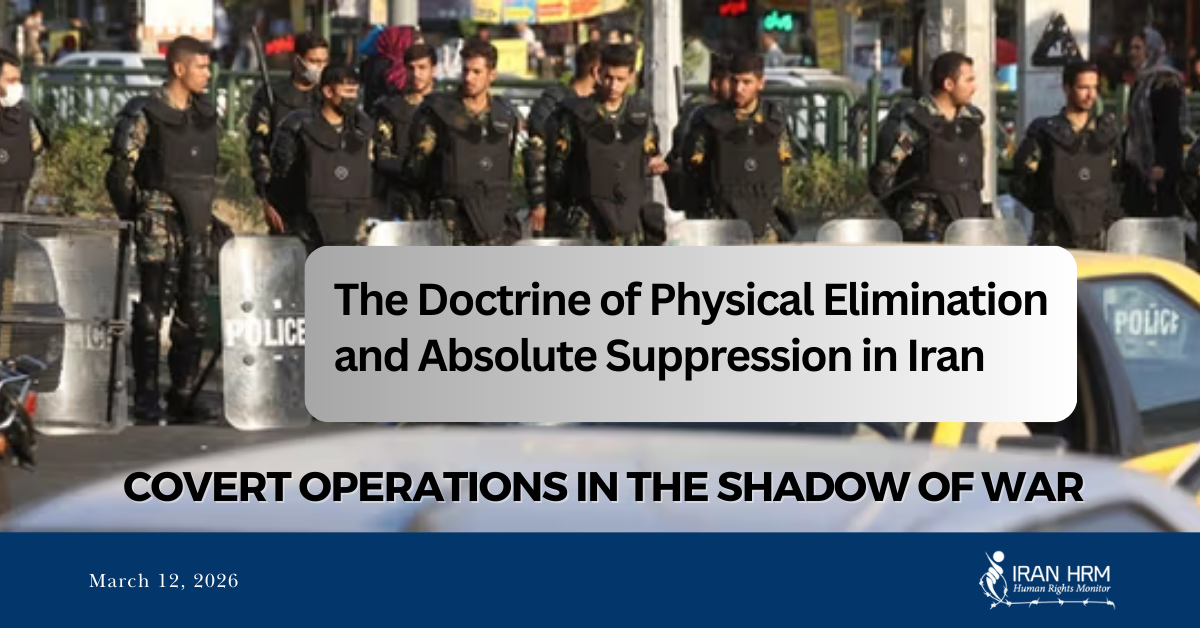
While the military crisis involving Iran has occupied global attention, Iranian authorities, through covert operations in the shadow of war and its rhetoric, have opened a new domestic front against citizens and prisoners. An examination of recent statements by the heads of the judiciary, alongside staggering execution statistics, reveals a “Preemptive Suppression Doctrine” aimed at suffocating any dissenting voice.

Transforming the Judiciary into a Supporting Arm of the Armed Forces
On March 4, 2026, Gholamhossein Mohseni-Eje’i, the Head of the Judiciary, explicitly declared that this institution is no longer an independent entity but acts in lockstep with the regime’s war machine. By officially declaring a state of war, he linked civil actions to “military treason”:
“Here again, the Judiciary stands alongside the defenders of security and the Armed Forces, working with even greater and higher seriousness. They both defend and support the defenders of security, whether in domestic issues or within the Armed Forces. We are now at a time of war; they have officially declared and started the war. If anyone performs any word or action that aligns with the will of this criminal enemy—namely the United States and the Zionist regime—they are in the enemy’s camp and must be dealt with based on those same revolutionary and Islamic principles applicable during wartime.”
The “Immediate Suffocation” Order: Suspension of the Right to Life
Mohammad Javad Larijani, a prominent theorist for the Judiciary, outlined the “Immediate Suffocation” doctrine during an internal meeting in March 2026. These remarks explicitly grant a license for extrajudicial killings and the physical elimination of protesters:
“We must immediately suffocate the slightest movement in the direction of the enemy’s wishes. Last time you saw that those afflicted with hypocrisy (Nifaq) are the Mojahedin (PMOI/MEK). Those who have a sickness in their hearts, these are all recruits of America. Therefore, any slogan or deviant movement must be suffocated on the spot under ‘Fire at Will’ (Atash-be-Ikhtiyar) orders. We must remain in full solidarity to ensure they do not celebrate here; we must make it a bitter poison for them… Everyone must stand behind our Basij forces and behind the military forces. Do not allow even a shred of mischief. Not even for a moment. In fact, under ‘Fire at Will’ orders, we must extinguish (silence) them on the spot.”
Torture in the Wards and Intimidation of Families
This approach was immediately implemented within the prisons. In Mahabad and Ghezal Hesar prisons, the natural protest of prisoners against the lack of shelter during bombardments was met with the firing of tear gas into locked wards. Furthermore, authorities have imposed an atmosphere of psychological torture by cutting off prisoners’ communications and directly threatening their families. These actions, confirmed by field reports, are a flagrant violation of the Prohibition of Torture; prisoners are trapped in enclosed spaces with no means of escape, subjected to the dual pressure of external bombardment and internal suppression.
The Execution Machine: One Victim Every 3 Hours
The harrowing statistics of executions during the first eight days of March indicate an “organized massacre” designed to cause social paralysis. The execution of 70 prisoners in 8 days conveys nothing but state terrorism:
- Chronological Sequence: The execution of 11 to 15 individuals on consecutive days (February 23 to 25 / Esfand 4-6) signals the round-the-clock operation of the gallows.
- Engineering Fear: The distribution of executions across more than 40 cities (from Yasuj and Khash to Rasht and Qazvin) demonstrates the regime’s intent to create a “geographical shock,” ensuring no part of Iran feels distant from the shadow of execution.
Daily Breakdown of Executions:
- February 27 (8 Esfand): Execution of 3 prisoners (including one woman) in Qazvin and Isfahan prisons.
- February 26 (7 Esfand): Execution of 5 prisoners in Behbahan, Ferdows, Sari, Taybad, and Yasuj prisons.
- February 25 (6 Esfand): Execution of 15 prisoners in Mashhad, Kashmar, Sabzevar, Gorgan, Shahrekord, Bushehr, Damghan, Chabahar, Lahijan, and Malayer.
- February 24 (5 Esfand): Execution of 11 prisoners in Yazd, Birjand, Rasht, Sirjan, Jiroft, Ahvaz, Khaf, Ilam, Borazjan, and Bam.
- February 23 (4 Esfand): Execution of 11 prisoners in Zanjan, Quchan, Saveh, Kashan, Kermanshah, Nishapur, Isfahan, Dorud, Qaemshahr, Gorgan, and Qom.
- February 22 (3 Esfand): Execution of 11 prisoners in Semnan, Nowshahr, Qazvin, Ardabil, Borujerd, Nain, Arak, Bandar Abbas, Tabriz, Qom, and Vakilabad Mashhad.
- February 21 (2 Esfand): Execution of 12 prisoners in Aligudarz, Nahavand, Yasuj, Dezful, Dizelabad Kermanshah, Karaj Central, Sanandaj, Hamedan, Zahedan, Iranshahr, and Torbat-e Heydarieh.
- February 20 (1 Esfand): Execution of 2 prisoners in Malayer and Kashmar prisons.
In total, 70 prisoners were executed over 8 days; an average of approximately one execution every 3 hours. This vast geographical reach is a tool for injecting terror into the entirety of society.
Turning Homes into “Forced Solitary Confinement”
Social media reports indicate that Basij forces are targeting the private lives of citizens by firing directly and indiscriminately at the windows of homes from which protest slogans are heard. This action effectively turns every home into a cell or “house arrest,” where a citizen does not even have the right to shout within their private space and is met with a military response if they protest.
Legal Conclusion and State of Emergency
The systematic actions and official rhetoric observed in Iran during March 2026 constitute a multi-layered violation of the bedrock principles of international law:
- Crimes Against Humanity (Article 7 of the Rome Statute): The high frequency of executions (70 in 8 days) combined with the official policy of “immediate suffocation” indicates a widespread and systematic attack directed against a civilian population, satisfying the criteria for Crimes Against Humanity, including murder and persecution.
- Right to Life and Prohibition of Summary Executions (Article 6 of the ICCPR): The call for “on-the-spot” elimination is a direct violation of the non-derogable right to life. International law strictly prohibits extrajudicial, summary, or arbitrary executions, regardless of wartime status.
- Violation of Fair Trial Guarantees (Article 14 of the ICCPR): The declaration by the Head of the Judiciary to bypass standard legal procedures in favor of “revolutionary wartime principles” effectively abolishes the right to a fair trial and the presumption of innocence.
- The Fourth Geneva Convention (Article 28): The continued detention of political prisoners in close proximity to strategic military targets targeted by aerial bombardment constitutes the use of civilians as “human shields,” a grave breach of humanitarian law.
- Prohibition of Torture and Ill-Treatment (CAT & ICCPR): The use of tear gas in enclosed wards and the systemic psychological terror inflicted upon families of prisoners constitute acts of torture and cruel, inhuman, or degrading treatment.
- Inviolability of the Home and Privacy (Article 17 of the ICCPR): Indiscriminate firing at residential windows targets the sanctity of the home, transforming private residences into zones of state-sponsored violence.
Call to Action
We call upon the international community and human rights organizations to:
- Document the Crime: Record the statements of Eje’i and Larijani as “direct incitement to crimes against humanity” in international records.
- Pressure to Stop Executions: The unprecedented surge in executions during wartime is a tool for political slaughter and must be condemned immediately.
- Security of Citizens in Homes: The world must not allow the Iranian regime to turn every home into a solitary cell and a death trap by firing at residences. The rights to freedom of expression and personal security are non-derogable, even in wartime.
- Prison Monitoring: Given the use of tear gas in wards and the threats against families, the deployment of independent monitoring missions is essential to prevent a catastrophe similar to the summer of 1988.
- Legal Proceedings: Cases against Mohammad Javad Larijani and Gholamhossein Mohseni-Eje’i for “direct incitement to commit crimes against humanity” must be opened immediately in international legal forums.
Time is running out to prevent a new mass killing.