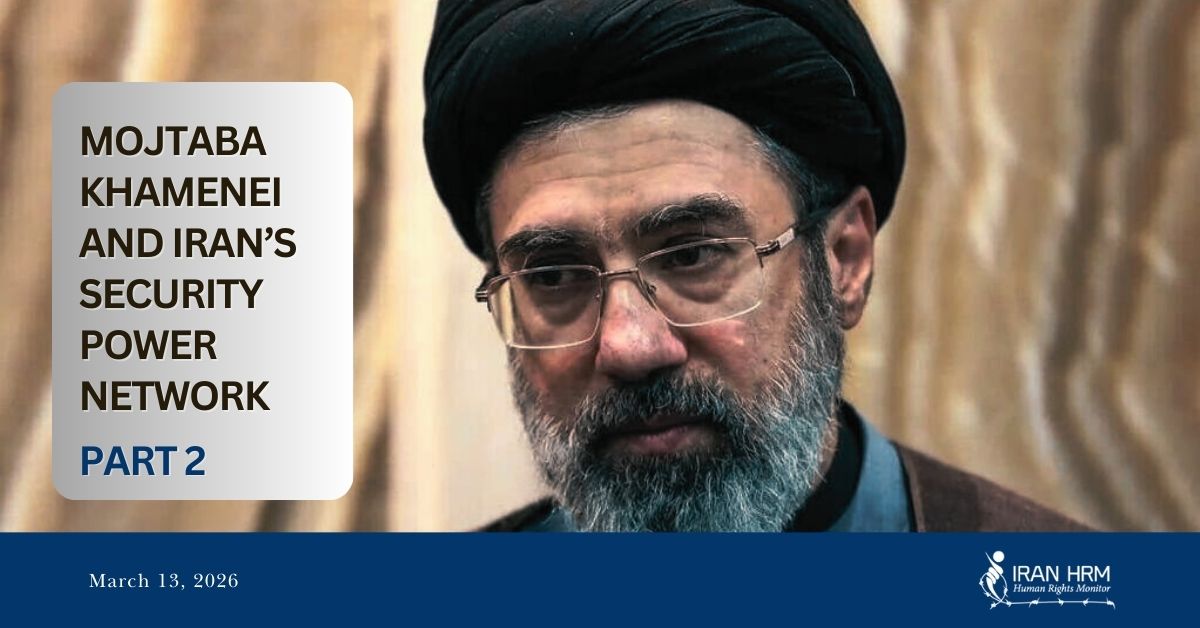
Economic assets and financial networks tied to the Supreme Leader’s inner circle
In the first part of this report, Mojtaba Khamenei’s role in the security structure of power in Iran and his connections with a network of commanders within the Islamic Revolutionary Guard Corps (IRGC) and intelligence institutions were examined; networks that have played a decisive role in suppressing popular protests in recent years.

However, the power structure of the ruling regime in Iran has not been formed solely on the basis of security and military influence. Alongside this security network, a complex system of economic foundations, quasi-state companies, and financial channels has developed over the past decades, placing significant portions of the country’s economic resources in the hands of circles close to the Office of the Supreme Leader.
This economic network includes a range of large foundations, companies affiliated with state institutions, foreign investments, and financial assets that many analysts consider one of the main pillars sustaining political power within the ruling system in Iran.
Within this framework, Mojtaba Khamenei’s name has appeared in a number of reports and analyses in connection with parts of this financial network; a network that, alongside security influence, plays an important role in consolidating the political power of circles close to the Supreme Leader’s office.
This report examines the different dimensions of this economic structure, the paths through which it developed, and the role played by regime-linked economic institutions in concentrating financial resources within this network.
Mojtaba Khamenei’s Financial Network and the Transfer of Iranian Wealth Abroad
Alongside his security and political role, one of the key dimensions of Mojtaba Khamenei’s power is a vast financial network that has reportedly developed over the past two decades both inside and outside Iran. This network includes a combination of international investments, luxury real estate holdings, and banking assets.
Investigations by international media and economic reports indicate that circles close to the Office of the Supreme Leader have gained access to enormous economic resources through a network of economic foundations, shell companies, and financial intermediaries.
According to investigations by media outlets such as Bloomberg and the Financial Times, as well as investigative reports published in Europe, the financial network associated with Mojtaba Khamenei includes a wide range of international investments, luxury real estate assets, and banking resources managed across different countries.
Estimates suggest that the value of this financial network is at least 3 billion dollars.
These assets are reportedly managed through a network of shell companies, foreign bank accounts, and financial intermediaries, with a significant portion concentrated in European real estate markets and international investment structures.
Concentration of Investments in the London Real Estate Market
One of the most significant centers of investment for this financial network is the luxury real estate market in London.
The Daily Mail reported that Mojtaba Khamenei owns a collection of luxury mansions on Bishops Avenue in north London. This street, often referred to as “Billionaires’ Row,” is considered one of the most expensive residential areas in Europe.
According to the report:
- Around 11 luxury mansions on this street have been attributed to a financial network linked to Mojtaba Khamenei
- The estimated value of these properties exceeds 100 million pounds
In addition, other reports have referred to purchases of luxury properties in different parts of London.
These include:
- The purchase of a mansion in 2014 valued at £33.7 million.
- The acquisition of a group of properties in 2013 and 2014 worth approximately £73 million
Reports have also mentioned the purchase of a luxury apartment in Kensington, near Kensington Palace, valued at £34 million.
In total, some investigations estimate that assets associated with this network in the London real estate market may be worth around £150 million.
Ownership of these properties has often been registered through shell companies incorporated in offshore financial jurisdictions.
Property and Investment Networks in Europe
The investments of this financial network are not limited to the United Kingdom and have expanded into several European countries.
According to investigative reports, the value of real estate and investment networks associated with this structure across Europe has been estimated at approximately 400 million euros.
Among the most notable reported assets are:
Germany
- Ownership of two hotels in the city of Frankfurt
• Including the five-star Hilton Grevenbroich hotel
A report by the German newspaper Frankfurter Allgemeine Zeitung (FAZ) described Frankfurt as “the European engine of the financial network of the Iranian regime.”
The report also referred to the activities of companies linked to Setad Ejraiye Farman-e Emam (Execution of Imam Khomeini’s Order) operating near the European Central Bank.
Austria
- Ownership of the luxury Schloss Hotel in the Kitzbühel region
• Investments in ski resort complexes
Spain
- Ownership of coastal properties and holiday resorts in Mallorca
United Arab Emirates
- Ownership of a luxury villa in an area often referred to as Dubai’s Beverly Hills
Canada
- Ownership of a penthouse in the Four Seasons Tower in Toronto
Banking Networks and Shell Companies
Investigative reporting indicates that the management of this financial network has been conducted through a series of shell companies and bank accounts in multiple countries.
Countries mentioned in these reports include:
- Switzerland
- United Kingdom
- Liechtenstein
- United Arab Emirates
Some of these companies have been registered in offshore financial jurisdictions such as:
- Isle of Man
- Nevis
This structure enables the transfer of capital and the management of assets without financial transparency.
Transfers of Oil Revenues
An investigative report by Bloomberg indicates that parts of this financial network have been used to transfer Iranian oil revenues into international markets.
With the tightening of international sanctions, Iranian oil sales were reportedly conducted through a non-transparent network of intermediary companies and foreign bank accounts. According to these reports, individuals close to the Office of the Supreme Leader and the IRGC played roles in managing parts of these networks.
The Role of Ali Ansari in the Financial Network
In many investigative reports, the name Ali Ansari has appeared as one of the key financial intermediaries linked to Mojtaba Khamenei.
Ansari is an Iranian businessman and the owner of Bank Ayandeh and the Iran Mall commercial complex.
According to a report by Bloomberg:
- Ansari helped establish banking relationship networks in Europe
- Through companies such as Birch Ventures and Ziba Leisure, he managed property investments
- Oil revenue transfers were conducted through shell companies operating in the United Arab Emirates
Ansari was sanctioned by the United Kingdom in 2025 because of financial links to the IRGC.
Major Financial Scandals
Alongside this financial network, reports have also referred to several large financial cases associated with these structures.
Among them:
The Gold Transfer Case to Turkey (2008)
Reports emerged regarding the transfer of 18.5 billion dollars in gold and cash to Turkey, which was reportedly seized by Turkish authorities at the time.
The €1.6 Billion Financial Corruption Case
Leaked documents between 2012 and 2013 referred to a financial case worth 1.6 billion euros, which some reports linked to financial networks close to the Supreme Leader’s office.
Bank Account in the United Kingdom
In 2009, reports emerged regarding the freezing of a bank account in the United Kingdom containing approximately 1.6 billion dollars, which was reportedly under the control of this financial network.
International Sanctions
On 4 November 2019, the United States Treasury Department placed Mojtaba Khamenei on its sanctions list.
The official statement declared that despite holding no formal government position, he acted on behalf of the leader of the ruling regime in Iran and maintained close cooperation with the IRGC and the Basij.
His name was added to the SDN sanctions list.
Conclusion
The body of evidence and reports published over the past two decades indicates that Mojtaba Khamenei is not merely a political figure on the margins of Iran’s power structure. Rather, he is considered one of the key actors within the security and economic networks associated with the Office of the Supreme Leader.
His influence within the Islamic Revolutionary Guard Corps, the IRGC Intelligence Organization, and financial networks connected to the regime has led many analysts to describe him as one of the central figures in the informal management of power in Iran.
In recent years, particularly during waves of nationwide protests, the role of security and military institutions in suppressing demonstrators has drawn increasing attention in human rights reports. Many of these institutions operate within a structure linked to the power networks surrounding the leader’s office and its inner circles; a structure in which Mojtaba Khamenei is often identified as an influential figure.
Under such circumstances, discussions about the possibility of Mojtaba Khamenei assuming leadership are not merely a domestic political issue. They raise serious questions about the future of Iran’s power structure, accountability for human rights violations, and the fate of civil liberties in the country.
For international observers and human rights institutions, examining his role and influence within the regime’s security and economic networks may provide important insight into the mechanisms of decision-making and responsibility for the suppression of popular protests.