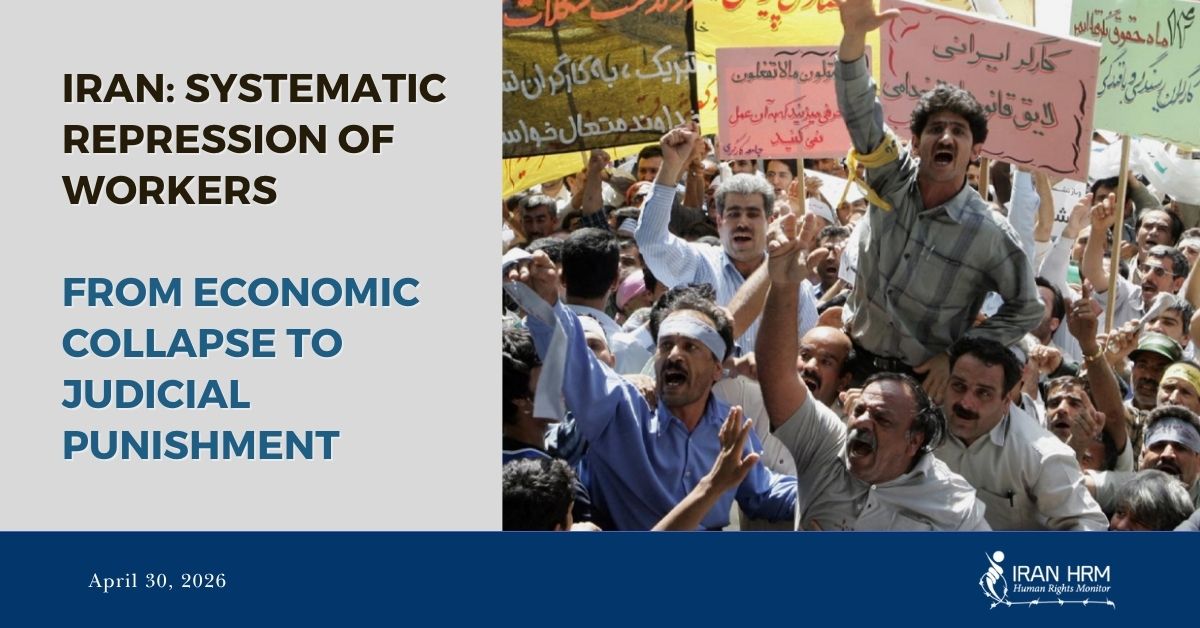
International Workers’ Day and the Situation of Workers in Iran
On the eve of International Workers’ Day, May 1, which is rooted in the historic struggles of workers to secure the minimum conditions of a dignified human life, the situation of workers in Iran under the rule of the mullahs’ regime reflects a multi-layered crisis. In this context, workers are not only facing a livelihood crisis, but any form of labor demand, peaceful protest, or attempt to establish independent organizations may be met with dismissal, summons, arrest, flogging, imprisonment, or even life-threatening security charges. This situation shows that the issue of workers in Iran has gone beyond a labor matter and has become a serious human rights concern.

Violation of Livelihood Rights and the Collapse of Living Standards
Available evidence, including admissions by state-affiliated media, indicates that the gap between wages and the real cost of living is steadily widening.
It is noteworthy that, according to official figures, the minimum wage for workers in the Iranian year 1402 increased by 27 percent on paper. However, a state-run newspaper wrote: “There is an 8 to 10 million toman gap between living costs and the 1402 wage; this wage gap in the previous year, 1401, was between 3 and 4 million tomans, meaning that this year it has increased by more than 100 percent” (Setareh Sobh, April 10, 2023).
At the same time, even official regime authorities have acknowledged the scale of poverty among working people. The regime’s Minister of Labor stated: “Approximately 14.2 million employed Iranians work with low income and without insurance” (Shargh Newspaper, May 23, 2022).
Meanwhile, the sharp rise in the prices of basic goods has intensified livelihood pressure. According to domestic media reports, “one kilogram of ground meat has reached 1.1 million tomans” and “one kilogram of rice has reached 500,000 tomans” (Shargh Newspaper, April 14, 2026).
Reports also show that “as of April 15, 2026, the minimum wage decree had still not been issued” (ILNA News Agency, April 15, 2026), although this should have been done before the end of the year.
These data show that workers in Iran have been deprived of the minimum conditions of a dignified human life.
Job Insecurity, Unemployment, and Widespread Dismissals
Alongside the collapse of livelihoods, job insecurity has become a structural feature of the labor market in Iran; a reality that even state media and regime officials have acknowledged.
Reports indicate that the wave of unemployment has increased significantly across different sectors. In one example, it was announced that in Khuzestan Province alone, “100,000 workers became unemployed” (ILNA News Agency, April 15, 2026). At the same time, estimates show that “around 3 million employed people, particularly workers, have lost their jobs or are at risk of losing them” (same source), reflecting a national crisis in employment.
At the workplace level as well, job insecurity is clearly visible. ILNA’s report from the Tabriz Industrial Zone states: “The employment situation is extremely bad… the volume of unemployed labor is very high,” and workers say: “If we make the slightest protest, we are easily dismissed” (ILNA, April 28, 2026).
Alongside these cases, multiple reports of workforce reductions in various industries show that temporary contracts and sudden dismissals have become routine practice, particularly for workers who lack job security even on the eve of retirement.
According to the annual statistical report of Human Rights Activists in Iran, in 1404, at least 672 months of delayed or unpaid wages in 188 units, 2,457 cases of dismissal or workforce reduction, 658 cases of unemployment, 560 months without insurance, 9 factory closures, and 2,259 workers left in uncertain conditions were recorded. The layoff of at least 1,200 workers in two industrial units was also reported.
This evidence shows that unemployment and dismissal in Iran are not merely economic consequences, but have become tools for controlling and restricting labor protests, placing workers in a permanent state of instability and vulnerability.
Labor Strikes and Protests; Livelihood Demands Under Repression
In response to the intensifying livelihood crisis and job insecurity, workers in Iran have repeatedly gone on strike and held protests in recent years; protests whose geographic and sectoral scope reflects a structural crisis in the country’s labor market.
On the eve of International Workers’ Day, reports indicate strikes by workers in the oil, gas, and petrochemical industries in cities including Gachsaran, Asaluyeh, Dehloran, Shiraz, Bushehr, Lordegan, Sirjan, Jask, Kangan, Kerman, Bandar Mahshahr, Bandar Abbas, Isfahan, and Yazd; a scope showing that labor protests have gone beyond a single industrial unit and have become a nationwide phenomenon. These protests have mainly formed in response to inadequate wages, delayed payments, removal of benefits, temporary contracts, and poor working conditions. However, instead of addressing these demands, the response of responsible institutions has in many cases been security-driven. In a clear example, workers stated in an ILNA report: “If we make the slightest protest, we are easily dismissed” (ILNA News Agency, April 28, 2026).
Under such conditions, strikes and peaceful gatherings have become among the few remaining tools for workers to raise their demands. Yet even this tool is met with summons, arrest, security pressure, threats of dismissal, and deprivation of work. This trend shows that the right to peaceful protest and the right to strike face serious restrictions in practice.
Key Cases of Repression Against Labor Protests and Strikes
A review of several key cases shows that labor demands in Iran are systematically answered through judicial and security tools.
At the Iran National Steel Industrial Group in Ahvaz, workers gathered to protest “non-payment of wages” and management conditions, but the Ahvaz Revolutionary Court sentenced 17 workers to “74 lashes” and fines on charges of “disrupting public order.”
During the nationwide truck drivers’ strikes, reports indicated the arrest of a number of drivers, the filing of accusations such as “filming roads and sending footage to media outlets,” and threats to revoke smart cards and impound vehicles.
Among contract workers in the oil and gas sectors in Asaluyeh and Gachsaran, protests were also met with a security response, including monitoring of workers’ dormitories, dismissal of protesting workers, and placing them on “blacklists” to deprive them of continued employment.
At Haft Tappeh Sugarcane as well, workers’ gatherings in protest working conditions and unemployment were met with intervention by security forces, arrests, and pressure on workers.
The protests of workers at Arak Aluminum Company, one of Iran’s largest industrial centers, involved more than 4,000 workers at the factory. Despite security pressures and the climate of intimidation created by management and security units, they continued their protests for nearly two months.
Taken together, these cases show that labor protests in Iran are not recognized as part of labor rights but are instead turned into security matters and suppressed through judicial and law enforcement tools.
Death and Injury of Workers; Consequences of the Lack of Safety and Oversight
The death and injury of workers in Iran have become among the clearest examples of violations of the right to life and health in the workplace; a crisis whose broad dimensions have been acknowledged even by domestic officials and media.
According to a report published on the occasion of World Day for Safety and Health at Work, between May 3, 2025, and April 27, 2026, at least 586 workers died because of incidents caused by unsafe environments or working conditions, and at least 4,424 workers were injured. In 1404, at least 1,270 workers were killed and 8,264 cases of injury in workplace accidents were recorded.
In this regard, an official at the regime’s Ministry of Health stated: “Every year, 10,000 workers lose their lives due to work-related accidents” (ILNA News Agency, May 14, 2025).
These figures show that workplace accidents in Iran are not exceptional cases, but part of a continuous and structural pattern. A significant portion of these incidents occurs in high-risk environments such as construction projects, oil and petrochemical industries, and especially mines, where the lack of safety equipment, weak oversight, and disregard for basic standards expose workers to constant risks.
Incidents such as fires in industrial workshops, gas poisoning, and mine collapses have repeatedly taken workers’ lives or caused serious injuries. In the mining sector, the risk of tunnel collapse and gas explosions in coal mines, without an effective mechanism for prevention and accountability, exposes workers to preventable deaths.
Bahman Karamloo, a 50-year-old prisoner held in Qezel Hesar Prison in Karaj, died in Aban 1404, corresponding to October-November 2025, due to physical pressure caused by forced labor and deprivation of medical care.
Rafiq Salimi, a labor activist from Sanandaj who has been detained since Azar 1401, corresponding to November-December 2022, and held in the city’s Central Prison, is struggling with a critical physical condition and deprivation of medical and healthcare services.
Therefore, workers’ deaths in Iran cannot be regarded merely as “accidents.” This situation is the direct result of the absence of safety standards, weak oversight, and the prioritization of economic interests over the lives of the workforce.
Suppression of Organizing and the Criminalization of Labor Demands
In Iran under the rule of the mullahs’ regime, the right to establish independent labor organizations is not recognized, and workers are effectively deprived of one of their most fundamental labor rights. The regime only tolerates affiliated and controlled bodies, including the “Islamic Labor Councils”; structures that serve not as tools to defend workers’ rights, but as part of the mechanism for controlling workplaces.
The regime “does not recognize any labor organization other than its own security-driven, self-made body known as the Islamic Labor Councils,” and the positions of relevant institutions, from the judiciary to the Administrative Court of Justice and the Supreme Labor Council, operate in practice against workers and in favor of employers.
In such an environment, attempts to create independent organizations or organize labor protests, instead of being recognized as part of workers’ rights, are met with security labels. Labor activists are prosecuted on charges such as “assembly and collusion against national security,” “propaganda against the system,” or “disrupting public order.” This trend shows that the ruling regime in Iran defines labor demands not as legitimate economic claims, but as threats to its political security. The result of this policy is the deprivation of workers of the right to organize, the right to collective bargaining, and the right to peaceful protest.
Arrest, Imprisonment, and Judicial Sentences Against Labor Activists
The repression of labor activists is one of the regime’s most important tools for preventing the formation of independent organization among workers. In recent years, well-known labor activists, union members, teachers, retirees, and protesting workers have faced prison sentences, flogging, exile, bans on activity, and deprivation of social rights.
Many activists in labor movements are currently serving their sentences in various prisons, mainly Evin:
Narges Mansouri: labor and trade union activist; 9 years in prison.
Mehran Raoof: labor activist, Iranian British dual national; 7 years and 6 months of discretionary prison sentence.
Nasrin Javadi: member of the Social Security Retirees Council; 7 years in prison and 74 lashes.
Nahid Khodajoo: retirees’ rights activist; 6 years in prison and 74 lashes.
Peyman Farhangian: labor activist; 6 years in prison and 2 years of exile to Zabol.
Davood Razavi: member of the board of directors of the Tehran Bus Workers’ Union; 5 years of discretionary prison sentence.
Issa Ebrahimzadeh: Kurdish labor activist; 5 years in prison.
Anisha Asadollahi: labor activist and translator; 5 years in prison.
Reyhaneh Ansarinejad: labor activist; 4 years in prison.
Fouad Fathi: Kurdish labor activist; 4 years in prison.
Reza Shahabi and Hassan Saeedi: members of the Tehran Bus Workers’ Union; each sentenced to 3 years and 7 months in prison.
Reports by human rights bodies and the UN Special Rapporteur describe the dimensions of this crisis as follows:
Labor-related arrests: in the one-year period from March 2025 to March 2026 alone, 20 labor activists were arrested directly in connection with trade union activities.
Corporal punishment: in addition to imprisonment, flogging sentences against workers, such as the sentence of 74 lashes for 17 Ahvaz steel workers, continue to be used as tools of torture and intimidation.
Executions of Workers and Death Sentences Against Activists Linked to Social Justice
The repression of workers and activists linked to social justice in Iran is not limited to dismissal, arrest, or imprisonment. In some cases, workers or activists with labor and civil backgrounds have faced execution or death sentences; a matter that reflects the connection between political repression and social repression within the regime’s judicial structure.
Mohammad “Nima” Masoum Shahi, a 38-year-old technical worker, was executed on April 20, 2026, together with Hamed Validi, a civil engineer, in Qezel Hesar Prison in Karaj. The two men worked together, and their case was linked to political accusations, including support for the People’s Mojahedin Organization of Iran.
In the report on workers, the case of Nima Masoum Shahi should be examined as an example of the execution of a worker on political charges, not as a labor activist. The significance of this case lies in the fact that it shows that workers in Iran are not only exposed to repression in the workplace, in labor protests, and in livelihood-related demands, but may also face the most severe punishment, execution, in political cases.
Alongside this case, the case of Sharifeh Mohammadi has particular significance. She is a labor and civil activist who was sentenced to death on the charge of “baghi,” or armed rebellion. The use of such a charge against a labor activist reflects the dangerous expansion of the securitization of labor and civil activities. Although the final status of her sentence must be written carefully based on the latest documented information, the essence of the case shows that labor activity in Iran can be escalated to life-threatening security charges.
International Labor Positions
The situation of workers in Iran has also drawn the attention of international labor bodies. The International Labour Organization, the International Trade Union Confederation, and IndustriALL Global Union have in recent years repeatedly expressed concern over violations of the right to organize, repression of trade union activists, lack of freedom of association, and the treatment of labor protests in Iran.
From the perspective of fundamental labor principles, the International Labour Organization emphasizes workers’ right to form independent organizations and their right to collective bargaining. The deprivation of Iranian workers of these rights is in clear contradiction with fundamental labor standards.
The International Trade Union Confederation has also placed Iran among countries where workers’ rights are severely violated and where there are no effective guarantees for the rights to organize, strike, and collective bargaining.
IndustriALL Global Union has also repeatedly protested judicial actions, flogging sentences, dismissals, and security pressure against protesting workers in connection with the repression of industrial workers, including workers in steel, oil, petrochemicals, mines, and heavy industries.
These positions show that the crisis facing workers in Iran is not a domestic or merely economic issue, but part of the broader violation of international labor standards and human rights.
Conclusion and International Call
On the eve of International Workers’ Day, the situation of workers in Iran reflects widespread violations of their livelihood, employment, safety, labor, and political rights. Admissions by regime media and officials regarding the wage gap, unemployment, lack of insurance, rising prices of basic goods, and the deaths of thousands of workers in workplace accidents show that this crisis cannot be denied.
The International Labour Organization, the International Trade Union Confederation, IndustriALL Global Union, and other international bodies defending workers’ rights are urged to conduct an urgent and independent review of the situation of workers in Iran; to place violations of the right to organize, the right to strike, the right to workplace safety, and the right to a fair wage on their agenda; and to take effective action for the unconditional release of imprisoned labor activists and the annulment of security sentences, flogging, exile, and other punishments issued against them.