An analysis of the legal, security, and judicial framework used to repress ethnic and religious minorities in Iran; from the securitization of border regions to arbitrary arrests, forced confessions, and denial of fair trial rights

Discrimination against ethnic and religious minorities in Iran has moved beyond isolated incidents or scattered administrative restrictions. Documented cases and data collected in recent years indicate that this discrimination operates through an interconnected system linking law, security institutions, the judiciary, geographic deprivation, and the death penalty. Within this framework, ethnic or religious identity can become grounds for security suspicion, social exclusion, arbitrary detention, denial of due process, and, in numerous cases, execution.
This report demonstrates that the repression of minorities in Iran, particularly in Kurdish regions and Sistan and Baluchestan Province, forms part of a broader structural pattern. In this pattern, legal and judicial mechanisms, combined with the securitization of geography and social control, are used to restrict identity, religion, language, civil activity, and even livelihoods.
Legal Framework; Institutionalizing Inequality and Enabling Security-Based Interpretation
Iran’s Constitution simultaneously recognizes certain freedoms while imposing broad restrictions on them. Articles 23, 24, 26, and 27 formally recognize freedom of belief, expression, association, and assembly. However, these rights are conditioned on vague concepts such as “Islamic principles,” “national security,” and “public order.” Due to the absence of precise legal definitions and the possibility of broad interpretation, security and judicial institutions are able to frame civil, cultural, labor, or religious activities as security threats.
In the religious sphere, Article 12 establishes the official religion of the state, while Article 13 recognizes only a limited number of religious minorities. As a result, communities such as the Baha’is remain excluded from official legal protection and are vulnerable to extensive restrictions in education, employment, property ownership, social participation, and personal security.
At the level of criminal law, charges such as “propaganda against the state,” “assembly and collusion,” “baghi” (armed rebellion), “enmity against God,” and “corruption on earth” are widely used against minority activists, residents of border regions, and individuals associated with ethnic or religious communities. The broad scope and ambiguous nature of these charges increase the possibility of arbitrary application and have effectively turned them into central tools of judicial repression.
This legal framework has contributed to the emergence of an approach in which not only political activity, but also ethnic identity, religious affiliation, and even place of residence may be treated as security concerns.
Minority Regions; The Securitization of Geography and Concentrated Repression
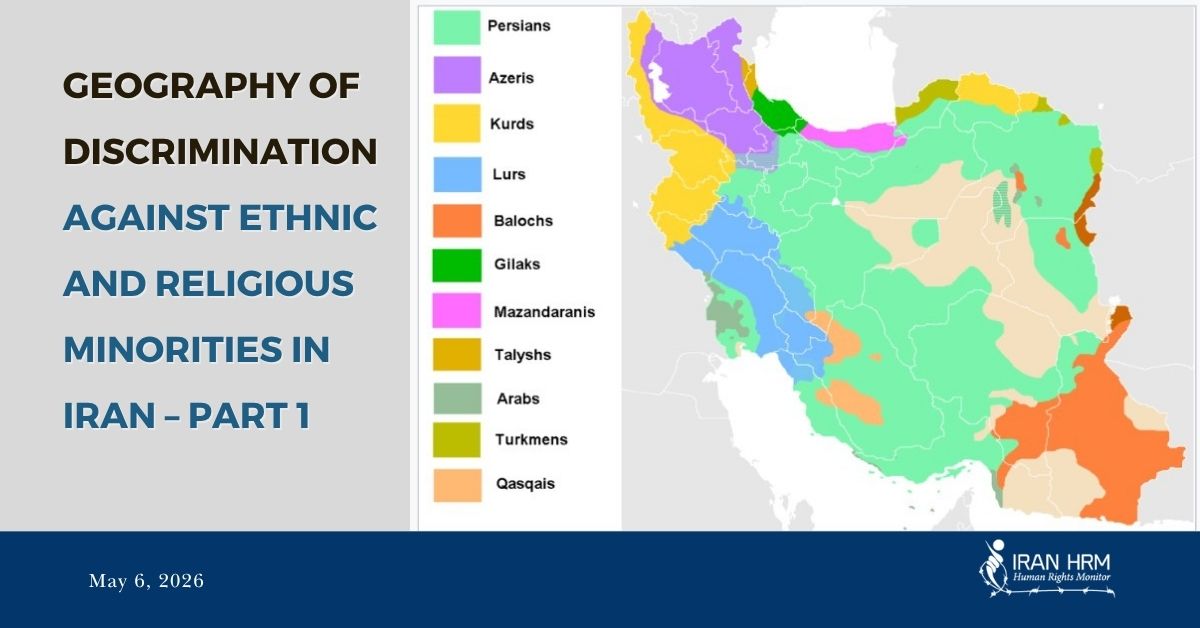
Kurdish regions and Sistan and Baluchestan Province have for decades been governed under a security-centered model. In addition to economic deprivation, underdevelopment, and unequal access to opportunities, these regions are subject to an extensive security and military presence.
Economic, cultural, linguistic, religious, and civil demands in these regions are frequently interpreted as threats to “national security” or “territorial integrity.” As a result, developmental and social policies have been replaced by security control, creating a cycle of poverty, instability, detention, violence, and repression.
Documented and continuously collected data indicate that ethnic minorities represent a disproportionate share of political prisoners, death-row inmates, and executed individuals. This pattern is particularly evident among Baluch and Kurdish communities and has intensified in recent years.
Mass Arrests; From Reactive Measures to Preventive Control
In recent waves of protests and security crackdowns, arrests have evolved beyond reactions to specific incidents and increasingly taken the form of systematic preventive control. Security forces have used surveillance tools, including urban cameras, digital monitoring, communication tracking, and local identification networks, to identify and detain individuals.
Arrests are often carried out at night, inside private homes, without clear judicial warrants, and accompanied by intimidation or violence against family members. Those targeted have included students, civil activists, Sunni clerics, lawyers, journalists, medical personnel, cultural activists, and in some cases minors under the age of 18.
The charges brought against detainees commonly include “propaganda against the state,” “assembly and collusion,” “baghi,” “enmity against God,” “membership in hostile groups,” or “cooperation with foreign intelligence services”; accusations that can carry severe punishments, including the death penalty.
This pattern indicates that arrests in minority-populated regions function not only as judicial responses but also as mechanisms of social control and public intimidation.
Detention Conditions; Systematic Pressure to Obtain Confessions
Documented reports indicate that many detainees are held in conditions that significantly violate international standards relating to fair trial rights and the prohibition of torture.
These conditions include prolonged solitary confinement, sleep deprivation, extended interrogations, psychological pressure, threats against family members, restrictions on communication, and denial of access to legal counsel during the early stages of detention.
In several cases, alleged confessions obtained under pressure, security detention, and denial of meaningful access to legal representation have formed the basis for severe sentences. The use of such confessions, particularly in death penalty cases, raises serious concerns regarding the integrity of judicial proceedings and the protection of the right to life.
Executions; Structural Use of the Death Penalty and the Disproportionate Targeting of Minorities
Executions in Iran have increased significantly in recent years and have become one of the principal instruments of social and security control. According to documented data collected on a daily basis:
In 2024, 993 executions were recorded.
In 2025, the number rose to 2,167.
By the end of April 2026, 682 executions had already been recorded.
This increase, combined with the disproportionate targeting of ethnic and religious minorities, indicates that the death penalty in Iran functions not only as a criminal punishment but also, in many cases, as a mechanism connected to the control of marginalized regions, political repression, and the creation of social fear.
Kurds; Security Charges, Opaque Trials, and Executions
In Kurdish regions, severe security-related charges including “espionage,” “baghi,” “enmity against God,” and “membership in opposition groups” are repeatedly brought against Kurdish citizens. Such charges, particularly in border areas, are often pursued in highly securitized environments with limited public access to case files.
Case Study: Idris Ali
Idris Ali, a Kurdish citizen from Sardasht in West Azerbaijan Province, was executed in Urmia Central Prison on May 21, 2025. He had been arrested and prosecuted on charges of “spying for Israel”; an accusation increasingly used in recent years in security cases involving residents of border regions.
According to reports published by human rights sources affiliated with the Iranian Resistance, Idris Ali was denied access to a lawyer of his choosing during interrogations in security detention centers in Urmia. His death sentence was reportedly based on confessions obtained under conditions of pressure and security detention.
Official narratives promoted by media outlets affiliated with the ruling regime in Iran portrayed him as linked to foreign intelligence services. However, field reports and information documented by individuals close to him have raised serious questions regarding the lack of transparency, absence of publicly available evidence, and restrictions surrounding judicial proceedings.
The case of Idris Ali illustrates how security-related accusations in Kurdish regions can lead to irreversible death sentences without sufficient guarantees of fair trial rights.
Baluch Citizens; Executions, Structural Poverty, and the Criminalization of Livelihoods
Sistan and Baluchestan Province represents one of the clearest examples of the overlap between structural poverty, religious discrimination, geographic marginalization, and security repression. In this province, the proportion of Baluch individuals among those executed is reported to be significantly higher than their share of the national population, while drug-related and security charges are extensively used against economically marginalized communities.
Fuel carrying, one of the few available sources of livelihood in deprived areas, has repeatedly been met with direct gunfire by security forces, resulting in the killing of unarmed civilians.
Case Study: Amer Ramesh
On April 26, 2026, the execution of 20-year-old Baluch prisoner Amer Ramesh was carried out in Zahedan Central Prison. He had been 18 years old at the time of his arrest in October 2024 during a security operation in the village of Balingi near Chabahar.
A key aspect of this case is that security forces initially informed his family that he had been “killed,” before it later emerged that he was alive and being interrogated in security detention facilities.
Several media outlets affiliated with the ruling regime in Iran broadcast videos of Amer Ramesh’s alleged confessions. Visible bruises and injuries could be observed on his face in the footage. Under international human rights standards, confessions obtained under physical abuse, coercion, or denial of legal safeguards cannot constitute a reliable basis for the imposition of the death penalty.
Supplementary Case: Mansour Dehmardeh
Mansour Dehmardeh, a Baluch citizen, represents another example of the intersection between poverty, personal vulnerability, severe accusations, and capital punishment. Human rights reports indicate that his case involved serious concerns regarding torture, coerced confessions, denial of fair trial rights, and disregard for his physical condition.
Taken together, the cases of Amer Ramesh and Mansour Dehmardeh demonstrate that repression in Baluchistan is not limited to conventional security cases. Rather, it operates through a broader combination of poverty, marginalization, religious discrimination, weak access to legal representation, and the absence of independent judicial oversight.
Conclusion to Part One
The cases examined in Kurdish and Baluch regions demonstrate how ethnic identity, religion, geographic deprivation, and security accusations are closely interconnected in Iran’s border areas. However, this pattern of repression extends beyond border regions alone.
Part Two of this report will examine additional dimensions of structural repression against Sunni Muslims, Ahwazi Arabs, and Baha’i citizens; including enforced disappearance, opaque executions, educational deprivation, and pressure exerted against families and wider communities.