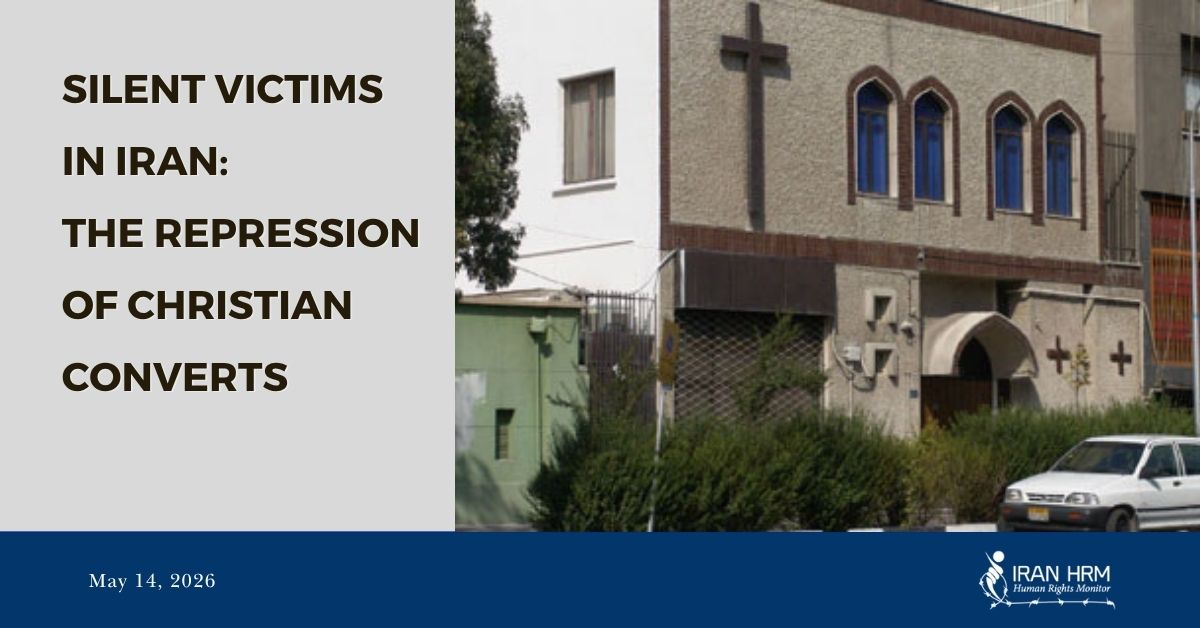
In these days, when awakened humans have cried out against the flagrant violations of human rights in Iran under the rule of the Islamic Republic—and during times when a deafening silence of inaction has enveloped the world in the face of these egregious violations, which amount to crimes against humanity and massacre—we must also remember Christians, the silent victims of this regime.

Although internet shutdowns have left little way to obtain up-to-date news regarding Christians imprisoned in the jails of the Islamic Republic, the intensification of the dire human rights situation in Iran—which we have witnessed particularly since the uprising of January 2026, ranging from the killing of protesters to mass arrests accompanied by relentless torture and unprecedented political executions—provides a clear picture of the current state of Christians in prison. This is especially true for women, as being a woman in a system that calls itself the “Islamic Republic” while abusing religion is, in itself, an unforgivable crime.
Faces of Silence: Recent Arrests and Heavy Sentences (2024–2026)
While the regime’s propaganda machine claims religious freedom, informal statistics show that as of early 2026 (1405), dozens of Christian citizens are being held in detention on baseless security charges. The following table documents part of this systemic repression in recent years:
Table: Status of Selected Christian Prisoners (2024–2026)
| Name of Accused | Primary Charges (Summary) | Legal Articles / Security Label | Sentence Announced | Brief Description |
| Nasser Navard Gol-Tapeh | Action against national security, propaganda against the regime, leading a house church. | Articles 500 & 500-bis / “Zionist Christianity” | 10 years imprisonment (New 2025 case) | One of five Christians sentenced to a total of 50 years in Tehran; his normal religious activities were recorded as “security crimes.” |
| Yousef (Joseph) Shahbazian | Establishing and managing a house church, proselytizing Christianity. | Article 500 and security labels | 10 years imprisonment (New 2025 case) | Leader of a Persian-speaking house church; convicted again using the same pattern of previous security charges. |
| Lida (Alexani/ Shahbazian) | Propaganda against the regime, collaboration in a house church network. | Article 500 and security labels | 8 years imprisonment | Wife of Joseph Shahbazian; convicted in the same 5-member Tehran case. |
| Ayda Najafloo | Propaganda against the regime, assembly and collusion, Christian online activity. | Articles 500, 500-bis, and security labels | Total of 17 years (10+5+2) | A 44-year-old convert; she fell from a bunk bed in Evin, breaking her T12 vertebra. Despite surgery and infection, she is denied medical leave. |
| Unnamed Christian Woman | Propaganda against the regime, assembly and collusion, participation in a house church. | Article 500 and security labels | 10 years imprisonment | Her name has been withheld to prevent further pressure on her family; she is a member of the 5-person Tehran case. |
| Morteza Faghanpour Sasi | Propagating against Sharia due to foreign ties, propaganda against the regime, insulting the Leader. | Articles 500, 500-bis, and 514 | 9 years and 6 months | Arrested in Varamin (2024); spent 20 days under torture in Ward 209 of Evin Prison. |
| Hesamuddin Mohammad Joneidi | Propagating against Sharia, propaganda against the regime. | Articles 500 and 500-bis | 8 years and 1 month | Convicted for participating in meetings, possessing a Bible, and communicating with Christians abroad. |
| Abolfazl Ahmadzadeh Khajani | Propagating against Sharia, propaganda against the regime. | Articles 500 and 500-bis | 8 years and 1 month | Part of his sentence was directly attributed to “communicating with Christians outside the country.” |
Past Repression: A Mirror to the Present
To understand what Christian converts—especially women—arrested recently may be enduring in the prisons of the Islamic Republic, we look here at the testimonies of some of these women who were arrested and later released in previous years. It is worth noting that, as is the custom with charges—especially following recent military tensions—the accusation of “collaboration with Israel” has become the refrain of judicial frame-ups. According to reports from the “Article 18” organization, following just one period of military tension (the first Iran-Israel war in June 2025), approximately 50 Christian citizens were arrested on this specific charge.
Testimonies from the Torture Chambers of the Islamic Republic
Maryam Jalili (Arrested 2009 – Interviewed 2022):
- “The solitary confinement cell was very small and resembled a cage… The interrogator repeated back to me every conversation I had at home with my family. I realized we were being wiretapped even inside our own house.”
- “The interrogators insisted: ‘You are a Zionist evangelical Christian. You receive money from the governments of Israel and America.’ They made so many baseless accusations with such certainty that I later found out even my own brother had believed them.”
- “They took us women to a very small room. The top of the wall had a window with broken glass, and the cold winter air blew in. There was no heater. We were 9 people and had to cling to each other to stay warm with a single small blanket. The space was so small we had to sleep side-by-side on our sides.”
- “The interrogator threatened: ‘Look at the acoustic insulation on the wall where it’s broken. That is the mark of a prisoner’s head who didn’t cooperate. If you don’t cooperate, the same will happen to you. I will put the noose around your neck and pull the stool from under your feet!'”
Nasrin Kiamarzi (Arrested 2013 – Interviewed 2020):
- “They took us to the ‘Alef-Ta’ detention center in Isfahan. One interrogator kicked my chair so hard I slammed into the wall. He cursed at me with foul language and kicked my hand and side.”
- “A young interrogator approached me with a disgusting, flirtatious tone and whispered in my ear: ‘I know your pseudonym is Sadaf. Now, Sadaf dear, write down whatever you know.’ I was terrified he intended to rape me. I preferred the previous interrogator who beat me over this person.”
- “The shower was installed directly above the toilet. The toilet had no door, just a half-wall. We went to the bathroom in fear because the male guards would open the door suddenly without notice. There were no female officers in ‘Alef-Ta.’ When one of us started her period, we had to shamefully ask a male guard for sanitary pads.”
- “Our charges included ‘illicit relations’ because the participants in prayer meetings were not related and the women were present without headscarves.”
Sahar Dashti (Arrested 2013 – Interviewed 2020):
- “I suddenly saw four computers in front of the officers. They had installed cameras in our rooms and were watching us. Even going to the bathroom or changing clothes was under their control and view.”
- “One of the interrogators called my family and told them a death sentence had been issued for their daughter (me). My mother went into shock and was hospitalized due to heart distress.”
Violations of International Law and Standards
The actions described above constitute a flagrant violation of international treaties to which Iran is officially committed:
- Violation of Freedom of Religion (Article 18 of UDHR and ICCPR): The criminalization of conversion and the formation of house churches.
- Violation of the Prohibition of Torture (Article 5 of UDHR): The use of solitary confinement, physical beatings, and psychological torture to extract confessions.
- Violation of the Right to a Fair Trial (Article 14 of ICCPR): Denial of access to a lawyer and issuing sentences based on forced confessions.
- Violation of Women’s Human Dignity: Humiliating body searches and denial of access to sanitary supplies (Violating standards of the Convention on the Elimination of All Forms of Discrimination Against Women – CEDAW).
- Abuse of Article 500-bis: This legal article effectively treats any ideological activity other than the regime’s official narrative as “deviant propaganda,” punishable by heavy imprisonment.
The Hypocrisy of Rulers of Iran: Religious Apartheid
While dozens of Christian prisoners are currently in captivity, Ghalibaf (Speaker of Parliament) sends messages of condolence for Armenian citizens killed in bombings, wishing them “eternal peace in the loving embrace of Jesus Christ.” This hypocrisy reflects a “Religious Apartheid”—a system that accepts official minorities for diplomatic theater but throws Persian-speaking Christian converts into dungeons on charges of “Zionist Christianity.” Ghalibaf, whether during his time as Chief of Police or as Speaker of Parliament through the ratification of laws like Article 500-bis, has been a key executive arm of this repression.
Two Sides of the Same Coin
The violation of the rights of religious minorities in Iran—particularly the rights of women within these minorities who face double repression—is the other side of the coin of systemic human rights abuse in Iran. The repression of minorities and the repression of street protesters are two sides of the same coin in the Islamic Republic’s survival strategy: “The creation of terror to maintain ideological uniformity for survival.” A government that feels threatened by even the silent prayer of a woman in her home is far more fragile than it appears when facing an awakened and diverse society. The international community must exert material pressure on this regime and force it to recognize human rights in all spheres.