Annual Assessment – 2025
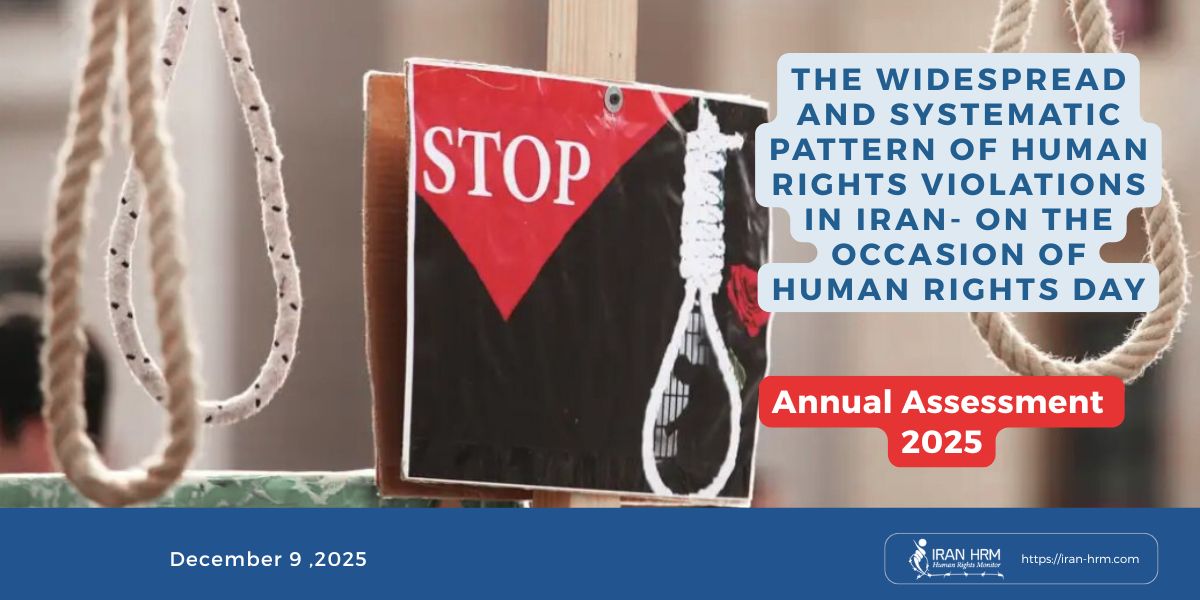
On the occasion of Human Rights Day, the human rights situation in Iran has once again become a central concern for the international community. Four decades of structural and systematic violations of fundamental rights have placed the ruling regime among the few governments in the world that have been condemned in at least 72 United Nations resolutions addressing the human rights situation in the country. This long-standing record of repression has not diminished; on the contrary, it intensified sharply in 2025.

In the most recent session of the UN General Assembly (November–December 2025), both the Third Committee and the plenary adopted a new resolution on the human rights situation in Iran. The resolution; one of the strongest issued to date; condemned the dramatic rise in executions, the institutionalization of torture, the repression of protesters, the denial of fair trial guarantees, and the pervasive impunity of officials. It also called for the immediate halt of executions and full access for UN human rights mechanisms. None of these requirements have been implemented.
An assessment of the past twelve months shows that repression in 2025 reached an alarmingly high level. Verified data indicates that 1,791 executions were carried out in the first eleven months of the year, with more than 1,500 prisoners on death row facing imminent danger. The year also saw the execution of at least 57 women, the highest recorded in four decades, reflecting a pattern of gender-based persecution and discriminatory punishment.
Taken together; torture, deteriorating prison conditions, preventable deaths, the targeting of women and minorities, and the repression of activists and detainees; 2025 represents one of the most severe periods of human rights deterioration in recent years.
2. Methodology
This report draws on credible field information, documented prisoner cases, and findings from UN human rights mechanisms to present a comprehensive assessment of the most serious human rights violations committed in Iran over the past year.
All names cited refer to political, ideological, or minority detainees, and have been carefully cross-checked for accuracy.
3. Key Findings
3.1. Right to Life and the Execution Crisis in 2025
The scale of executions in 2025 reflects a dramatic intensification of the regime’s policy of physically eliminating political opponents and vulnerable groups. According to reliable data, 1,791 executions were carried out during the first eleven months of 2025, more than double the 993 executions recorded in 2024. At least 57 women were executed, marking the highest figure in four decades. Many executions followed unfair trials, denial of access to lawyers, and coerced confessions obtained under torture. Kurds and Baluchis were disproportionately represented among those executed.
Documented cases (executions / death sentences / imminent risk):
- Behrouz Ehsani Eslamlou, Mehdi Hassani – executed after unfair trials and lack of legal representation.
- Dozens of political and ideological prisoners sentenced to death, including:
- Zahra Shahbaz Tabari, Lakan Prison (Rasht)
- Manouchehr Fallah, sales representative – Lakan Prison
- Amin (Peyman) Farah-Avar Gisavandani, poet – Lakan Prison
- Karim Khojasteh, Lakan Prison
- Mohammad-Javad Vafaei-Sani, boxing champion – Vakilabad Prison (Mashhad)
- Ehsan Faridi, engineering student – Tabriz Prison
- Vahid Bani-Amerian, postgraduate in management – Qezel Hesar Prison
- Pouya Ghobadi, electrical engineer – Qezel Hesar Prison
- Mohammad Taghavi-Sangdehi, BA in Graphic Design – Qezel Hesar Prison
- Abolhassan Montazer – Qezel Hesar Prison
- Babak Alipour, BA in Law – Qezel Hesar Prison
- Akbar (Shahrokh) Daneshvarkar, engineer – Qezel Hesar Prison
- Varisheh Moradi, university graduate – Evin Prison
- Farshad E’temadifar, Sheiban Prison (Ahvaz)
- Masoud Jame’i, Sheiban Prison (Ahvaz)
- Alireza Mardasi, Sheiban Prison (Ahvaz)
- Reza Abdali, Sheiban Prison (Ahvaz)
- Nima Shahi, Karaj Central Prison
- Hamed Validi, Karaj Central Prison
3.2. Torture and Forced Confessions
Torture remains a standard practice in security detention centers and prisons. Documented methods include severe beatings, suspension, electric shocks, sleep deprivation, sexual threats, “coffin cells,” and coerced confessions. Baluchi, Kurdish, and Sunni detainees reported the harshest forms of torture.
In many cases, interrogators used techniques such as driving needles under fingernails, burning the body with heated objects, and exerting psychological pressure on children and teenagers to extract confessions. The pattern documented among protesters of recent years shows combined physical and psychological torture, resulting in long-term trauma among many victims.
Forced confessions are routinely broadcast by state media to justify repression and pave the way for heavy sentences. The cycle of “arrest → torture → forced confession → televised broadcast → heavy sentencing” remains a defining feature of the denial of fair trial guarantees.
Documented cases of torture:
- Loghman Alizadeh – severe physical deterioration after torture (Qezel Hesar)
- Hassan Saeedi – died under torture (Ahvaz Intelligence)
- Hamzeh Darvish – nine years of torture and solitary confinement (Lakan Prison)
- Javad Kiani-Ashtarjani – at risk of death due to torture (Evin)
- Rouhollah Karki – tortured in a safe house (Ahvaz)
- Iliya Zarei – 17-year-old; tortured and hospitalized
- Abdolsalam Shahmiri – Zahedan; torture and prolonged uncertainty
- Mohammad Banazadeh Amirkhizi – ongoing torture in Qom Intelligence Detention
- Pezhman Toubere-Rizi – critical condition after torture
- Arghavan Fallahi – six months of torture; transferred to an unknown location
- Saman Mirdoraghi – died under torture (Andimeshk Intelligence)
- Saeed Salimi and Parsa Salimi-Majd (17) – tortured in Ward 209 of Evin
3.3. Deliberate Medical Deprivation and “Slow Death”
Systematic denial of medical care; one of the most entrenched forms of “white torture” has intensified in 2025. Prisoners with life-threatening conditions are routinely denied hospital transfers or even basic medication.
At least 23 women died in Qarchak Prison since the start of the year due to medical neglect, misdiagnosis, or delayed transfers.
Documented cases:
- Maryam Shahraki – died after misdiagnosis and denial of urgent cardiac treatment (Ferdows Prison – 21 Shahrivar 1404)
- Jamileh Azizi – died in Qarchak after untreated cardiac symptoms (28 Shahrivar 1404)
- Somayeh Rashidi – epileptic prisoner; irreversible condition after delayed transfer (25–29 Shahrivar 1404)
Additional critical cases:
- Abolhassan Montazer-Moghaddam – Qezel Hesar; severe cardiac and renal conditions, denied surgery
- Mir Yusef Younesi (72) – Fashafuyeh; denied essential surgery
- Mohammad-Ali Akbari Monfared – paralysis, diabetes, severe infection; risk of amputation
- Reza Ehtehami (70) – cardiac illness; denied treatment
- Ayyub Parkar (69) – Sheiban; multiple illnesses, denied hospital transfer
- Jaber Albushohkeh – risk of blindness; denied treatment
Other prisoners denied treatment include:
Manouchehr Fallah, Peyman Farah-Avar, Yaghoub Derakhshan, Maryam Akbari-Monfared, Shiva Esmaeili, Fatemeh Ziaei, Marzieh Farsi, Forough Taghipour, Ma’soumeh Askari, Hoda Mehreganfar, Ahmad Naseri, Yusef Savari, Mohammad-Ali Akbari-Monfared.
3.4. Preventable Deaths and Suicides
Combined torture, psychological pressure, and medical neglect have led to a wave of preventable deaths and suicides across Iranian prisons.
Documented cases:
- Omid Jahani – died due to medical neglect (Babol – 9 Azar 1404)
- Ali Darabi – suicide in Fashafuyeh (3 Azar)
- Payam Sattari – suicide after torture and sexual assault (19 Khordad)
- Mohammad Koushki – suicide in Qezel Hesar after prolonged deprivation
- 23 women – Qarchak Prison; deaths due to medical neglect
3.5. Enforced Disappearance as a Tool of Repression
Enforced disappearance has become a central instrument of repression in 2025. Sudden transfers, complete communication cutoffs, and denial of information to families constitute a pattern that violates Articles 9 and 14 of the ICCPR and may amount to crimes against humanity.
Documented cases (2021–2025):
Siamak Barati, Nader Teymouri, Ahmadreza Djalali, Fariborz Babakhani, Emad Mazraeh, Mehdi Mahmoudi (17), three Kurdish political prisoners, Saleh Bahramzehi (16), Rassam Sohrabi, Hamidallah Arbabi, Saeed Masoudi, Iman Khodri, Hafizollah Shahbakhsh, Danial Moshki, Parisa Darvish, Ali Younesi, Bijan Kazemi, Arghavan Fallahi, Vahid Bani-Amrian, Pouya Ghobadi, Babak Alipour, Akbar Daneshvarkar, Seyed Mohammad Taghavi, Osman Mameh.
3.6. Women: Gender-Based Persecution and Structural Violence
2025 marks the worst year in four decades for women prisoners and death-row detainees.
Key findings include:
- Execution of at least 57 women
- Deaths of 23 women in Qarchak due to medical neglect
- Transfer of political women prisoners to a 40-step underground facility in Evin
- Severe medical deprivation affecting women such as Maryam Akbari-Monfared, Shiva Esmaeili, Fatemeh Ziaei, Marzieh Farsi, Forough Taghipour, among others
This constitutes systematic gender-based persecution under international human rights law.
3.7. Ethnic and Religious Minorities
Kurdish, Baluchi, Arab, Sunni, and Bahá’í communities face entrenched discrimination and intensified repression. Minorities account for around 20% of all executions despite forming a smaller share of the population. Operations in minority regions involved lethal force, mass arrests, and torture.
4. Patterns of Violations
The cumulative evidence; torture, disproportionate executions, enforced disappearances, medical deprivation, and the targeting of women and minorities; demonstrates that these violations are structural, coordinated, and intentional.
Institutional impunity for security and judicial officials enables the continuation and expansion of these violations.
5. Legal Assessment
These violations constitute serious breaches of Iran’s obligations under the International Covenant on Civil and Political Rights, including Articles 6, 7, 9, 10, 14, and 26.
The scale, severity, and systematic nature of torture, executions, enforced disappearances, and persecution of women and minorities meet the legal threshold for crimes against humanity.
6. Conclusion and Call for Immediate Action
The findings presented in this report depict a gravely deteriorating human rights landscape in Iran. Thousands of prisoners; including political detainees, ideological prisoners, women, and minorities; face the risk of torture, slow death, or execution.
The situation requires urgent and coordinated international action to prevent further violations and protect vulnerable detainees.