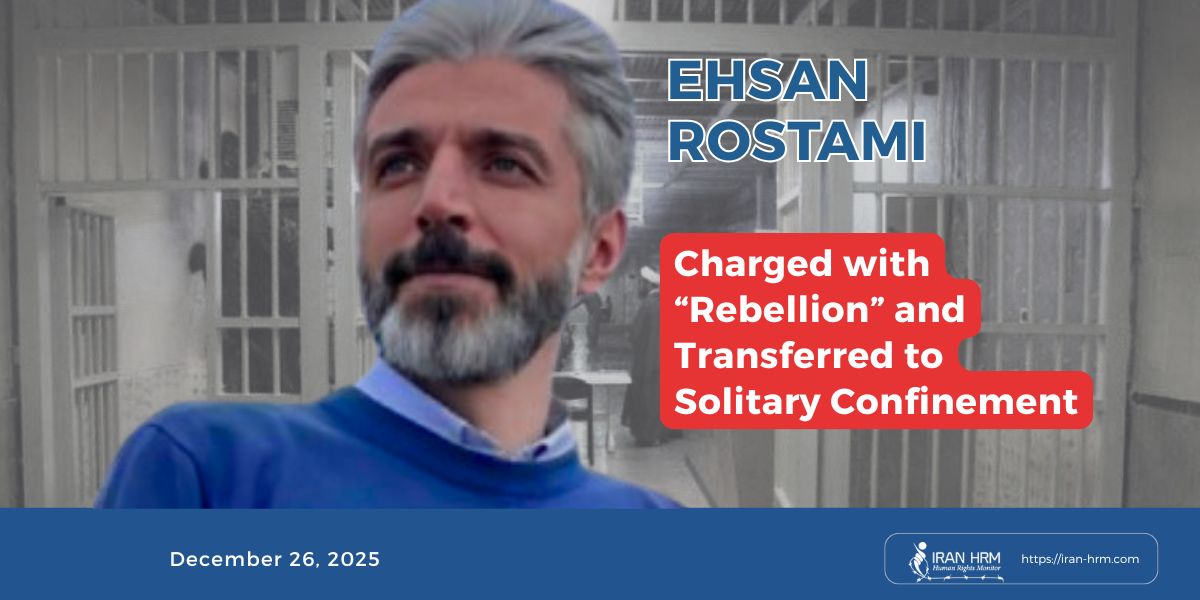
Ehsan Rostami, an Iranian political prisoner and cultural activist, has been transferred to solitary confinement following the formal accusation of the national security charge known as rebellion or “baghi”. This charge, under Iran’s penal code, carries the potential for the death penalty. His transfer has triggered serious concerns regarding his legal fate, physical well-being, and psychological safety.

Factual Account
On 10 December 2025, Rostami was summoned to Branch Five of the Evin Prosecutor’s Office, overseen by interrogator Jalayer, where he was formally charged with “rebellion” on allegations of cooperation with opposition groups. Shortly after the interrogation session, he was transferred to solitary confinement without public disclosure of evidence, procedural details, or confirmation of access to a lawyer of his choosing.
Rostami had previously been arrested on 20 August 2025, during coordinated security raids targeting several of his relatives and acquaintances in Tehran. Among those detained was his cousin, Ramin Rostami. The detainees were held for approximately four months under intensive interrogation and pressure.
Hunger Strike and Detention Conditions
Beginning on 1 October 2025, Ehsan Rostami and his cousin initiated a 23-day hunger strike in protest against coercive interrogation practices and ongoing pressure from security forces. His family later warned of his deteriorating physical condition. The recent transfer to solitary confinement, following prolonged interrogation and hunger strike, has significantly intensified concerns over his health and safety.
Arrest and Abuse of Family Members
As part of escalating pressure, Jahangir Rostami, Ehsan Rostami’s 63-year-old father and a retired educator, was arrested on 16 October 2025 at his home in Harsin. Reports indicate that he was severely beaten during arrest, sustaining injuries to his head and face. Two days later, security agents reportedly brought him, visibly injured, before his son in an apparent attempt to extract forced confessions.
Jahangir Rostami was provisionally released on 16 December 2025 after posting bail of approximately 1.5 billion tomans. Retired teachers’ associations in Kermanshah and Harsin publicly condemned his arrest and mistreatment.
Personal Background
Ehsan Rostami, 36, is a sociologist and a graduate of Allameh Tabataba’i University. He is known as the director of an independent publishing house and bookstore, and as a cultural figure active in the fields of philosophy, political thought, and socio-economic studies. His cousin, Ramin Rostami, 29, is an electrical engineer and an independent cultural publisher.
Human Rights Analysis
The imposition of the charge of “rebellion”, Rostami’s transfer to solitary confinement, and the lack of transparent information regarding legal representation raise serious concerns about violations of fair trial guarantees. Prolonged solitary confinement, particularly under undefined conditions, is widely recognized as a form of cruel, inhuman, or degrading treatment.
The threat of capital punishment, combined with procedural opacity and psychological pressure, places Rostami’s right to life, security, and human dignity at serious risk. These practices reflect a broader pattern of using severe and ambiguous national security charges against cultural and civil activists in Iran.
Conclusion
The case of Ehsan Rostami illustrates the systematic use of heavy security charges, family intimidation, and solitary confinement against non-violent cultural figures in Iran. Without transparency, due process, and immediate safeguards, this case carries the risk of irreversible judicial consequences. Continued international attention remains critical to prevent further violations and to protect the fundamental rights of this political prisoner.