By Mohammad Nahid (Human Rights Activist)*

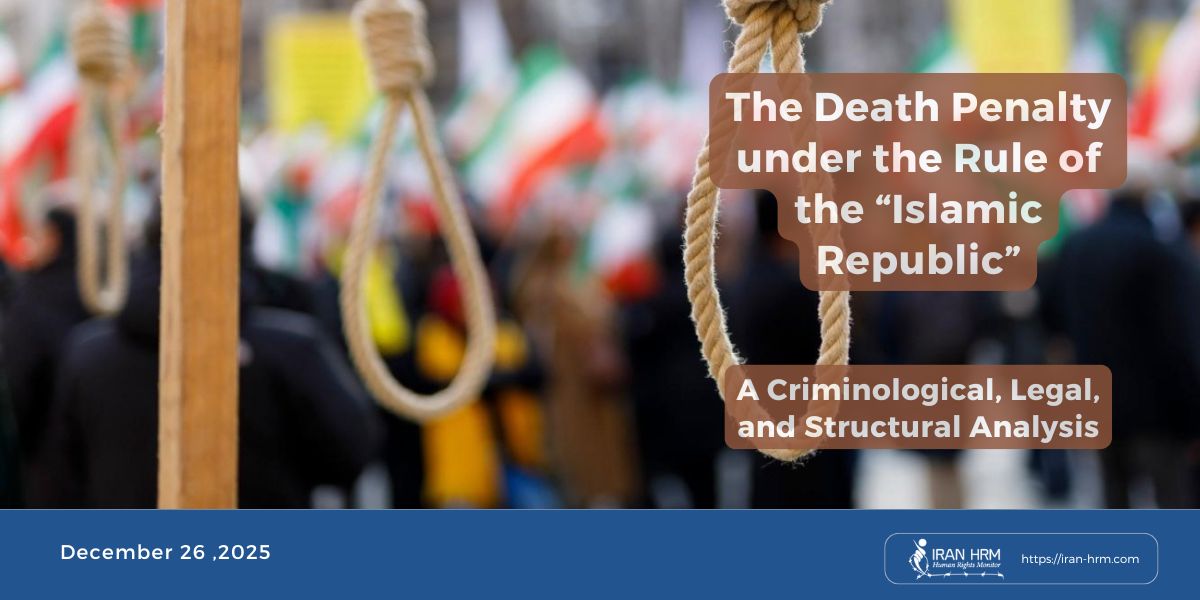
The death penalty in the Islamic Republic of Iran has consistently been one of the most critical areas of human rights violations. In 2025, this issue has taken on new dimensions. Reports by human rights organizations indicate that from the beginning of 2025 until mid-November, more than 1,400 executions have been carried out in Iran; according to some supplementary reports, this figure exceeds 1,700, making it one of the bloodiest years of the past four decades.
This situation is not merely a criminal phenomenon. From the perspectives of critical criminology, international law, and studies of authoritarian governance, it constitutes part of a repressive and organized structure in which the death penalty is employed as a tool for social control, political survival, and the reproduction of official ideology.
Given these statistics, criminological and legal analysis of executions in Iran can be examined along several overarching axes.
Criminological and Legal Components of the Death Penalty in the Islamic Republic
1. Execution as a Tool of Governance and Political Repression
In Iran, execution is increasingly used by the regime as a “calculated mechanism” to instill fear, suppress resistance, and control society.
Executions ostensibly carried out under security-related charges such as moharebeh (“enmity against God”) or efsad-e fel-arz (“corruption on earth”) are, in many cases, manifestations of political repression. These charges stem from the substance of the Islamic Republic’s penal laws, which enable the ideological criminalization of political activity with the punishment of death.
Political death sentences have increased particularly against ethnic minorities (Kurds, Baluchis, and others).
Moreover, in the recent period—especially following heightened tensions during the so-called “twelve-day war”—a significant portion of executions have been carried out under pretexts such as “treason,” “espionage,” or other security-related accusations.
From a criminological perspective, therefore, execution functions as a state instrument for reproducing the authority of the Velayat-e Faqih (Guardianship of the Jurist) and ensuring regime survival, rather than merely as a penal response to crime.
2. Execution-Oriented and Discriminatory Penal Laws
Under the Islamic Penal Code of the Islamic Republic, numerous crimes are punishable by death: hudud offenses (such as adultery and sodomy), qisas (intentional murder), certain ta’zir (punishment) offenses, and political-economic crimes (such as corruption). In addition, drug-related offenses are defined under the Anti-Narcotics Law, which prescribes the death penalty for some categories of crimes.
Amendments to the Anti-Narcotics Law have, in practice, expanded the scope of executions. According to reports by Iran Human Rights, some legal revisions have lowered the minimum quantity of drugs required for issuing a death sentence.
This breadth of criminalization and severity of punishment reflects a structure in which “Sharia-embedded” laws are primarily designed to consolidate power, particularly in ta’zir offenses and drug-related crimes. Broad criminalization of political-economic offenses (such as “economic corruption” or “disruption of the economic system”) under the Islamic Penal Code is also punishable by death.
From the standpoint of criminal justice, such extensive legalization of execution—without transparent oversight, without guarantees of fair trial, without effective right to defense, and relying on coerced confessions—can lead to arbitrary executions.
3. Compatibility or Conflict with International Law
International human rights law—particularly the International Covenant on Civil and Political Rights (ICCPR)—imposes strict limitations on the use of the death penalty. One of its core principles is that execution must be restricted to the “most serious crimes,” typically understood as crimes involving intentional killing. The UN Human Rights Council has repeatedly emphasized this standard.
Under this criterion, a large proportion of executions in Iran (for example, executions for drug-related offenses) cannot be justified under international law. Indeed, UN human rights experts have explicitly pointed this out.
Furthermore, reports indicate that many of these executions are accompanied by violations of fundamental fair trial rights, including denial of access to legal counsel, lack of fair trials, and the use of torture to extract confessions. Human rights activists have noted that confessions in many cases are obtained under torture or ill-treatment during interrogation.
Given the scale of executions (more than one thousand in a single year), some human rights bodies have increasingly characterized the situation as “systematic” and potentially amounting to “crimes against humanity.” For example, Iran HRM has suggested in its reports that the United Nations should seriously investigate executions in Iran.
From the perspective of international criminal law, the use of execution as a tool of political repression (rather than merely punishment for crime) can activate international accountability mechanisms, such as international pressure, Human Rights Council resolutions, or the establishment of fact-finding missions.
4. Structural Criminology and the Role of Social Inequality
One aspect of structural criminology is the recognition that crime (in this case, drug trafficking) may be rooted in economic, social, and political conditions. Iran faces economic pressure stemming from sanctions related to its nuclear and missile policies and its regional militarism supported by proxy forces, as well as poverty, unemployment, class disparities, and inequality. These conditions can form part of the “origins of crime” in the drug economy.
When the state responds through harsh anti-narcotics laws (including execution), instead of harm-reduction policies, social care, or restorative justice, it effectively imposes official violence on vulnerable social groups.
This dynamic can be understood as a cycle of structural repression:
poverty and inequality → increased participation in illegal markets (such as drug trafficking) → severe repression by the criminal justice system through executions → collective fear and consolidation of political authority based on ruthless power.
This cycle benefits a politico-religious system that reproduces its power order through the application of the death penalty.
Additionally, ethnic discrimination in executions is a crucial parameter. Independent reports (such as those by Hengaw) show that individuals from ethnic minorities (Kurds, Baluchis, Turks, and others) constitute a significant proportion of those executed. This indicates that execution is not only a tool of political repression but also a mechanism for suppressing minorities and reinforcing ethnic inequality.
5. Ideological Legitimacy: Velayat-e Faqih and Divine Law
Within the framework of the absolute Guardianship of the Jurist, criminal law (including the Islamic Penal Code) derives religious legitimacy. In this sense, execution, as a Sharia-based, is not merely a material instrument of repression but also a symbol of the regime’s ideological power.
This religious legitimacy enables the regime to justify mass executions not only as punishment for crime but as manifestations of divine and political authority.
At the same time, the fact that many executions are carried out with minimal transparency—some executions are secret, and official figures are underreported—reveals a contradiction between propaganda about “divine justice” and the realities of injustice, inequality, and repression.
Implications and Recommendations to Relevant International Bodies
- Recognizing Executions as a Structure of Repression, Not Merely Judicial Misconduct
The international community must analyse executions in Iran within the framework of state policy of repression.
- Strengthening Accountability Mechanisms
Support for legal action against perpetrators of human rights violations in relevant international judicial forums.
- Demanding Reform of Penal Laws
Any reform-oriented process must include:
- Abolition of the death penalty
- Elimination of vague security-related charges
Concluding Summary
An examination of executions in the Islamic Republic of Iran in 2025, along with a review of historical patterns over the past 47 years of governance, demonstrates that the scale and nature of these executions cannot be understood merely as a criminal phenomenon. They are part of a legal, political, and ideological structure that employs the death penalty as a primary tool of governance, social control, political repression, and management of socio-economic inequalities. Penal laws based on an authoritarian interpretation of Sharia, vague and expansive criminalization, lack of fair trial guarantees, structural discrimination against minorities, and the political use of execution all indicate that this legal system is deeply entrenched and institutionalized.
From the perspective of international law, many of these executions are incompatible with the standard of “most serious crimes” and are accompanied by systematic violations of fundamental rights; thus, in many cases, they can be characterized as “arbitrary executions” or even “organized repression.”
However, the 47-year experience of governance under the Islamic Republic shows that fundamental reform of this situation—whether at the level of penal laws, the political-judicial structure of adjudication, the elimination of discrimination, or the abolition of execution for non-serious crimes—is practically impossible within the existing framework. This is because the structure of absolute Velayat-e Faqih, the official ideology, and the security-driven nature of the judiciary constitute the main pillars of this cycle of violence and repression.
Accordingly, the criminological and legal conclusion is that:
Only through structural change and transition away from the current political system can fundamental revisions in laws, penal policies, judicial justice, and the state’s approach to human dignity be realized.
As long as this ideological-political structure remains in place, the cycle of widespread, discriminatory, and politically motivated executions will continue to be reproduced in new forms.
————-
* The views expressed by the author are his own and do not necessarily reflect those of Iran HRM.