Pressure Intensifies on Political Prisoners Opposing the Death Penalty
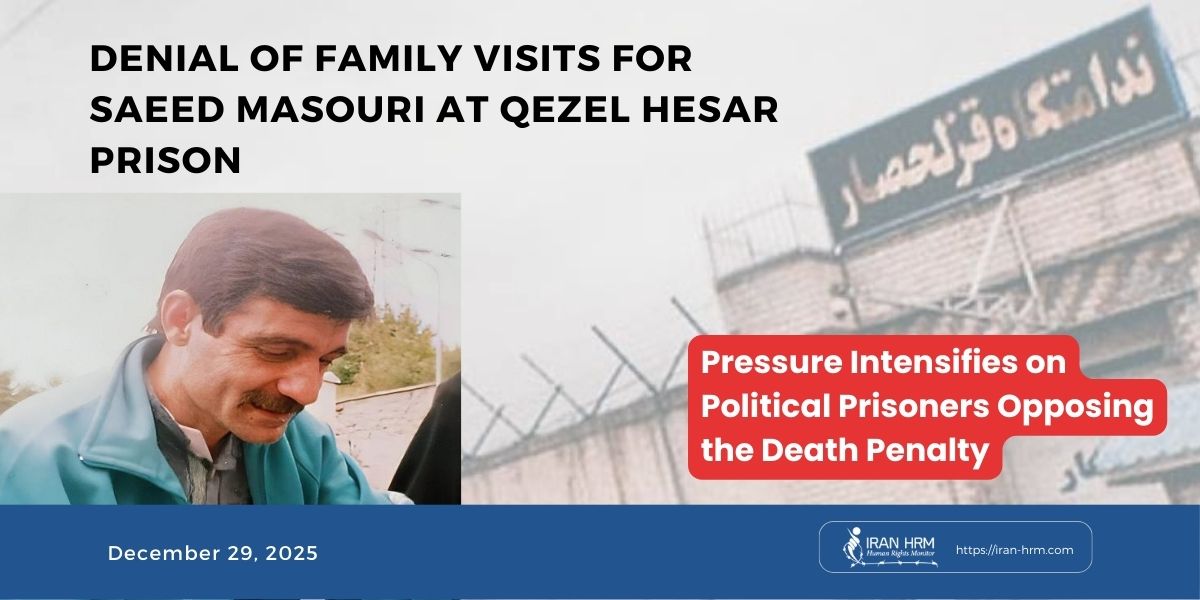
On Saturday, 27 December 2025, Saeed Masouri, one of Iran’s longest-held political prisoners, was denied all family visits by order of the Tehran Prosecutor’s Office. The measure was imposed following his public opposition to the death penalty and the dissemination of messages emphasizing steadfast resistance to repression. The decision comes amid escalating pressure on political prisoners who openly oppose capital punishment.

Notification of the Ban on Visits; Prosecutorial Order Implemented Inside Prison
Saeed Masouri, a political prisoner currently held at Qezel Hesar Prison in Karaj, was formally informed that he is prohibited from all in-person and cabin visits with his family until further notice. Prison authorities cited a direct order from the Tehran Prosecutor’s Office. According to sources close to his family, the ban is directly linked to Masouri’s recent activities and statements opposing executions.
In recent days, Masouri has also reportedly faced verbal threats. He has been warned that continued opposition to the death penalty and support for anti-execution campaigns could result in further restrictions and punitive measures.
July 2025 Message; Emphasis on Resistance Against Prison, Exile, and Execution
In July 2025, Saeed Masouri released a message from inside prison in which he reaffirmed his refusal to retreat in the face of repression and capital punishment. In that message, he stated:
“As a political prisoner and a supporter of the People’s Mojahedin Organization of Iran … I wish to state clearly that … there can be no retreat on the path of freedom and dignity, even in the face of prison, exile, and executions.”
Human rights observers note that the publication of such statements by long-term political prisoners, particularly during periods of intensified executions, often triggers heightened scrutiny and retaliatory measures by security and judicial authorities, including the denial of family visits.
Opposition to the Death Penalty; The Core Reason for Intensified Pressure
Over the years, Saeed Masouri has repeatedly spoken out against what he has described as “hasty and systematic executions” and has called for an end to the implementation of death sentences. He is known as a supporter of the campaign referred to as “Tuesdays Against the Death Penalty,” an initiative aimed at drawing public attention to the human and legal consequences of capital punishment. The campaign has received support from political prisoners, their families, and civil society activists.
Human rights defenders emphasize that depriving prisoners of family contact is a well-established tool of psychological pressure in Iranian prisons, frequently used against inmates who publicly oppose executions.
Twenty-Five Years of Imprisonment Without Leave; Background of a Veteran Political Prisoner
Saeed Masouri was born in 1965 in Khorramabad. He was arrested on 8 January 2001 while entering Iran and was detained in the city of Dezful. His family remained unaware of his whereabouts for several months and was only informed of his detention in the spring of 2001. During the initial phase of his arrest, Masouri spent 14 months in solitary confinement at the Intelligence Office in Ahvaz before being transferred to Ward 209 of Evin Prison.
In 2002, Tehran’s Revolutionary Court sentenced him to death on charges of “enmity against God” in connection with alleged cooperation with the People’s Mojahedin Organization of Iran. The sentence was later commuted to life imprisonment. Masouri has now spent more than 25 years in prison without a single day of leave, making him one of Iran’s longest-detained political prisoners.
Forced Transfers, Threats, and Denial of Medical Care
Throughout his imprisonment, Saeed Masouri has been subjected to repeated transfers between prisons and to severe security and disciplinary restrictions. Reports indicate that at various times, particularly following public statements and protests, he has faced direct threats.
In August 2016, Masouri and several fellow prisoners were reportedly beaten and transferred to a high-security ward. In protest against prison conditions and systemic abuses, they launched a hunger strike that lasted 40 days. In subsequent years, concerns have repeatedly been raised about his health and the persistent denial of access to specialized medical treatment.
In August 2023, Masouri was transferred along with other long-term political prisoners to Evin Prison. One month later, in September 2023, he was forcibly returned to Qezel Hesar Prison following a violent intervention by prison guards. On 27 July 2025, he was abruptly transferred to Zahedan Prison but was returned to Qezel Hesar after widespread domestic and international reactions.
Denial of Visits; A Form of Collective Punishment Against the Prisoner and His Family
The denial of family visits to Saeed Masouri, coupled with recent threats, is widely regarded as a form of additional punishment imposed on both the prisoner and his relatives. For years, family visits had been one of the few means through which his relatives could maintain contact with him and monitor his physical and psychological condition.
Human rights activists warn that such measures not only violate the right to family life but are deliberately used to silence dissenting voices from inside prisons and to exert severe psychological pressure on prisoners and their families.
Conclusion
The ban on family visits imposed on Saeed Masouri at Qezel Hesar Prison, following the publication of his explicit messages opposing the death penalty and emphasizing steadfast resistance, has once again drawn attention to the situation of political prisoners who challenge capital punishment in Iran. His prolonged imprisonment, repeated transfers, threats, and ongoing deprivations illustrate a broader pattern of using psychological pressure and punitive restrictions to suppress peaceful dissent within the prison system.