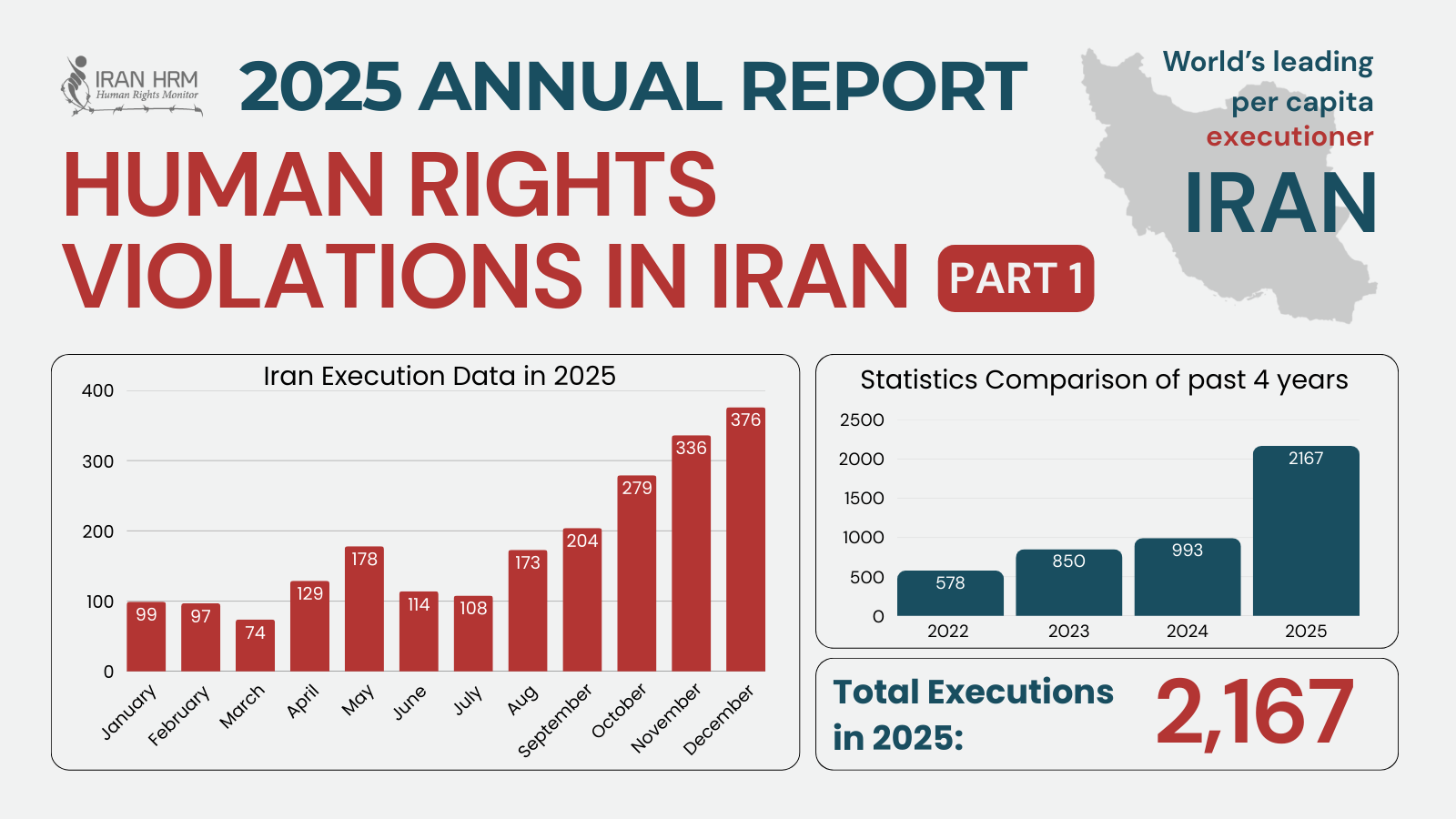
Coordinated Intensification of Structural Repression Under the Clerical Regime
Overview of the Human Rights Situation in Iran in 2025
Repression as a Tool for Regime Survival
The year 2025 marked a critical turning point in the intensification and structural deepening of human rights violations in Iran. Collected data and documentation indicate that the ruling regime in Iran shifted its pattern of repression from episodic and reactive responses to crises toward a sustained, coherent, and deliberately planned policy of governance. Compared to 2024, the scope, intensity, and overlap of violations expanded across all major areas of human rights, to the extent that some of the most severe forms of repression, particularly violations of the right to life; became accelerated and institutionalized practices.

An examination of trends in 2025 demonstrates that the developments of this period were not the result of isolated abuses or exceptional circumstances, but rather the direct outcome of conscious and structural policies pursued by the clerical regime. Throughout the year, the mullahs’ regime deployed a synchronized combination of judicial, security, legislative, and administrative instruments, forming an architecture of repression aimed at social control, organized intimidation, and the containment of public dissent and discontent.
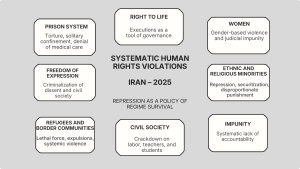
Coordinated and Structural Intensification of Human Rights Violations
Human rights violations in Iran throughout 2025 manifested as a set of coordinated, targeted, and accelerating measures that permeated all major aspects of individual and collective life. These developments were not fragmented reactions, but components of a deliberate policy by the clerical regime to impose social control, generate public fear, and secure the survival of its rule. The main dimensions of this coordinated intensification are outlined below:
- Executions as a tool of political intimidation and control: An unprecedented escalation in the use of the death penalty, accompanied by an expansion of secret executions, systematic reductions in transparency, and the instrumentalization of executions to instill social fear and suppress public discontent.
- Systematic violations of prisoners’ rights, particularly political and ideological prisoners: The imposition of punitive transfers, prolonged solitary confinement, torture and ill-treatment, and the deliberate denial of access to medical care, as part of an organized pressure policy pursued by the clerical regime.
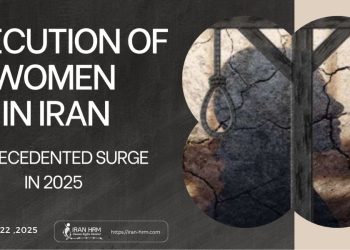
- Escalating violence against women under conditions of judicial impunity: An increase in femicide, unfair judicial treatment of women, and the continued impunity of perpetrators, operating within a framework of discriminatory laws and control-oriented state policies.
- Repression of ethnic and religious minorities: Arbitrary arrests, heavy sentences, executions, and structural discrimination, particularly in border and deprived regions, within a broader strategy of securitizing identity and imposing collective punishment.
- Intensified pressure and violence against Afghan refugees, border porters, and fuel carriers: Rising arbitrary arrests, forced expulsions, direct shootings, border killings, and deprivation of basic human rights; measures that reflect the deliberate use of overt violence to control peripheral regions, spread fear, and prevent the spillover of social protests.
- Restrictions on freedom of expression and systematic suppression of the digital space: The criminalization of peaceful expression, extensive surveillance, pressure on journalists and civil society activists, and the disruption or restriction of communications during critical periods.
- The crushing of civil society: Repression of teachers, workers’, students’, and other independent professional and social associations through arrests, judicial rulings, and sustained security and administrative pressure.
- The persistence of structural impunity for perpetrators of human rights violations: The continued absence of accountability for officials and institutions responsible for serious abuses, despite mounting international warnings and responses.
Prisons as Instruments of Repression and Maximum Pressure
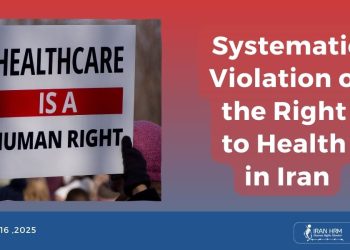
Violations of prisoners’ rights in 2025 reached a level that can be considered an integral component of the regime’s repression policy. Reports indicate intensified punitive transfers, prolonged solitary confinement, torture and ill-treatment, and the deliberate denial of medical care to prisoners; particularly political and ideological detainees. These measures, often accompanied by organized pressure on prisoners’ families, demonstrate that the clerical regime uses prisons as tools to inflict suffering, erode physical and psychological resistance, and prevent the expansion of social protests.
Escalating Violence Against Women Under Judicial Impunity
In the area of women’s rights, data from 2025 reveal a deeply alarming surge in gender-based violence, including femicide and unfair judicial treatment. Comparison with 2024 shows that not only has impunity for perpetrators not diminished, but in some cases has intensified, reinforcing a structural cycle of violence against women. These developments have unfolded within a legal and political environment shaped by discriminatory laws and the simultaneous operation of control-oriented state policies.
Heightened Pressure on Minorities Through Securitization and Harsh Punishment
Ethnic and religious minorities in 2025 continued to face disproportionate levels of arbitrary detention, severe sentencing, executions, and structural discrimination. The securitization of identity and the convergence of judicial and security policies have intensified violations of the principles of equality and non-discrimination, deepening social fractures and contributing to sustained instability in marginalized regions.
Expanding Restrictions on Expression and the Systematic Suppression of the Digital Sphere
With regard to freedom of expression and access to information, 2025 was marked by the expansion of restrictive legislation and the systematic deployment of digital surveillance tools. Measures justified by the ruling regime in Iran under broad security pretexts have, in practice, led to the criminalization of peaceful expression, the erosion of public space, and the restriction of collective action. Communication shutdowns and disruptions during critical periods had direct and wide-ranging impacts on the daily lives of citizens.
Conclusion
An assessment of the human rights situation in Iran in 2025 demonstrates that repression has moved beyond episodic responses and become a permanent instrument for governing society under the ruling regime in Iran. Within this framework, human rights violations are not exceptions, but integral elements of governance.
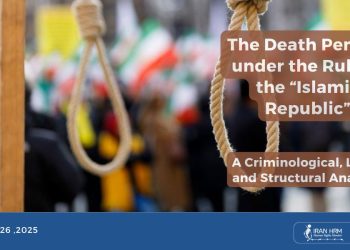
Among all these dimensions, the right to life occupies a central position. The growing and opaque use of the death penalty indicates that executions have become a core pillar of intimidation and social control. Accordingly, Section Two of this report is dedicated to a detailed examination of the death penalty; a practice that in 2025, in all its forms, assumed a distinctly political character and played a decisive role in the architecture of repression.
Subsequent sections of this report will be published in detail in the following installments.