The Right to Life and the Death Penalty in Iran – 2025
Capital Punishment as an Instrument of Survival Policy under the Clerical Regime
Analytical Introduction
In 2025, the use of the death penalty in Iran entered a new and dangerous phase; one in which execution no longer functioned as a judicial response to crime, but as a central instrument of governance aimed at preserving regime survival. An examination of execution patterns shows that the commonly used distinction between “political” and “non-political” executions is misleading. This distinction obscures the true function of capital punishment and normalizes state violence under the guise of law enforcement.

In terms of function and impact, all executions in Iran today carry a political character. Whether imposed directly under security-related charges against political prisoners or categorized under offenses such as drug-related crimes or homicide, capital punishment in each case serves the same purpose: instilling public fear, suppressing social dissent, and preventing protests and popular uprisings.
Accordingly, this section examines the death penalty not as a collection of isolated cases, but as an integrated instrument of survival policy under the clerical regime; an instrument closely linked to the judicial apparatus, structural social discrimination, and mechanisms of repression, playing a central role in controlling society and consolidating power.
As the wave of political executions intensified in 2025, judicial authorities and state-affiliated media openly defended the issuance and implementation of death sentences. On 16 July 2025, the Media Center of the Judiciary stated that “decisive and uncompromising action against those who undermine security and act against national security is a public demand,” emphasizing that severe sentences, including execution, are imposed within this policy framework. Similarly, in a report published on 29 October 2025, the state-run ISNA news agency described executions in so-called security cases as having been carried out “after the completion of all legal procedures and confirmation by the Supreme Court,” framing them as part of “lawful action against those disrupting public order and security.”
Key Indicators of Executions in Iran – 2025
1) Total Executions and Year-on-Year Comparison
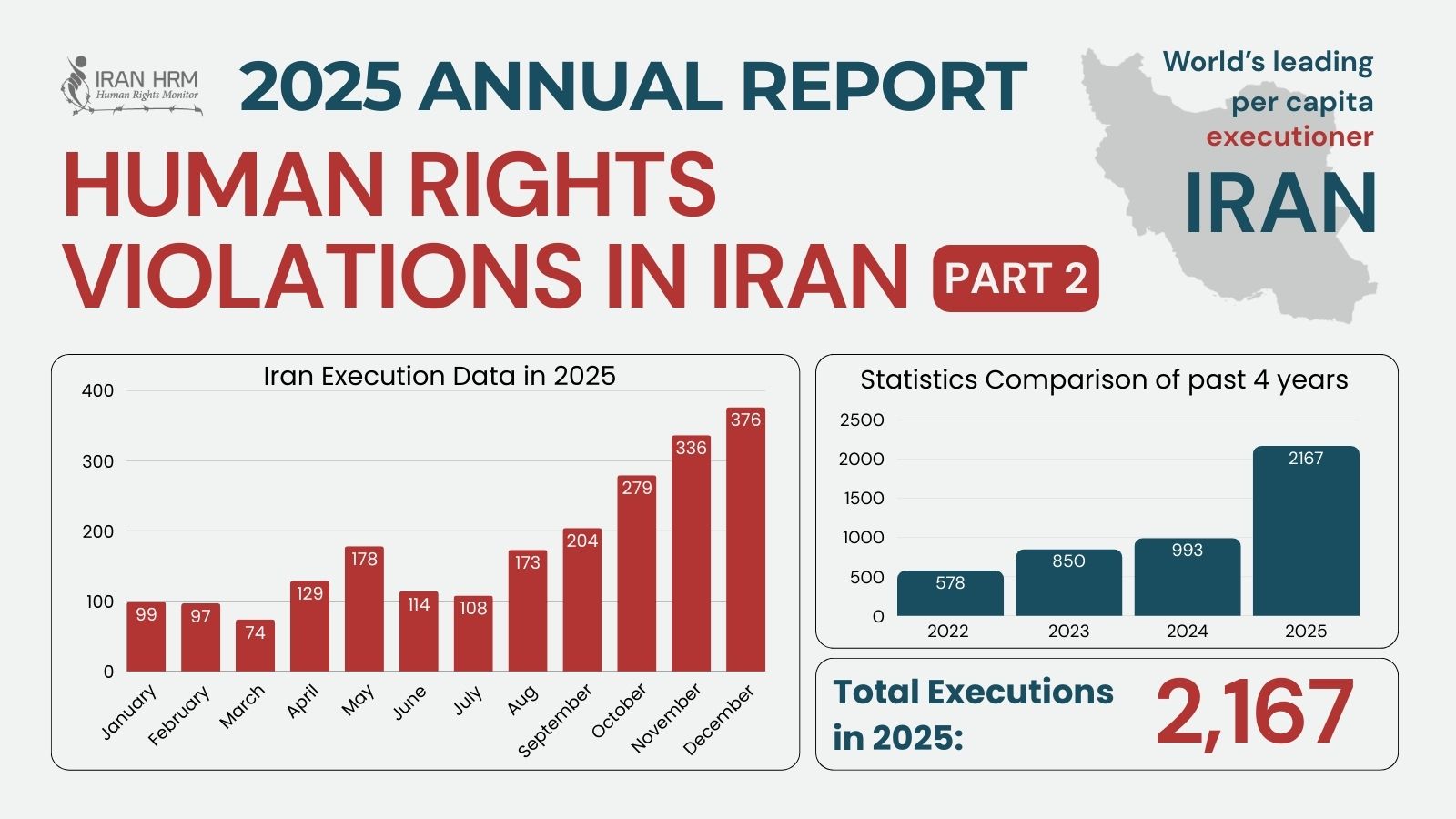
In 2025, at least 2167 people were executed in Iran. This figure represents a sharp increase compared to previous years and reflects the intensified use of capital punishment as a tool of governance during a period of deep crisis. Trend analysis over recent years indicates that 2025 recorded one of the highest levels of executions in Iran’s contemporary history.
2) Unprecedented Acceleration in the Second Half of the Year
The pace of executions accelerated markedly in the second half of 2025. The number of executions carried out during the final six months of the year more than doubled those recorded in the first half. In December 2025 alone, 376 people were executed; an average of 12 executions per day, marking an exceptional surge at the end of the year; highlighting the unprecedented surge in the final months.

3) Geographic Expansion of Executions
The geographic spread of executions across a wide range of cities and provinces in 2025 demonstrates that the death penalty has been employed not merely as a judicial sanction, but as a mechanism for instilling fear across diverse regions of the country. At the same time, documenting executions carried out in remote prisons and smaller cities remains severely constrained, suggesting that the actual number of executions may exceed recorded figures.
4) Women and Child Offenders
Among those executed in 2025 were more than 60 women, a significant increase compared to the previous year. In addition, at least six child offenders were executed during the year, constituting a clear violation of Iran’s international obligations under international human rights law, particularly in relation to the rights of the child.
5) Public Executions
In 2025, at least 13 executions were carried out in public. The use of public executions, which has increased compared to previous years, aims to generate social shock and collective fear. This method of implementation constitutes a clear form of cruel, inhuman, and degrading treatment and serves as a display of coercive state power.
6) Age Range of Victims
Those executed in 2025 ranged in age from 18 to 71 years. This broad age spectrum indicates that capital punishment has targeted a substantial segment of Iran’s socially and economically active population.
7) Political and Security Prisoners
Throughout 2025, the issuance and confirmation of death sentences against political and security prisoners increased, particularly under vague charges such as “baghi” (armed rebellion), “moharebeh” (enmity against God), and “efsad fel-arz” (corruption on earth). At the same time, a number of political prisoners were held under finalized death sentences or faced imminent execution, reflecting the direct use of capital punishment as a tool for political elimination and suppression of dissent.
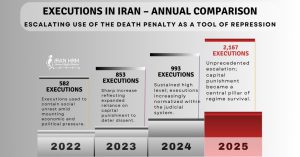
A comparison with previous years highlights the unprecedented scale of executions recorded in 2025.
As executions accelerated throughout 2025, international human rights bodies issued repeated warnings about Iran’s escalating use of the death penalty. In September 2025, the Office of the United Nations High Commissioner for Human Rights reported that UN independent experts were appalled by what they described as an “unprecedented execution spree,” stressing that the trend is incompatible with Iran’s obligations under the International Covenant on Civil and Political Rights, particularly the right to life under Article 6.
In a related intervention, the UN Human Rights Office urged Iranian authorities to halt executions and move toward abolition, warning that the continuation of capital punishment amid a rapidly rising execution rate raises grave human rights concerns.
In October 2025, the United Nations Special Rapporteur on the situation of human rights in Iran underscored that the expanding use of the death penalty has moved beyond criminal justice and has effectively become an instrument for intimidating society and suppressing social dissent; an assessment reflected in official communications released through the UN human rights system.
Within the same context, Amnesty International stated throughout 2025 that the sharp rise in executions, the secretive implementation of death sentences, and the extensive reliance on vague security-related charges indicate an escalation of structural repression and systematic violations of the right to life in Iran. Amnesty International characterized the trend as a “horrifying assault on the right to life” and called for urgent international action.
Political Prisoners Sentenced to Death or at Immediate Risk of Execution
In 2025, dozens of political prisoners in Iran were held under finalized death sentences or faced imminent execution. These sentences were predominantly issued on the basis of forced confessions extracted under torture, denial of access to independent legal counsel, and summary trials conducted behind closed doors. The individuals listed below were primarily sentenced to death on charges of baghi (armed rebellion), solely on the basis of alleged affiliation with or support for the People’s Mojahedin Organization of Iran:
Pouya Ghabadi, Mohammad Taghavi, Shahrokh Daneshvar-Kar, Vahid Bani-Amerian, Abolhassan Montazer, Zahra Shahbaz Tabari, Nima Shahi, Manoochehr Fallah, Amin Farah-Avar, Mohammad-Javad Vafa’i-Sani, Ehsan Faridi, Babak Alipour, Karim Khojasteh, Hamed Validi, Reza Abdoli, Farshad Etemadi, Masoud Jamei, and Alireza Mardasi.
Key Case: Zahra Shahbaz Tabari
Zahra Shahbaz Tabari, a 67-year-old electrical engineer and renewable energy specialist, represents one of the most emblematic cases of politically motivated death sentences against women in 2025. She was arrested in April 2025 in Rasht without a judicial warrant and, following a fundamentally unfair process, was sentenced to death on charges of baghi and alleged cooperation with the People’s Mojahedin Organization of Iran.
The evidence presented against her consisted solely of a piece of fabric bearing the slogan “Woman, Resistance, Freedom” and an unsent audio file. Her trial before the Revolutionary Court in Rasht lasted less than ten minutes and was conducted without access to an independent lawyer.
In December 2025, UN human rights experts called for an immediate halt to the execution of her death sentence, stating that the case constitutes a clear example of the denial of fair trial guarantees and the political use of capital punishment.
On 23 December 2025, more than 400 prominent women from around the world signed an open letter describing her death sentence as a symbol of the systematic repression of women in Iran. As of the end of December 2025, Zahra Shahbaz Tabari remained at immediate risk of execution in Lakan Prison, Rasht.
2. Religious and Faith-Based Executions
Alongside political executions, 2025 also witnessed the continuation and intensification of religious and faith-based executions. Sunni Muslims, particularly in predominantly Baluch regions, were disproportionately targeted by death sentences. In many of these cases, religious identity was closely intertwined with security-related charges. At the same time, judicial pressure and threats of capital punishment against Baha’is and Christian converts persisted, reflecting a broader pattern in which the clerical regime employs execution, or the threat of execution, as a tool of collective intimidation and prevention of social organization.
Sunni Prisoners – Key Case
On 8 April 2025, five prisoners were executed at Vakilabad Prison in Mashhad: Farhad Shokri, Abdulhakim Azim Gorgij, Abdulrahman Gorgij, Taj-Mohammad Khormali, and Malek-Ali Fadaei-Nasab. Four of those executed were Sunni Muslims. They were charged with baghi, following proceedings marked by serious violations of fair trial standards, including the use of torture to obtain forced confessions. These executions form part of a pattern of targeted religious repression against Sunni communities.
3. So-Called “Non-Political” Executions; The Political Function of Capital Punishment
The clerical regime has sought to depoliticize a large proportion of executions by labeling them as “ordinary crimes.” However, a structural examination of these cases demonstrates that such a distinction lacks any human rights basis. Structural poverty, regional discrimination, the absence of fair trial guarantees, and the instrumental use of capital punishment to control marginalized social groups reveal that even executions categorized as “non-political” are political in function at their core.
4. Secret Executions and the Additional Suffering of Families
A significant number of executions carried out in 2025 were conducted secretly and without prior notification to families. In numerous cases, the bodies of those executed were not returned, burial locations were withheld, or families were prohibited from holding mourning ceremonies. These practices, combined with the summoning and intimidation of relatives, deliberately transfer suffering from the executed individual to their families and the broader community and constitute a clear form of cruel, inhuman, and degrading treatment.
5. The Social Function of Executions
In 2025, executions served a role far beyond punishment and became part of the governing language of the clerical regime. The primary functions of this policy included:
- Instilling public fear and social shock
- Pre-emptively preventing protests and popular uprisings
- Consolidating a survival strategy through overt state violence
Within this framework, execution delivers a clear message to society: the cost of dissent is life itself.
6. Resistance to the Execution Machine
In response to the accelerating wave of executions, 2025 witnessed the emergence of one of the most extensive forms of resistance within Iran’s prison system. The campaign known as “Tuesdays Against Executions,” which continued through its 101st week, became the most visible manifestation of organized opposition to the death penalty through coordinated hunger strikes by prisoners in dozens of facilities. The campaign, active in more than 55 prisons, reflects the growing breadth of opposition to executions among diverse groups of detainees.
Within this context, the large-scale strike involving more than 1,500 prisoners in Ward 2 of Qezel Hesar Prison marked a turning point in the history of prison-based protests. Despite severe threats, the cutting of water and food, transfers to solitary confinement, and the presence of anti-riot forces, the strike persisted and compelled the clerical regime to temporarily retreat and suspend the implementation of some execution orders. The return of several death-row prisoners from solitary confinement and promises of a temporary halt to executions demonstrated that collective resistance can raise the political cost of enforcing capital punishment.
These developments indicate that even under conditions of maximum repression, organized protest and collective solidarity among prisoners can disrupt the machinery of execution; a reality that became clearly visible for the first time in 2025.
Conclusion and Link to Part Three
The year 2025 demonstrated that capital punishment in Iran functions not as an instrument of justice, but as a central pillar of the clerical regime’s survival strategy; a strategy that operates in direct conjunction with imprisonment, torture, and structural repression. The following section of this report examines this linkage in detail within Iran’s prison system and the deliberate denial of fundamental rights.
Further installments of this report, examining additional dimensions of human rights violations in Iran in 2025, will be published in subsequent issues.