Systematic Escalation of Violations Against Prisoners’ Rights
Prison as a Site of Repression
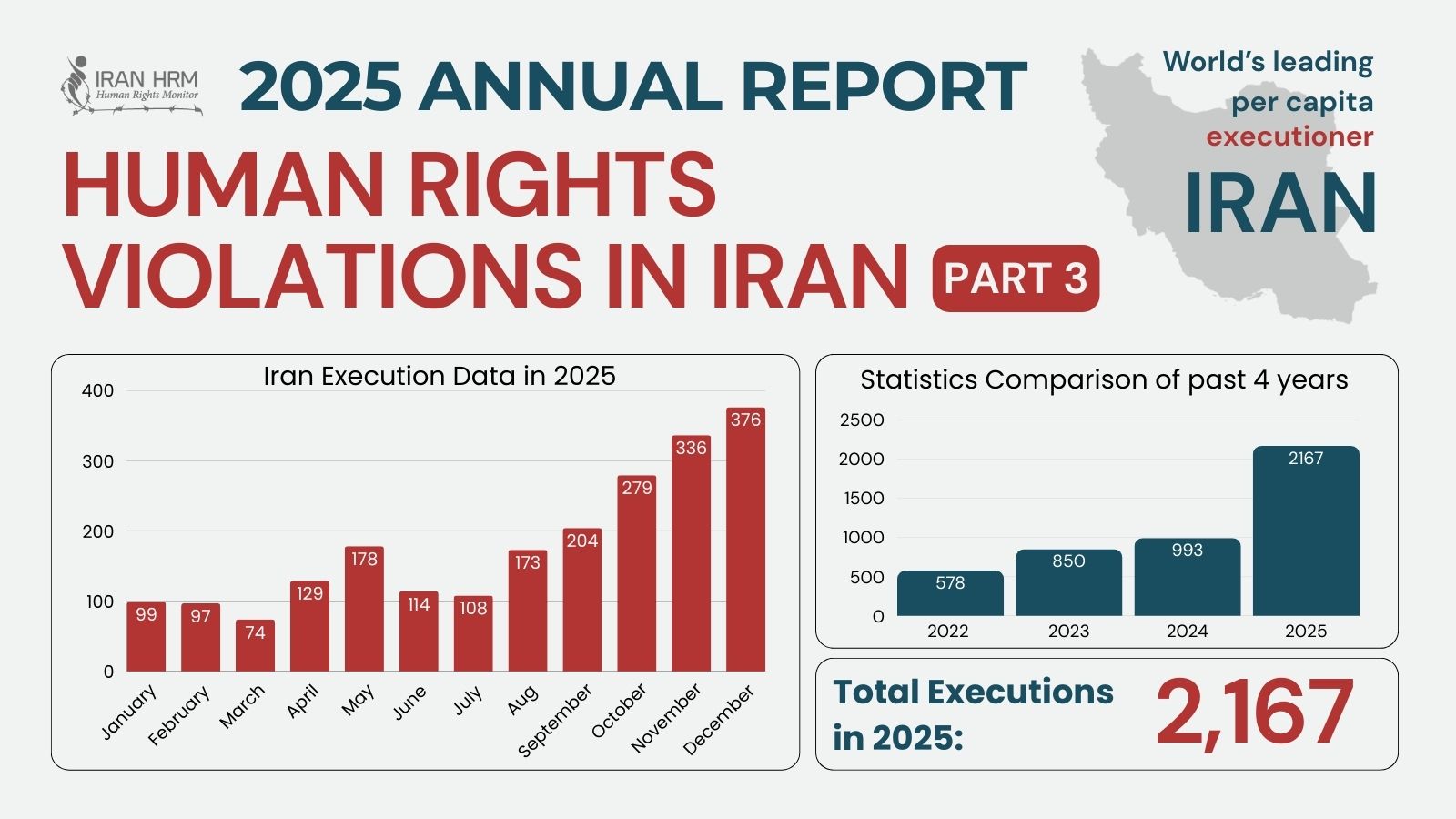
Section Two of this report demonstrated that in 2025, the shocking rise in the implementation of death sentences became one of the main instruments of intimidation and social control in Iran. However, the policy of physically eliminating dissent does not begin at the moment of execution. It begins inside prisons; where, long before death, human dignity is systematically eroded.

In 2025, prisons in Iran were not merely places for holding convicted individuals or carrying out sentences. They became spaces for the exercise of pressure, punishment, and security control. Prison administration, through tools such as punitive transfers, prolonged isolation, deliberate denial of medical care, forced labor, and pressure on families, became an integral part of the broader apparatus of repression.
From this perspective, the first manifestation of this policy inside prisons appears not in the death sentence itself, but in the manner in which prisoners are transferred and held. For this reason, an examination of punitive transfers constitutes the starting point of this section.
Punitive Transfers and Internal Exile
Escalation of Punishment Outside Judicial Frameworks
In 2025, the sudden and punitive transfer of political and ideological prisoners to prisons, wards, or detention facilities that were inappropriate for their legal status became a fixed tool for intensifying repression within Iran’s prison system. These transfers were frequently carried out without prior notice, without transparent judicial orders, and with the aim of inflicting psychological shock, severing family ties, and increasing security pressure. In practice, they amounted to additional punishment imposed outside any judicial process.
The prevailing pattern of such transfers included sudden relocation without informing families, the use of violence and degrading treatment during transfers, deprivation of medication and personal belongings, placement in wards or prisons incompatible with the nature of the charges, and transfers carried out in retaliation for protests or information sharing by prisoners.
On 8 August 2025, hundreds of political prisoners were transferred from Fashafuyeh Prison to Wards 7 and 8 of Evin Prison. Reports indicate beatings, threats, degrading treatment, and the use of handcuffs and shackles during the transfer. Many prisoners sustained bruises and injuries. One day earlier, on 7 August, groups of financial prisoners, followed on 8 August by large numbers of political and security prisoners, were transferred from Fashafuyeh to Evin without prior notice to their families and without being allowed to collect personal belongings. This action provoked widespread concern among families and human rights bodies.
Following the bombing of the administrative compound and main entrance of Evin Prison on 26 June 2025, dozens of women political prisoners were abruptly transferred to Qarchak Prison in Varamin. The transfer was carried out without warning and under fully securitized conditions. Reports indicate that some women were injured during the explosion, yet were denied immediate medical assistance. Many prisoners, including those with chronic illnesses, were unable to collect essential medications and were subsequently deprived of access to life-saving treatment.
According to a statement by UN Special Procedures mandate holders on 23 June 2025, the forced and violent transfer of prisoners, the use of restraints, threats, and the severing of contact with families constitute inhuman and degrading treatment.
On 18 June 2025, Alireza Younesi was violently and suddenly transferred from Ward 4 of Evin Prison to an undisclosed location. The transfer was carried out with the direct knowledge of the prison director, and the prisoner was beaten during the process. On 30 September 2025, Mehdi Vafaei Sani, a political prisoner in Ward 7 of Evin Prison, was also transferred to an unknown location following a protest, without prior notice.
On 14 October 2025, Hamid Haj-Jafar Kashani was transferred, after one month in solitary confinement, to a ward housing prisoners convicted of violent crimes in Qezel Hesar Prison in Karaj. This transfer constituted a clear violation of the principle of separation of offenses. His family reported repeated threats and serious concerns regarding his safety. On 26 November 2025, Armin Khodayari (Ehsan), a 20-year-old political prisoner from Zanjan, was transferred to Detention Facility No. 2 in Rasht, where individuals accused of drug-related crimes are held.
“White Torture”
Solitary Confinement, Uncertainty, and Psychological Erosion
“White torture” is among the most destructive forms of abuse inflicted on prisoners in Iran. Through prolonged isolation, deprivation of human contact, sensory deprivation, threats, and deliberate uncertainty, this practice targets the psychological integrity of prisoners without leaving visible physical marks. Solitary confinement in Iranian prisons, particularly in security wards, is not an exceptional measure; it is a systematic tool for control and psychological attrition.
In security wards of Evin, Rajaee Shahr, Kerman, and detention centers affiliated with security agencies, prisoners are held in windowless cells, under constant lighting or complete darkness, and in total silence. In many cases, access to books, paper, newspapers, mirrors, or even brief interaction with others is denied.
Documented testimonies indicate that prolonged solitary confinement, imposed without clear charges, without access to legal counsel, and without family contact, leads to gradual psychological deterioration. Threats against family members, the arrest of spouses or children, and threats of sexual violence or slow death in detention have formed part of the psychological pressure applied.
Reported consequences include memory and concentration disorders, chronic anxiety, severe depression, auditory and visual hallucinations, and in some cases complete psychological collapse. Women political prisoners have been among the most vulnerable victims of these practices. Prolonged isolation, lack of social support, and deliberate uncertainty have left lasting impacts on their personal and social lives.
In the report of the UN Special Rapporteur on the situation of human rights in Iran (A/80/349), the prolonged use of solitary confinement, deliberate uncertainty, denial of family contact, and reliance on forced confessions are described as elements of a structural pattern of violations against prisoners’ rights.
Deliberate Denial of Medical Care
A Policy of Attrition and Preventable Deaths
In 2025, the denial of access to medical care for political and ideological prisoners became one of the most structural forms of torture within Iran’s prison system. This deprivation was not the result of resource shortages. It stemmed from deliberate and security-driven decisions.
The prevailing pattern included delaying or cancelling hospital transfers despite medical diagnoses, restricting treatment to prison clinics lacking specialized facilities, cutting off essential medications, and direct interference by security agencies in medical decision-making. This pattern was observed across multiple facilities, including Evin, Qarchak, Fashafuyeh, Qezel Hesar, Lakan Prison in Rasht, and Sheiban Prison in Ahvaz.
In the June 2025 interim report of the United Nations Secretary-General, emphasis was placed on the denial of medical care to prisoners and the resulting preventable deaths.
Link: https://www.ohchr.org/en/statements-and-speeches/2025/06/deputy-high-commissioner-presents-secretary-generals-report-human
Documented cases include elderly and seriously ill prisoners such as Mohammad Banazadeh Amirkhizi, Abolhassan Montazer Moghaddam, and Ali Moazzi. Among women prisoners, individuals including Maryam Akbari Monfared, Shiva Esmaili, Marzieh Farsi, Forough Taghipour, Fatemeh Ziaei, Masoumeh Askari, and Hoda Mehrganfar have been held under life-threatening conditions without effective access to specialized medical treatment.
Preventable deaths in detention increased during the year. Since the beginning of 2025, at least 23 women have died in Qarchak Prison alone. Notable cases include the deaths of Maryam Shahraki in Fardis Prison in Karaj, Jamileh Azizi in Qarchak, and Somayeh Rashidi, who suffered from epilepsy. Cases of suicide following denial of medical care or torture were also recorded, including Omid Jahani, Ali Darabi, Payam Sattari, and Mohammad Koushki.
The official response of the ruling regime to these findings has been blanket denial. Kazem Gharibabadi, Deputy Foreign Minister for Legal Affairs, dismissed the reports of the UN Special Rapporteur on prisoners’ conditions as “political and lacking legal basis,” without addressing the documented cases.
Forced Labor and Prison Exploitation
Institutionalized Abuse
Judicial authorities have portrayed “prisoner employment” as an achievement. However, evidence indicates that what is implemented in many cases amounts to forced labor; without free consent, without fair wages, and without minimum labor protections.
Forced labor has been reported in prisons including Evin, Fashafuyeh, Mahan, Dastgerd Isfahan, Vakilabad Mashhad, Sheiban Ahvaz, Arak, and Qarchak Varamin. A substantial portion of the revenue generated by prisoner labor is allocated to prison administrations and the Prisons Cooperative Foundation, while prisoners receive minimal compensation. Available data indicate the operation of 1,675 affiliated workshops employing nearly 100,000 prisoners.
Reports describe long working hours, physically demanding labor, and extremely low wages. Women prisoners, particularly in Qarchak Varamin and Vakilabad Mashhad, have faced aggravated forms of forced labor.
Hidden Collective Punishment
Pressure on Families of Political Prisoners and Justice-Seeking Families
In 2025, pressure, intimidation, and harassment of families of political prisoners and justice-seeking families reached a structural level. These practices included summonses, arrests, threats, deprivation of basic rights, and restrictions on communication with prisoners. Their objective has been to silence demands for justice and prevent information dissemination.
Documented cases include the families of Akbari Monfared, Shiva Esmaili and Mohammad Javad Vafaei Sani, families of Kurdish political prisoners, and multiple instances of arrests and threats against justice-seeking families in Tehran, Mashhad, Sanandaj, Tabriz, and Rasht. These practices contradict the principle of individual criminal responsibility and amount to hidden forms of collective punishment.
Conclusion
The findings of this section demonstrate that in 2025, violations of prisoners’ rights in Iran were neither isolated nor incidental. Punitive transfers, prolonged solitary confinement, psychological torture, deliberate denial of medical care, forced labor, and pressure on families collectively reflect a coherent and deliberate policy aimed at controlling, eroding, and gradually eliminating dissent.
Within this framework, prisons have functioned not merely as sites of detention or sentence enforcement, but as key instruments for the exercise of structural violence. Punishment has frequently extended beyond judicial rulings, with consequences reaching families and the broader social environment.
An examination of this pattern shows that state violence has not remained confined within prison walls but has been reproduced across wider spheres of society. Understanding this continuity between what occurs inside prisons and what unfolds in the public sphere provides the necessary context for the next section of this report, which examines violence against women and systemic discrimination in Iran in 2025.