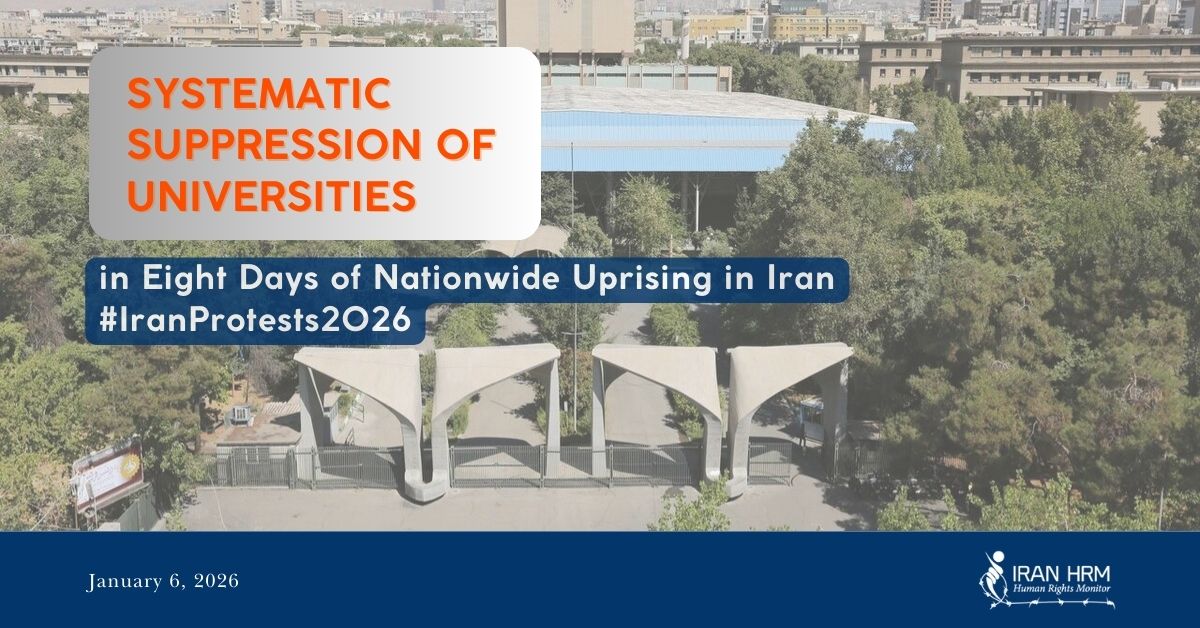
Key Developments in Universities
According to field reports from Simay-e-Azadi TV (Days 1 to 4 of the uprising): In the early days, student protests began at major universities in Tehran. Students at the University of Tehran, Sharif University of Technology, and Polytechnic (Amirkabir) held gatherings on campus to declare their support for the popular uprising. In response, the regime deployed security forces and plainclothes agents, attempting to prevent students from leaving and joining street protests through physical assault. During this period, targeted arrests of student activists began at their private residences.

According to statements published on Student Councils’ channels (January 1st to 2nd): On the night of January 1st, one of the regime’s most brutal actions took place. Security forces raided the female dormitory of Beheshti (Melli) University. In this attack, plainclothes agents broke down doors and created an atmosphere of terror, detaining several female students. Simultaneously, at the University of Tehran, security forces violated the university’s sanctity by using ambulances to transport troops and detainees.
According to analytical reports from the Amirkabir Newsletter and student organizations (January 2nd to 3rd): As the uprising spread to other cities, universities in Isfahan, Tabriz, Shiraz, and Mashhad also joined the protests. On January 3rd, the regime activated the “mass suspension” mechanism. According to reports by the Amirkabir Newsletter, hundreds of students nationwide received “entry ban” and disciplinary suspension SMS messages. Additionally, following protest gatherings at the University of Mazandaran, the Amirkabir Newsletter reported the arrest of students such as Parsa Loghmani. During these days, universities effectively entered a state of militarization; per this source, checkpoints were established at the entrances of major universities to search students’ personal belongings and mobile phones to prevent the entry of any protest symbols.
According to human rights reports (Summary until the end of January 3rd): By the end of the seventh day of the uprising, the suppression pattern shifted from “clashes at the protest site” to “nighttime abductions from dormitories” and “systematic suspensions”. The regime’s primary goal in shifting classes to “remote learning” at universities like Allameh and Beheshti (starting January 2nd) was to dismantle nighttime dormitory gatherings and return students to their hometowns to prevent the formation of “Resistance Units” in the capital.
Based on monitoring reports from “Amirkabir Newsletter,” “National Student Councils,” and field reports from “Simay-e-Azadi TV” until the end of January 3rd, the list of several detained students whose identities have been confirmed is as follows. It should be noted that due to the security environment and nighttime raids on dormitories, the actual figures are much higher than these names:
| Name and Surname | University / Field of Study | Date of Detention | Description |
| Abolfazl Morovati | MSc Computer Engineering – Sharif University | Jan 3, 2026 | Detained with severe beating in front of the university gate |
| Sarireh Karimi | Law – University of Tehran | Jan 2, 2026 | Former Secretary of the Student Council |
| Shahin Shokoohi | PhD Sociology – University of Tehran | Jan 1, 2026 | Detained by security forces at his residence |
| Parsa Loghmani | Social Sciences – Mazandaran University | Jan 3, 2026 | Following protest gatherings inside the university |
| Motahareh Gouneh-ei | Dentistry – Tehran Univ. of Medical Sciences | Jan 1, 2026 | Detained with violence |
| Amirhossein Asgari | Amirkabir University (Polytechnic) | Jan 2, 2026 | Detained by plainclothes agents |
| Zahra (Niloufar) Safarian | University of Tehran | Jan 1, 2026 | Detained during raids on student environments |
Also:
- Yasuj University: Arrests at this university relate to January 1st and 2nd. Following widespread demonstrations in Yasuj, security forces targeted student activists, detaining several at their homes or private dormitories.
- Chamran University of Ahvaz: According to the Amirkabir Newsletter, security pressure on dormitories peaked on January 3rd, and several students were detained.
- Bu-Ali Sina University of Hamadan: Following the martyrdom of “Amirhossein Bayati” in Hamadan (January 3rd), the atmosphere at Bu-Ali University became highly militarized on January 4th, and several students attempting to hold a memorial were detained.
Details of Dormitory Raids (December 31st to January 3rd):
Female Dormitory of Beheshti (Melli) University: According to student statements, on the night of December 31st, security forces raided the female dormitory. In this attack, several female students were detained30. Reports indicate that plainclothes agents used pre-prepared lists to abduct students31. The identities of some of these girls have not yet been officially released due to security threats against their families.
Dormitories of University of Tehran and Sharif: Reports from “Amirkabir Newsletter” indicate the illegal entry of university security (Harasat) along with security agents into dormitory rooms late at night to create intimidation and identify protest leaders.
Status of Detainees:
According to joint statements by student organizations, most of these students were transferred to undisclosed locations after being abducted, and their contact with families has been severed. These reports emphasize that arrests occurred without judicial warrants and, in many cases, involved brutal beatings (such as the cases of Abolfazl Morovati and Parsa Loghmani).
While the nationwide uprising entered its eighth day, universities became focal points of solidarity with strikers and protesters in besieged cities (such as Malekshahi). In response, the regime implemented the following repressive measures:
- Tarbiat Modares University (Tehran): Students held a protest with the slogan “This is the year of blood, Seyed Ali [Khamenei] will be toppled”. Security forces locked the main gates, confining students inside to prevent them from joining street protesters. According to a statement by students of this university, on January 4th, security forces “hostaged” students by chaining the gates.
- University of Tehran, Sharif, and Amirkabir: Widespread gatherings were reported with slogans such as “Death to the oppressor, be it the Shah or the Leader [Khamenei]”.
- Forced Closure: Major universities including Allameh and Beheshti declared classes “remote” under pretexts such as “energy imbalance” and “cold weather,” with the sole aim of evacuating dormitories and dismantling protest hubs. According to an official announcement by the Academic Affairs Department (which students called “Educational Martial Law”), classes were closed to disperse protest centers.
Mass and Arbitrary Detentions on January 4th:
- Elm-o-Sanat University (Tehran): Following a protest gathering on campus, security (Harasat) and plainclothes agents identified and abducted at least 3 students while they were leaving the university.
- University of Sistan and Baluchestan: Reports on January 4th indicate a tense atmosphere in the dormitories. Security forces detained several protesting students who had been identified in previous days.
- Tarbiat Modares University: As mentioned, students were “taken hostage” inside the university, and reports of scattered arrests at the campus perimeter have been received.
- Violation of Fundamental Freedoms (Legal Analysis)
The regime’s recent actions constitute a gross violation of international treaties:
- Violation of the Right to Security and Prohibition of Arbitrary Detention (UDHR Article 9): Abducting students from dormitory rooms without judicial warrants.
- Violation of Freedom of Assembly and Expression (Articles 19 and 20): Using tear gas and pellets in enclosed university environments.
- Torture and Degrading Treatment: Reports from Simay-e-Azadi indicate the beating of students during arrest (e.g., Abolfazl Morovati) and their transfer to undisclosed detention centers.
- Gender Discrimination and Targeted Violence against Women: Raiding female dormitories and using physical violence against female students is a clear violation of conventions protecting women’s rights.
- Right to Peaceful Assembly: Confining students within Tarbiat Modares University.
- Right to Personal Security: Abducting students from within or the perimeter of educational environments.
- Right to Education: Systematic suspension of students and forced “remote learning” for security purposes.
- Appeal to International Bodies
We urge all human rights organizations and international bodies to:
- Pressure the Iranian regime for the immediate and unconditional release of detained students facing torture.
- Form an international investigative committee to examine the status of secret detention centers and the condition of disappeared students.
- Condemn the regime’s actions in militarizing universities as a crime against civil society.
- Practical Recommendations
Human rights organizations and international bodies possess specific legal and executive tools beyond issuing statements to increase pressure on the regime’s suppression machine “on the ground”60. Our suggested practical solutions are listed below:
- Fact-Finding Mission with Access to Prisons: International bodies, through the UN Human Rights Council, can request the immediate dispatch of an independent mission to visit Evin, Fashafouyeh, and undisclosed detention centers (such as IRGC detention sites). The physical presence of inspectors increases the cost of torture and extrajudicial killings for the regime.
- Application of “Universal Jurisdiction”: International bodies can initiate legal cases against university presidents who permitted security forces to enter dormitories (e.g., presidents of Beheshti or Tarbiat Modares) and the commanders of the raiding units. Under this principle, these individuals can be detained and prosecuted if they travel to countries that are members of international conventions.
- Diplomatic Pressure to Revoke “Educational Martial Law”: International bodies (e.g., UNESCO) can hold the regime accountable for mass suspensions and forced remote learning. They can urge their governments to summon the regime’s ambassadors and demand the immediate release of abducted students as a condition for continuing diplomatic relations.
- Academic Boycott and Suspension of Cooperation with “Repressive” Universities: International bodies can urge universities worldwide to suspend any memoranda of understanding or scientific cooperation with universities that have placed their environment at the disposal of security forces. This action entirely strips the repressive managers of their international credibility.
- Requirement of Transparency Regarding “Enforced Disappearances”: Given the abduction of students from dormitories without warrants (such as the female students of Beheshti University), human rights organizations can request the UN Working Group on Enforced or Involuntary Disappearances (WGEID) to compel the regime to announce the location and health status of these individuals.
- Establishing a “Secure Information Corridor” for Students: International bodies can assist student organizations by providing censorship-circumvention tools and satellite internet, ensuring that the voice of university suppression reaches beyond borders without interruption and that the documentation of crimes is not halted.