Targeted Repression of Sunni Communities in Kurdish and Baluch Regions
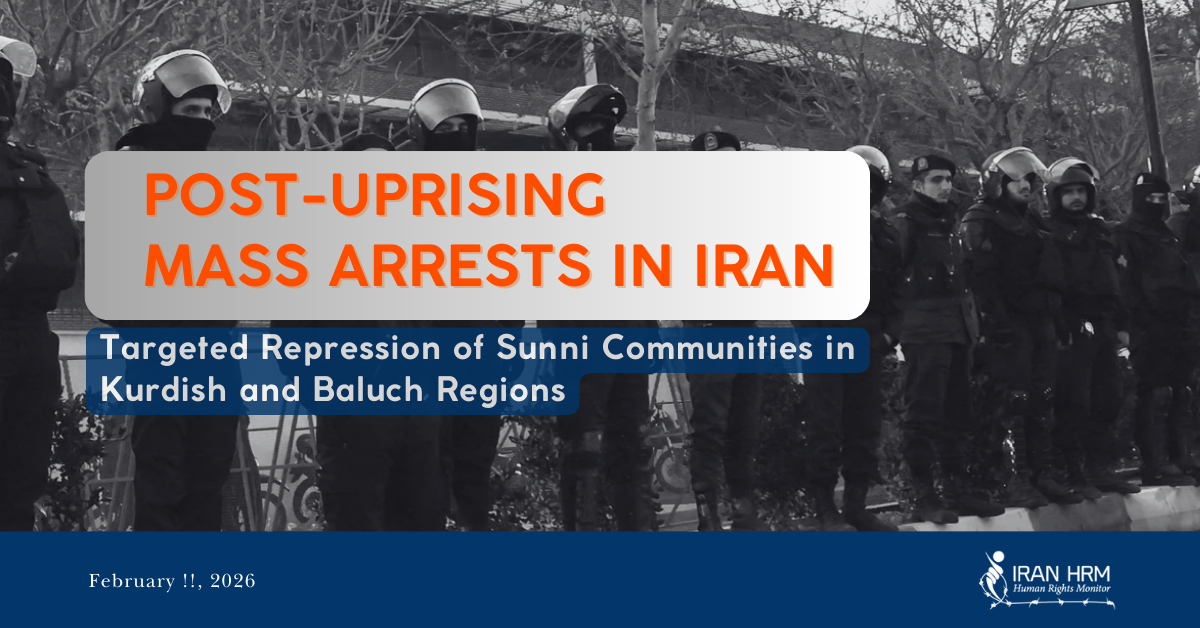
Since 10 January 2026, following the peak of nationwide protests, a wave of widespread and unprecedented arrests has unfolded across Iran. The scope of these detentions rapidly expanded beyond street protesters to encompass diverse segments of society. Students, lawyers, journalists, civil activists, clerics, teachers, physicians, nurses, local community figures, and even certain political officials have faced arrest, summons, or security-related charges.

This pattern has not been confined to a specific province or social class. It has been nationwide, multilayered, and unpredictable. Geographic location, social status, or political orientation have not functioned as safeguards against detention.
Available estimates place the number of detainees at up to approximately 50,000 individuals. Amnesty International has characterized these arrests as widespread and arbitrary, expressing concern over violations of fair trial guarantees, denial of access to chosen legal counsel, and reports of ill-treatment and coerced confessions. The organization has stated that such practices are inconsistent with Iran’s international obligations concerning freedom of expression, peaceful assembly, and the right to a fair trial.
While the crackdown has been national in scope, evidence indicates that religious minorities, particularly Sunni communities in Kurdish and Baluch regions, have faced more concentrated and targeted pressure. This report focuses specifically about Sunni communities within the broader post-uprising arrest campaign and analyzes the structural patterns underlying this repression.
Targeted Pressure on Sunni Communities
Analytical reports indicate that Sunni minorities, especially Kurds and Baluch communities, have been disproportionately affected due to their visible participation in protests and longstanding criticism of systemic discrimination.
In border and ethnically diverse regions, repression operates within a heightened security framework. These areas are often perceived by authorities as sensitive or potentially unstable. As a result, the targeting of religious and social leaders functions as a preventive mechanism aimed at limiting community mobilization and weakening independent local networks.
This dynamic transforms arrests from isolated judicial actions into instruments of broader social control.
Structural Pattern of Post-Uprising Repression
Documentation since 10 January 2026 reveals a consistent operational pattern:
- Nationwide and Cross-Class Scope
Detentions have affected both central urban areas and peripheral provinces. The broad social spectrum targeted indicates an effort to generate general deterrence rather than neutralize a specific group.
- Targeting of Influential Social Networks
In Sunni-majority regions, clerics and religious educators have been particularly targeted. These figures often serve as moral authorities and community intermediaries. Their detention weakens trust networks and reduces collective capacity for civic engagement.
- Recurrent Operational Methods
Multiple documented cases share similar features:
• Night-time raids on private homes;
• Absence of transparent judicial warrants or clear charges;
• Transfer to undisclosed locations;
• Limited or no information provided to families;
• Confiscation of communication devices and personal materials.
The repetition of these elements indicates coordinated implementation rather than isolated incidents.
- Prolonged Judicial Uncertainty
Many detainees remain in legal limbo without formal charges or effective access to counsel. This uncertainty places psychological pressure on both detainees and their families and reinforces a climate of intimidation.
- Social Deterrence Function
The combination of widespread scope, targeting of respected figures, and enforced uncertainty suggests that arrests serve not only judicial purposes but also a preventive social function. The objective appears to be the reduction of civic participation and the discouragement of renewed protest activity.
This pattern is particularly visible in Sunni-populated regions.
Focus on Kurdistan: Pressure on Local Religious Leadership
The city of Bukan became a focal point during the January 2026 protests. Shortly thereafter, multiple Sunni clerics in Bukan, Sanandaj, Baneh, Sardasht, and Urmia were arrested or subjected to legal pressure.
Documented cases include:
• Mamosta Abdulrahman Hosseinpour, Bukan;
• Mamosta Loghman Amini, Sanandaj;
• Mamosta Mohammad Khazrnajad, Bukan;
• Mamosta Seyed Mohammad Mousavian, Bukan;
• Mamosta Molla Hossein Hadithi, Bukan;
• Mamosta Mohammad Mahmoudzadeh, Baneh;
• Mamosta Molla Saeed Rahmani, Sardasht;
• Mohammad Salehi, Urmia.
The temporal proximity and geographic concentration of these cases indicate coordinated targeting of clerics who had publicly criticized violence against protesters.
Case Study: Mamosta Abdulrahman Hosseinpour
In mid-January 2026, security forces conducted a night-time raid on the home of Mamosta Abdulrahman Hosseinpour, a Sunni religious educator in Bukan. He was arrested and transferred to an undisclosed location. Authorities reportedly searched his residence and confiscated communication devices without providing clear charges.
At the time of writing, no official information has been released regarding the legal basis for his detention or his place of custody. His family has not been granted meaningful access to information or legal representation.
This case reflects core elements of the broader pattern: night-time arrest, lack of transparency, denial of family information, and potential arbitrary detention.
In Sunni-majority regions, clerics serve not only religious roles but also important social and mediating functions. The detention of such individuals therefore carries broader implications, signaling control and deterrence to the surrounding community.
From a human rights perspective, continued denial of information raises concerns regarding arbitrary detention, due process violations, and possible short-term enforced disappearance under international standards.
Similar Pattern in Baluchistan
In Sistan and Baluchistan province, reports indicate comparable patterns of arrest affecting Sunni clerics in cities such as Zahedan, Chabahar, and Khash. Operational similarities include night raids, sudden summons, undisclosed transfers, and restricted family contact.
Friday prayer gatherings in this region have historically served as spaces for social expression. Targeting religious leaders in this context suggests a preventive strategy aimed at limiting collective mobilization.
The parallels between Kurdish and Baluch regions reinforce the assessment of a coordinated structural approach.
International Legal Obligations
Iran is a party to the International Covenant on Civil and Political Rights. Under this treaty, arbitrary detention is prohibited, detainees must be promptly informed of charges, and access to legal counsel and fair trial guarantees must be ensured.
The documented pattern raises serious concerns regarding:
• Arbitrary detention on a mass scale;
• Violations of fair trial rights;
• Risk of ill-treatment or coercion;
• Potential discriminatory targeting of religious minorities.
Requests for the Fact-Finding Mission
In light of the documented pattern of arrests and targeted pressure on Sunni clerics, the Fact-Finding Mission is respectfully requested to:
- Examine post-uprising arrest patterns in minority-populated provinces as a potential structural policy;
- Assess documented cases of Sunni clerics, including Mamosta Abdulrahman Hosseinpour, within the framework of arbitrary detention and short-term enforced disappearance.
- Independently verify detainees’ access to legal counsel, family notification, and detention conditions.
- Evaluate whether the concentration of arrests in Sunni communities constitutes discriminatory practice inconsistent with international obligations