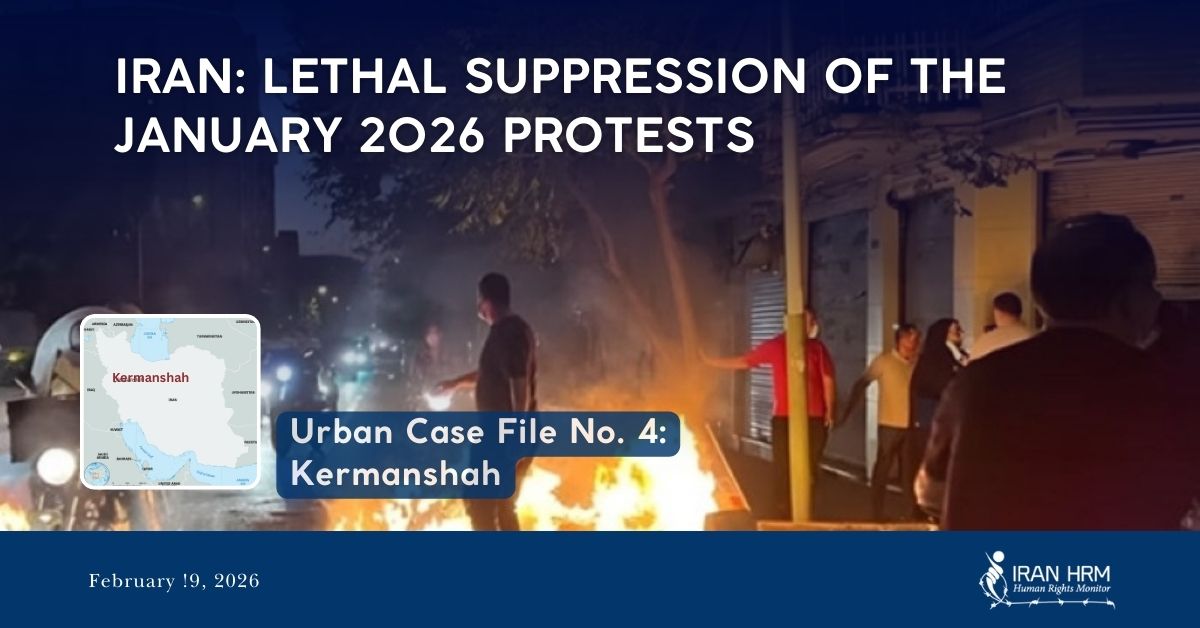
City Case File No. 4; Direct Gunfire, 48-Hour Killings, and Post-Uprising Security Crackdown
Concentration of Killings Within a 48-Hour Period
In Kermanshah province, the highest number of confirmed fatalities occurred within two days: 8 and 9 January 2026, corresponding to 18 and 19 Dey 1404. Within less than 48 hours, simultaneous reports of direct gunfire emerged from multiple neighborhoods across the city.

Shahrak-e Moallem, Dareh Derazh, Sabouni, Taq-e Bostan Boulevard, Dowlatabad, Jafarabad, and Elahiyeh were among the areas where live ammunition was reportedly fired at protesters.
The concentration of deaths within such a short time frame and across multiple locations indicates coordinated and simultaneous use of lethal force at the city level, rather than an isolated or sporadic confrontation.
One witness stated:
“Shots were fired from close range. This was not intended to disperse people.”
Pattern of Shots to the Upper Body; Lethal Use of Force
Available information concerning the manner of death of several victims indicates gunshot wounds to the head, chest, and abdomen.
Among the deceased were a child, 17-year-old teenagers, women, a medical worker, a teacher, an athlete, and a university student. This composition suggests that lethal force was used without distinction between armed individuals and unarmed civilians.
A witness reported:
“No one had weapons. The bullets were hitting people’s bodies directly.”
In some cases, victims were reportedly passing through the area or engaged in daily activities at the time they were shot. If independently verified, such circumstances may indicate disproportionate use of force.
Official Narrative; “Decisive Confrontation with Rioters”
In the days following the protests, security and judicial authorities in Kermanshah province announced a “decisive confrontation with elements of unrest” and the arrest of “field leaders.”
The provincial prosecutor stated that detainees would be dealt with “without leniency,” and the provincial intelligence office reported the identification and arrest of principal actors in the disturbances.
However, no provincial authority publicly disclosed the number of fatalities, the causes of death, or details regarding the use of live ammunition.
While the official narrative emphasized confrontation with “rioters,” the list of confirmed victims includes unarmed civilians, teenagers, and individuals engaged in ordinary activities.
Use of Firearms Prior to the Peak of Protests
Documented cases from 3 and 4 January 2026, corresponding to 13 and 14 Dey 1404, in Jafarabad neighborhood indicate that live ammunition had already been used prior to the peak of protests on 8 and 9 January.
Two 17-year-old teenagers were killed on 13 Dey, and another young man died the following day in hospital after being wounded.
These incidents suggest that lethal force was not merely a spontaneous reaction to escalating clashes.
- Internet Shutdown; Restricting the Flow of Evidence
At the height of the shootings, reports emerged of severe internet disruption or shutdown in Kermanshah province. This limits the transmission of images and documentation related to the events.
One witness stated:
“When the internet was cut, no one could publish anything anymore.”
The timing of communication restrictions coinciding with widespread shootings has raised concerns regarding the concealment of evidence.
- Second Phase of Suppression; From Streets to Homes
After street gatherings subsided, widespread arrests were reported across the province. Accounts describe nighttime raids, arbitrary detentions, and transfers to undisclosed locations.
This shift in pattern suggests a transition from public crowd control to a broader security operation extending into private spaces.
A local source stated:
“After two days of shootings, they started taking people from their homes at night.”
- Pressure on Families and Control of Public Narrative
Some families of the deceased reported restrictions on mourning ceremonies and pressure to remain silent regarding the circumstances of death.
One source stated:
“They told us not to speak about how he was killed.”
Such patterns may indicate efforts to control public narratives and prevent dissemination of details.
Legal Assessment; Possible Qualification Under Crimes Against Humanity Framework
Under international criminal law, particularly Article 7 of the Rome Statute of the International Criminal Court, crimes against humanity include acts such as murder, enforced disappearance, imprisonment, torture, or other inhumane acts when committed as part of a widespread or systematic attack directed against a civilian population, with knowledge of the attack.
In the case of Kermanshah province, the following elements merit consideration:
- Attack Directed Against a Civilian Population
The list of victims includes a child, teenagers, women, a medical worker, a teacher, an athlete, and unarmed civilians. No publicly available evidence has been presented indicating that these individuals were armed at the time of death.
- Widespread Nature and Temporal Concentration
The concentration of fatalities within less than 48 hours and across multiple urban locations indicates simultaneous and coordinated use of lethal force; exceeding the characteristics of an isolated incident.
- Systematic Pattern
Following the shootings of 8 and 9 January, widespread arrests and nighttime raids were reported. This transition from street-level violence to organized detentions may reflect a coordinated pattern of repression.
- Official Acknowledgment of Security Operations
Provincial authorities publicly referred to “decisive confrontation” and arrests of protest leaders. While details regarding lethal force were not disclosed, acknowledgment of extensive security operations during the same timeframe strengthens the element of awareness.
- Pressure on Families and Communication Restrictions
Reports of intimidation of families and simultaneous internet shutdowns may be relevant in assessing attempts to control consequences of a broader operation.
Legal Conclusion
Taken together, the documented elements; multiple killings within a short timeframe, use of live ammunition against unarmed civilians, organized post-protest arrests, and pressure on families; may warrant examination under the framework of a widespread or systematic attack against a civilian population.
A definitive legal qualification requires:
- Full access to forensic and medical records
• Examination of operational orders and chain of command
• Secure interviews with witnesses and detainees
• Comparative assessment of similar patterns in other provinces
Request to the Fact-Finding Mission
Given the potential alignment of these elements with international criminal law standards, it is essential that:
- The role and responsibility of provincial authorities and operational units in authorizing and executing live fire be examined;
• The chain of command and levels of awareness among senior officials be clarified;
• Cases of enforced disappearance and arbitrary detention be documented;
• Immediate preservation and collection of evidence be ensured.
Annex
Confirmed Fatalities in Kermanshah Province (as of 14 February 2026)
The complete list of identified and confirmed fatalities in the city of Kermanshah and its affiliated counties, as of 14 February 2026 (25 Bahman 1404), is provided below.
Kermanshah City (49 individuals)
- Gholamhossein Ahadi
- Seyed Arman Mousavi
- Iraj Feyzi
- Sina Rasoulizadeh
- Shahla Kakayi
- Hamidreza Yousefi
- Abolfazl Qal’ehgari
- Omid Shojaeian
- Farhad Cheraghi-Zad
- Nazanin Salehi
- Mahan Rostami
- Hassan Nouri
- Mohammadamin Salami
- Arshan Ghasemi
- Amirali Abbasi-Far
- Azad Elahi
- Reza Rasaei
- Soheil Khazaei
- Sina Maleki
- Abdolreza Azizi
- Ali Taheri
- Mohsen Rezaei
- Masoud Rezaei
- Mehran Haji Aliani
- Meysam Razmi
- Milad Feyzi Namivandi
- Mojarad Rashidi
- Melika Dastyab (Shahmoradi)
- Elham Zeinali
- Tayebeh Rezaei
- Saman Nazari
- Saman Fattahi
- Sajjad Feyzi
- Erfan Jameh Shourani
- Navid Salehi
- Bayat Sobhani
- Yasin Mirzaei Qal’eh Zanjiri
- Keyvan Rezaei
- Kamran Akbari
- Amirmohammad Arbapouri
- Tiam (Mohammadreza) Kiani-Manesh
- Ebrahim Yousefi
- Farhad Balash Zar
- Mohammadmehdi Badri
- Hassan Fallahi
- Mohammad Jafari
- Reza Qanbari
- Rasoul Kadiourian
- Reza Kadiourian
Eslamabad-e Gharb (6 individuals)
- Dr. Sajjad Kiani
- Reza Darvishi
- Masoud Sahami
- Milad Farrokhi
- Navid Mirzaei
- Jaber Abdi
Harsin (1 individual)
- Ali Azizi Jafarabadi
Total Confirmed Fatalities in Kermanshah Province: 56
Residents of Kermanshah Province Killed in Other Cities
- Robina Aminian – from Nowsheh (Paveh, Kermanshah Province); killed in Tehran.
- Hassan Ali Norouzi Samaleh – from Kermanshah; killed in Mashhad.