Universities in a Security Deadlock
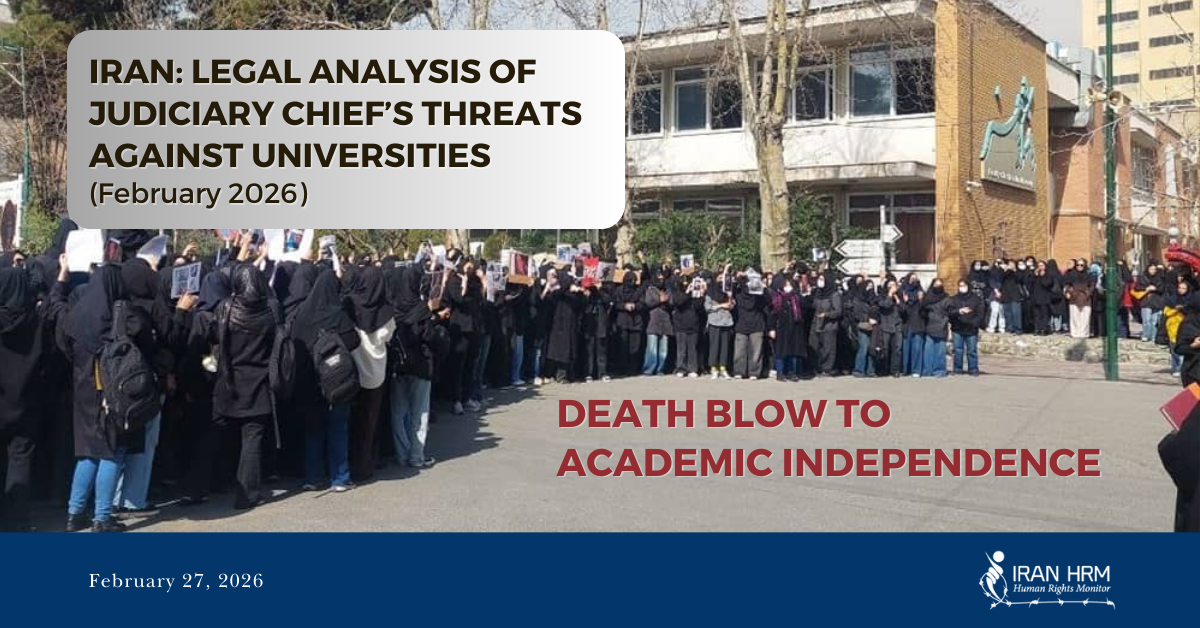
With the escalation of student protests in late 2025 and early 2026, especially in recent days after the nationwide protests of January 2026, the Judiciary of the Islamic Republic of Iran, has adopted an aggressive stance to conquer the last bastions of academic independence. The recent remarks by the Chief of the Judiciary transcend mere rhetoric; they serve as a roadmap for the “securitization” of educational environments and the transformation of universities into an arm for security agencies.

Evidence of the Incident: The Alborz Speech
According to the ILNA News Agency on February 25, 2026 (Esfand 6, 1404), Gholam-Hossein Mohseni-Ejei, the Chief of the Judiciary, took an unprecedented stance against the university institution during his provincial visit to Alborz on February 23 (Esfand 4). Acknowledging the pressure exerted on executive officials, he stated:
“For a long time, we have emphasized to the relevant ministers… that if you can control the issues within the university yourselves, organize and investigate them so it does not reach the Judiciary and no crime occurs, that would be very good… The Minister of Science said we will certainly activate the disciplinary committees… This morning, I emphasized again that based on what you said, some of these individuals (protesting students) have committed crimes; this cannot be overlooked. I told them to ‘identify and introduce’ (report) them. If you do not, we will be forced to take action for identification ourselves. Naturally, the cost will be higher.”
Legal Critique and Violation of International Standards
The Chief Justice’s remarks directly violate several fundamental principles of international law and academic freedoms:
- Violation of Institutional Autonomy: According to the Lima Declaration (1988) and the UNESCO Recommendation (1997), higher education institutions must be immune from state and judicial interference. Ejei’s directive to “identify and introduce” students destroys the administrative and ethical independence of the university, turning it into an “informant” entity.
- Transforming Universities into Judicial Enforcers: Disciplinary committees are, by definition, administrative-educational bodies. Converting these committees into a mechanism for “identifying criminals” for the Judiciary is a flagrant violation of the Separation of Powers and an abuse of educational structures for policing purposes.
- Threat of Violent Arrests: The phrase “the cost will be higher” in Iranian judicial jargon signifies a departure from administrative procedures and the employment of violent arrest tactics by operational forces within university campuses or student residences, targeting the physical and psychological safety of the academic community.
The Repression Puzzle: Systematic Collaboration Between the Judiciary and the Government
A comparison of Mohseni-Ejei’s threats with recent changes in the “Student Disciplinary Regulations” reveals a systematic collaboration to stifle the university environment:
| Tool of Repression | Mechanism in Disciplinary Regulations (Gov) | Alignment with Ejei’s Directive (Judiciary) |
| Identification & Reporting | Criminalizing online activities and relying on security reports. | Explicit order to ministers to “introduce” (report) protesting students. |
| Pre-emptive Suspension | Allowing student suspension prior to a court verdict. | Pressuring the university to “remove” the student before judicial intervention. |
| Enforcement Intervention | Facilitating the entry of intelligence agencies into disciplinary cases. | Threat of “direct identification action” in case of non-cooperation by the university. |
Violation of International Covenants (ICCPR & ICESCR)
This approach by the Chief of the Judiciary constitutes a clear violation of Iran’s international obligations:
- Article 13 of the ICESCR: Which emphasizes the right to education in a free and independent environment.
- Article 19 of the ICCPR: Criminalizing student gatherings and protests, and threatening them with arrest, is a direct violation of the right to Freedom of Expression and Opinion.
Conclusion: Universities Under Judicial Guardianship
The remarks of Mohseni-Ejei on February 23, 2026, dealt a death blow to the fragile independence of Iranian universities. This approach proves that the Judiciary is not seeking justice, but rather the total securitization of the academic sphere. The threat of “increased costs” for universities that do not cooperate in repressing their own students is a serious warning sign of imminent widespread arrests and violent crackdown.
Demands from the International Community and Human Rights Organizations
Given the explicit threats which signify a systematic crackdown on academic freedom, we call upon the UN Special Rapporteur on Human Rights in Iran (Ms. Mai Sato), UNESCO, and all international bodies to take the following urgent actions:
- Official Condemnation of Judicial Interference: Issue an immediate statement condemning Mohseni-Ejei’s remarks and reminding Iran of its obligations under the Lima Declaration and the 1997 UNESCO Recommendation.
- Warning Against Arbitrary Detentions: Call on Iranian authorities to halt any “identification” and arrest of students for peaceful activities, citing Articles 9 and 19 of the ICCPR.
- Monitoring Disciplinary Committees: Request human rights bodies to closely monitor changes in internal university regulations that have been weaponized for “pre-emptive criminalization.”
- Supporting Academic Freedom: Urge global universities and scientific unions to respond to the transformation of Iranian universities into “security arms” and exert diplomatic pressure to ban enforcement forces from academic grounds.
Underlying Principles of These Demands:
- The Principle of Institutional Autonomy: Recognized as a fundamental prerequisite for the realization of the Right to Education (Article 13 of the ICESCR).
- The Principle of Academic Immunity: The necessity of an absolute separation between “disciplinary infractions” and “criminal offenses” to prevent politically motivated reprisals and judicial overreach within educational spaces.
- The Right to Personal Security: A prohibition on threats of “increased costs,” which constitute State Intimidation and a direct violation of the psychological and physical security of students and faculty members.
Annex: Legal Framework and Violated International Standards
- Lima Declaration on Academic Freedom (1988): Specifically Articles 7 and 19, which mandate the autonomy of higher education institutions from state interference and judicial-police surveillance.
- UN ICESCR General Comment No. 13: Which stipulates that the “Right to Education” is predicated upon Institutional Autonomy and academic freedom.
- UNESCO Recommendation (1997): Emphasizing the self-governance of universities and prohibiting the use of academic environments as tools for state security and repressive policies.