
Transfer of Repression from Courtrooms to Detention Centers; Secret Facilities and the Reproduction of 1980s Confession Patterns
Amid the killing of protesters during the January 2026 uprising and following the relative decline of street demonstrations, repression entered a new phase. Parallel to large-scale arrest operations, security forces and Revolutionary Guard units carried out coordinated night raids on homes, workplaces, and universities, initiating a renewed wave of violent detentions. Numerous arrests were conducted without judicial warrants, and detainees were transferred to undisclosed locations. In many instances, families remained unaware of their whereabouts for days.

Subsequent accounts indicate the transfer of detainees to unofficial and so-called “temporary” detention facilities; centers operating outside the formal registry of prisons. Within these closed environments, intensive interrogations, prolonged solitary confinement, physical and psychological pressure, and coerced confessions became integral components of the repression apparatus. These confessions were later introduced in court proceedings or broadcast through state media as evidentiary material.
Patterns reported from these facilities; including sleep deprivation, threats against family members, the use of pre-written scripts for recorded confessions, and repeated recordings until a preferred narrative was secured; structurally mirror methods used during the 1980s. In this framework, detention centers function not merely as custodial sites but as spaces where security narratives are constructed and case files are manufactured.
Methods of Arrest; Night Raids and Violent Detentions
During the protests from December 2025 to January 2026; arrests extended beyond street confrontations. In the days and weeks following demonstrations, an organized pattern of night raids targeted private homes, student dormitories, and workplaces. In numerous cases, security and plainclothes agents entered residences without presenting judicial authorization, confiscated personal belongings and mobile phones, and detained individuals in front of their families. Families often remain uninformed of detainees’ locations for extended periods.
Street arrests were accompanied by direct and, in certain cases, potentially lethal violence. One documented case concerns Sara Ebrahimi, also known as Darya Ebrahimi, born in 1980 in Nahavand. Surveillance footage shows her falling to the ground while being pursued by security forces in Naziabad, Tehran. A plainclothes agent is seen kicking her head and face. Another individual strikes the back of her head with a machete. The footage indicates that she was unarmed and defenseless.
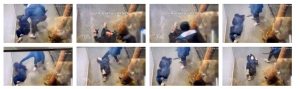
According to accounts from relatives, Sara was transferred to hospital but died due to severe hemorrhage and traumatic brain injury. Her family reported that her body was transferred without prior notice to Behesht Zahra cemetery and buried at night. They further reported pressure to remain silent and to accept an official narrative.
Regardless of the final judicial outcome, the visual evidence reflects a pattern of arrests involving severe force against defenseless individuals; indicating that the objective extended beyond crowd control to inflicting serious harm followed by detention.
Similar incidents were reported in Shiraz, Mashhad, Karaj, and Rasht, where detainees were reportedly subjected to severe beatings at the time of arrest. Violence at the moment of apprehension marked the beginning of a concealed phase. Many detainees were transferred directly to facilities operating outside transparent prison structures. At this stage, access to legal counsel, communication with family, and urgent medical care was effectively denied, while interrogations commenced under coercive conditions.
Temporary and Unofficial Detention Centers; Soroush and Other Facilities Outside Formal Oversight
Reports from multiple cities indicate that a significant proportion of detainees from the Dey 1404 protests were initially transferred to so-called “temporary” or “undisclosed” facilities: centers not listed in the official registry of prisons and lacking independent oversight.
One such facility is the “Soroush” detention center in Mashhad. Available information suggests it operates under the authority of the Law Enforcement Force and is located behind a sports warehouse without official signage. Many families were unaware of their relatives’ location during the initial days and only learned of their transfer after persistent inquiries. Testimonies describe intensive interrogations, restrictive conditions, and pressure to extract confessions.
A similarly named facility has been reported in Shiraz, located near the Criminal Investigation Department and known locally as “Ahmadi No.” Local sources identify it as a site for initial detention and interrogation of many protesters. Reports from this facility also describe physical and psychological coercion and severe restrictions on family contact.
Common characteristics of these centers include legal ambiguity regarding detainees’ status in the early days, denial of independent legal counsel, and complete isolation from families; conditions that facilitate coercive interrogation and forced confession.
Prison as an Extension of Repression; Mass Injection of Detainees into an Already Degraded System
Following the arrests from December 2025 to January 2026; tens of thousands were added to prison populations already operating beyond official capacity. This influx occurred without infrastructure expansion, resource allocation, or adherence to legal separation standards. The result was overcrowded and chaotic conditions conducive to systematic human rights violations.
Rooms designed for 20 to 30 individuals reportedly housed over 100. In the women’s ward of Adelabad Prison in Shiraz, more than 150 individuals were confined in a space designed for 30. Reports describe difficulty breathing, overcrowded sleeping arrangements, and detainees sleeping on the floor. The principle of separation of offenses was not observed; protest detainees were held alongside individuals convicted of murder, narcotics offenses, and violent crimes. Minors and students were included in this arrangement.
In Karaj Central Prison, between 800 and 1,200 individuals were reportedly placed in Hall 2 and in a sports warehouse. Outdoor areas were converted into holding spaces. In Qezel Hesar, approximately 500 detainees were confined in a quarantine unit designed for 180 beds; many reportedly slept on the floor during winter without adequate bedding.
Beyond overcrowding, the demographic composition of prisons shifted significantly. Political detainees and protesters were housed with ordinary criminal offenders. Reports indicate that minors were detained alongside adults. Such proximity threatens personal safety and functions as psychological pressure.
Solitary confinement was widely applied. Some detainees were held in isolation for days or weeks during intensive interrogations aimed at securing confessions. Denial of family contact, absence of legal counsel, and lack of information regarding case status transformed solitary confinement into a multilayered instrument of coercion.
Sanitary conditions deteriorated correspondingly. In Adelabad, access to showers and toilets was limited. In Evin Prison, food ratings were reportedly reduced. In Qezel Hesar and Karaj, shortages of hot water, blankets, and basic hygiene supplies were documented.
Injured detainees: including individuals with pellet wounds or injuries from beatings, remained in these conditions. Reports indicate that many were denied specialized medical treatment and received only minimal care.
Some detainees’ names were not registered in official systems, and families were informed that “no record exists.” Combined with transfers to interrogation units without confirmed return, this situation has generated serious concerns regarding enforced disappearance.
In this framework, prison ceases to function solely as a custodial institution and instead operates as an active extension of street repression within closed environments shielded from public oversight.
The sudden injection of thousands of detainees into already overcrowded prisons appears structural rather than incidental; severe congestion, unsafe mixing of populations, detention of minors with adults, extensive use of solitary confinement, and restriction of medical and hygienic access collectively create conditions where physical and psychological degradation becomes integrated into interrogation and prosecution processes.
Interrogation Methods and Forced Confessions
Interrogation constitutes the central link in this cycle. Reports from families and independent lawyers indicate that indictments in many cases rely primarily on “confessions”; statements allegedly obtained under solitary confinement, psychological pressure, threats, or physical abuse.
Some detainees have declared in court that their confessions were extracted under duress. In certain cases, recorded confessions were broadcast on state media prior to completion of judicial proceedings, undermining the presumption of innocence and prejudicing trial environments.
Pressure extended to families, who reportedly faced threats, summons, or coercion to remain silent. Some families were required to sign written undertakings, refrain from public memorials, or accept official narratives. Excessively high bail amounts were set in certain cases, effectively beyond families’ financial capacity.
Heavy reliance on confessions, combined with expedited indictments, increases the risk of severe sentences, including the death penalty; particularly considering public statements by senior judicial authorities emphasizing “decisiveness” and “zero tolerance.”
Systematic Denial of Legal Counsel and Family Contact
A consistent practice in handling detainees from the January protests has been organized deprivation of basic legal rights; including access to chosen legal counsel and family communication.
Available information indicates that only a subset of detainees considered to face “lighter charges” were granted limited and monitored family contact; often held in facilities such as Greater Tehran Prison. Although concerning, their status was partially traceable.
In contrast, detainees labeled with “security” or “serious” charges were entirely deprived of independent legal counsel and family contact. In many cases, their location was not disclosed. Families circulated between prosecutor’s offices, prisons, intelligence departments, and forensic institutions without receiving clear answers. This situation facilitates unmonitored interrogation and increases the risk of severe or secret sentences, including executions.
Enforced Disappearance; Complete Uncertainty Regarding Fate
Multiple cases of enforced disappearance have been reported. Families state that relatives left home to participate in protests and never returned. Their names were not recorded among hospital casualties, nor were bodies identified at forensic facilities. No official authority has acknowledged arrest or provided information.
Denial of detention, absence of accountability, and refusal to provide information constitute enforced disappearance under international law, imposing severe psychological suffering on families and obstructing legal recourse.
Death in Custody; Sepehr Shokri

Sepehr Shokri was reportedly shot during protests. At a memorial ceremony on 17 February 2026, at Behesht Zahra cemetery, his mother stated:
“They shot him in the side of his navel; the bullet came out from the other side. We took him to hospital; they operated twice; it was successful. They came into the hospital and killed my child.”
If independently verified, this account suggests that the boundary between confrontation and medical sanctuary collapsed during repression. Entry of security or plainclothes agents into a hospital and interference with medical treatment would constitute a violation of the right to life and the protected status of medical facilities and patients.
In another case, 22-year-old Nima Jafari died after detention by the Intelligence Department of Bandar Abbas. His family reportedly faced pressure to attribute the death to suicide.
- References to 1980s Patterns and the Reproduction of Past Methods
Certain official statements and analyses aligned with state institutions have referred to “modeling after the 1980s”; a period marked by mass arrests, summary trials, and political executions. The resurgence of patterns such as expedited proceedings, reliance on coerced confessions, restriction of legal access, and emphasis on severe punishment has generated serious concern regarding repetition of historical abuses.
Within this context, an investigative report by Fox News, citing sources affiliated with the Iranian resistance, referred to detention facilities described as “black boxes”; where thousands are allegedly held under conditions reminiscent of the 1980s, including confinement in extremely restricted spaces and prolonged isolation.
Analytical Conclusion
If Report No. 1 delineated the “judicial phase of repression,” Report No. 2 exposes its pre-judicial mechanism; a chain that begins with violent arrest, passes through unmonitored detention centers, consolidates through prison overcrowding and prolonged solitary confinement, and culminates in coerced confessions leading to indictment and sentencing.
In this model, speed replaces due diligence; confession substitutes independent investigation; intimidation supplants guarantees of defense rights. This process represents not isolated case handling but management of a social movement through integrated security and judicial instruments.
The legal consequences and international responses to this trajectory will be examined in the next section of this report.