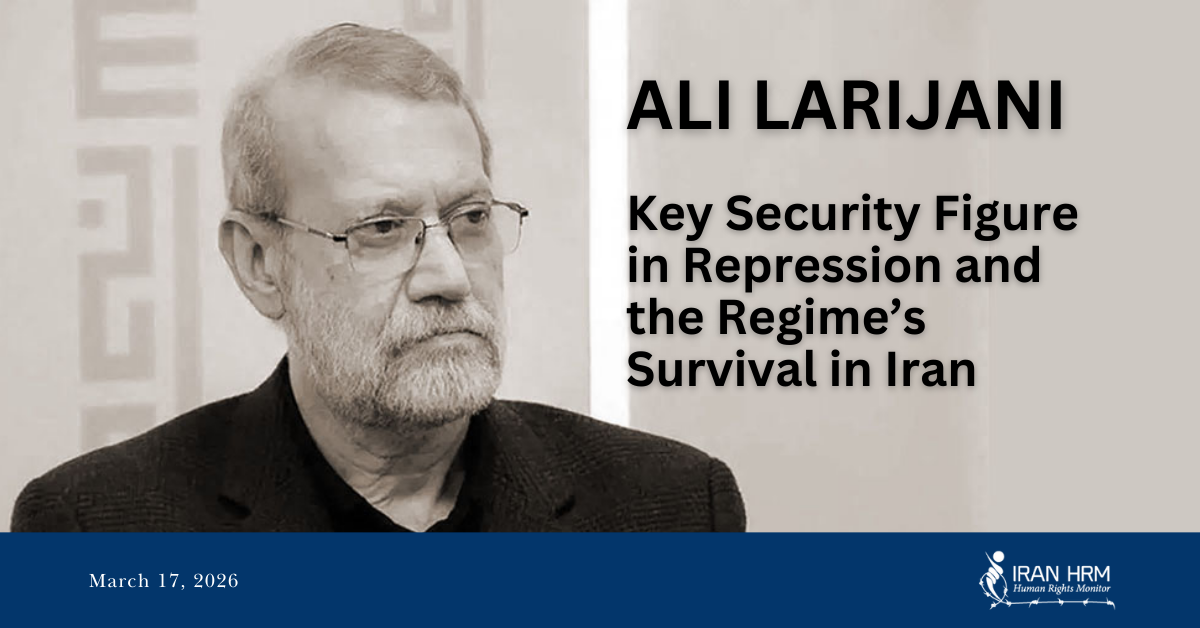
Ali Ardeshir Larijani was one of the key figures in the power structure of the ruling regime in Iran; an individual who, over four decades, operated across three defining domains; security, media, and politics, and played a role in consolidating this structure. His trajectory, from managing state media to presiding over parliament and ultimately serving as Secretary of the Supreme National Security Council, reflects a position that was not merely administrative, but functioned at the level of decision-making and implementation of security policies.

Within this framework, Larijani’s role cannot be confined to a single office. At each stage, he advanced components of the mechanisms of control and repression; from shaping official narratives and discrediting opponents, to engineering power balances and participating in the management of security responses to protests. This continuity presents a profile of an individual who played an effective role in linking the various instruments used to maintain the system.
During the current devastating war, his statements and positions demonstrated that, within the ruling structure’s calculations, preserving strategic instruments of power; including nuclear programs and missile capabilities, takes precedence over humanitarian considerations. By emphasizing preparedness for a prolonged war and acceptance of its costs, he supported an approach that sustains conflict even at the expense of escalating human casualties and widespread destruction within the country.
This record indicates that, within this framework, the preservation of such instruments of power and the continuation of confrontational policies have been prioritized over the safety and living conditions of citizens, while the suffering of society has not held a determining place in decision-making processes.
Family Background; A Power Network at the Core of the State
To understand Ali Larijani’s position, he must be viewed within the context of his family; a family that is not merely a kinship network, but a network of influence across multiple layers of the ruling structure. He was born on 3 June 1957 (13 Khordad 1336) in Najaf, into a family whose father, Mirza Hashem Amoli, was a prominent religious authority. This background provided him, from the outset, with religious and political capital. His marriage to Farideh Motahhari, the daughter of Morteza Motahhari, further reinforced this position with ideological legitimacy.
Power Network of the Larijani Family
| Name | Relation | Sphere of Influence | Link to Corruption or Repression |
| Mirza Hashem Amoli | Father | Religious authority | Provided traditional legitimacy |
| Ali Larijani | Subject | Security, media, political | Role in repression and power consolidation |
| Sadegh Larijani | Brother | Judiciary | 63 personal bank accounts; corruption allegations |
| Mohammad Javad Larijani | Brother | Political/ideological institutions | Land seizure allegations; justification of repression |
| Fazel Larijani | Brother | Economic network | Bribery case (“Black Sunday”) |
| Morteza Motahhari | Father-in-law | Ideological legitimacy | Connection to core revolutionary doctrine |
This concentration of familial power represents a structural example of exclusivity, impunity, and lack of accountability within the ruling system in Iran.
From War Fronts to Military Structure; The Security Roots of a Political Figure
Larijani entered the Islamic Revolutionary Guard Corps in 1982 and remained within its structure until 1992. According to available records, he served as Deputy for Legal and Parliamentary Affairs in the Ministry of the IRGC from 1986 to 1989, and from 1989 to 1992 as Deputy Chief of the Joint Staff. He also played a founding and managerial role in the IRGC’s Self-Sufficiency Organization.
This background is significant because it shows that Larijani was shaped within a military-security structure before becoming a media or parliamentary figure. His relationship with the IRGC was therefore not incidental or political, but structural and formative. This connection later became evident in his approach to protests, security coordination, and support for the IRGC’s role in maintaining the system.
Eleven Years at State Broadcasting; Institutionalizing Soft Repression
Larijani’s appointment as head of the state broadcasting organization in 1993 marked the beginning of a period in which state media was increasingly transformed into a direct instrument for shaping public opinion, discrediting opponents, and normalizing repression. He remained in control of this institution for 11 years, and the defining legacy of his tenure was not media development, but the consolidation of broadcasting as a security arm of the ruling system.
A clear example of this period was the program Hoviyat (“Identity”), in which forced confessions of intellectuals, writers, and critics were broadcast. The objective was not information, but humiliation, character assassination, and the social elimination of dissenting voices. Larijani not only did not distance himself from this process, but openly defended it, accusing critics of receiving funding from foreign embassies.
This position demonstrates that, under his leadership, state media functioned not merely as a governmental outlet, but as part of a system of psychological interrogation, labeling, and legitimization of political exclusion.
During this period, Larijani effectively demonstrated how repression could be carried out without bullets; through imagery, narrative control, accusation, and televised confessions. This aspect of his record is central to any human rights analysis, as it exposes the relationship between state media and the violation of fundamental rights.
Twelve Years as Speaker of Parliament; Engineering Law and Preserving Power Balance
From 2008 to 2020, Larijani served as Speaker of Parliament for 12 years. This period marked his consolidation as a key figure in managing the internal balance of power; an individual capable of bridging the office of the Supreme Leader, the IRGC, successive governments, and the legislative structure.
During this time, his role extended beyond administering parliament. In critical moments, parliament was used as a tool to regulate power dynamics; including the rapid approval of the JCPOA within a short timeframe, and the obstruction of investigations into internal corruption.
In the case of the 63 personal bank accounts attributed to Sadegh Larijani, he played a role in silencing criticism and preventing transparency. Likewise, during protests by victims of financial institutions, instead of defending those affected, he held them responsible for their situation, effectively siding with the structures of economic exploitation.
During the protests of December 2017, he again aligned with official narratives, supporting propaganda against protesters and describing such content as a means of “clarifying public understanding.” This position indicates that parliament under his leadership did not function as a representative body of society, but rather as a political cover for the securitization of protests.
Secretary of the Supreme National Security Council; From Repression of the 2025 Uprising to Escalation of War
Larijani’s return to the highest security position marked the most significant phase of his career. According to available documentation and international reporting, in his role as Secretary of the Supreme National Security Council, he became one of the central figures in both the repression of the 2025 protests and the management of the post-Khamenei power structure.
In the uprising of late 2025, he described protesters as “organized forces” seeking “civil war,” and claimed that weapons such as G3 rifles and pistols had entered the scene. This rhetoric reflects a recurring pattern used to justify the deployment of lethal force; namely, reframing social protest as an armed security threat.
His role extended beyond rhetoric. Reports indicate his involvement in shaping a model of repression that included internet shutdowns, the use of military-grade weapons, and the normalization of a permanent state of emergency. In this context, he referred to protesters as “armed terrorist networks” and framed harsh measures as necessary to maintain order.
In the subsequent phase, particularly after the death of Ali Khamenei, Larijani also emerged as a central figure in managing wartime dynamics and security diplomacy. Reports highlighted his role in security coordination and engagement with external actors, including Russia, positioning him at the core of the evolving power structure.
At the same time, Larijani’s name appeared on the sanctions list of the U.S. Department of the Treasury. The Department announced that 12 individuals and 13 entities were designated for their role in the repression of protests in Iran, with Larijani identified among those sanctioned in his capacity as Secretary of the Supreme National Security Council. The U.S. Treasury emphasized that these measures targeted “designers of repression,” indicating that his role in directing security responses to protests had been recognized at the international level.
Empire of Corruption; Wealth, Rent-Seeking, and Systematic Exploitation
The Larijani family has, over the years, been widely associated with systemic corruption. Beyond being a political network, it represents a power–wealth nexus in which access to authority has been directly linked to the accumulation of economic resources.
Key elements of this pattern include:
- The alleged seizure of approximately 342 hectares of national land in Varamin
- The “Black Sunday” case involving Fazel Larijani and evidence of bribery and influence-peddling
- The case of 63 personal bank accounts linked to Sadegh Larijani, through which interest generated from public deposits was reportedly diverted
- A financial misconduct case amounting to 525 billion tomans, described as part of a broader pattern of concealment
In addition to these documented cases, reports have also referred to extensive personal wealth attributed to Ali Larijani. According to opposition sources, his assets have been estimated at approximately 28 trillion tomans, along with millions of euros in holdings in Dubai and Malaysia. These figures, as presented, are based on opposition reporting and should be understood within that context.
This body of evidence presents a broader picture of the relationship between political authority and economic gain; a system in which power enables wealth accumulation, while oversight and accountability remain largely absent.
Conclusion
Ali Larijani’s trajectory can only be understood through its continuity; from the IRGC to state broadcasting, from parliament to the Supreme National Security Council. At each stage, he utilized different instruments to sustain the ruling system; military and security structures, media control, legislative engineering, and direct repression.
For this reason, his role is not defined by his official titles, but by this continuity itself; a central figure in the survival of the ruling regime in Iran, with deep roots in security institutions, a decisive role in the repression of protests, and clear links to networks of corruption and concentrated power.