Persistent Patterns of Gross Human Rights Violations in Detention in Iran:
The Islamic Republic of Iran not only violated the fundamental principle of the right to life during the January 2026 uprising, shocking the global community, but continues to perpetrate gross violations of universal human rights within its prisons. The authorities are seeking vengeance against detained protesters through torture, forced confessions, and “expedited” summary trials—resulting in severe sentences including the death penalty. They are also abusing judicial power to eliminate the most basic rights of political prisoners, namely the freedom of expression and belief.

Case Study: Forough Taghipour – Evin Prison (Supplementary Case-Files and Punitive Restrictions)
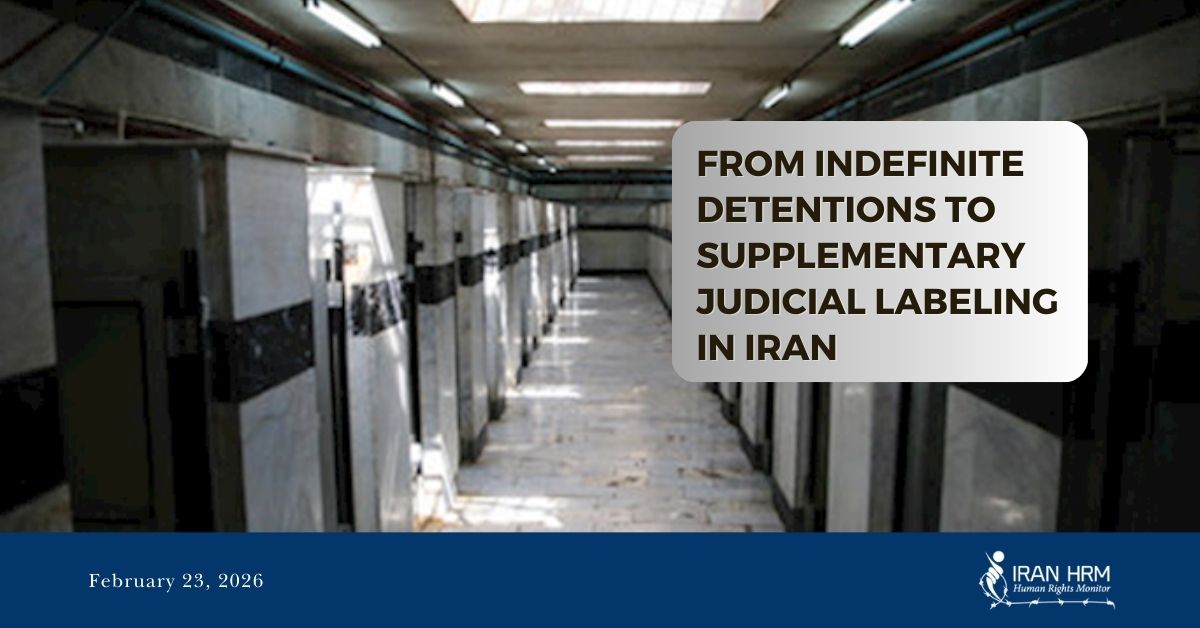
Forough Taghipour, 31, holding a bachelor’s degree in accounting, has been serving a five-year sentence in Evin Prison since August 2023. She is now facing new judicial proceedings and severe communication restrictions. Despite having been previously arrested and tried twice on charges such as “Baghi” (armed rebellion), “assembly and collusion,” and “propaganda against the state,” prison authorities have leveled a new charge of “disseminating false information” against her. Consequently, she has been deprived of phone calls and family visitations for one month. This practice is widely used in detention in Iran to exert psychological pressure, increase prisoner isolation, and restrict the flow of information regarding prison conditions. Furthermore, she was summoned via video conference to Branch 2 of the District 33 Prosecution Office (known as “Moghadas”) for interrogation on the charge of “propaganda against the state within the prison.” This signifies “repression within repression”—a prisoner arrested for expressing her beliefs is denied the right to hold those same beliefs even while incarcerated.
Analysis of Human Rights and Criminal Violations:
- Violation of Freedom of Expression during Incarceration (Article 19 ICCPR): Punishing a prisoner for expressing opinions within the prison is a double violation of freedom of expression; incarceration does not negate fundamental intellectual rights.
- Use of Communication Deprivation as a Tool of “White Torture”: Cutting off contact and visitations based on political charges violates the UN Nelson Mandela Rules regarding the minimum standard of treatment for prisoners. This act constitutes cruel and degrading treatment.
- Violation of the Principle of Double Jeopardy (Ne Bis in Idem): Opening consecutive cases with identical or similar charges (e.g., propaganda against the state) for a single act is an abuse of the judicial process to illegally extend the duration of imprisonment.
Case Study: Maryam Javadi – Dowlatabad Women’s Prison, Isfahan (Arbitrary Detention and Legal Limbo)
Maryam Javadi, a 27-year-old journalism student from Chermahin residing in Isfahan, has been in detention for nearly eight months in Dowlatabad Prison without a judicial verdict or final case determination. Arrested in July 2025 by security forces, she remains in a state of total legal limbo. Prolonged detention outside the norms of due process—where the presumption of innocence and the right to a speedy trial are ignored—is a systematic mechanism used to pressure political prisoners. Sources close to her family report that her interrogation process has been uncharacteristically prolonged to coerce her into accepting the interrogators’ demands. This has resulted in severe anxiety, insomnia, and psychological erosion. The vague charges against her include “insulting the Supreme Leader,” “membership in opposition groups,” and “propaganda against the state.” Reports indicate she has faced repeated threats during detention aimed at extracting forced confessions.
Analysis of Human Rights and Criminal Violations:
- Arbitrary Detention: Holding a defendant for eight months without a verdict violates Article 9 of the ICCPR, which guarantees the right to trial within a “reasonable time.”
- Violation of the Presumption of Innocence: Prolonged pre-trial detention effectively transforms “temporary detention” into “preemptive punishment,” entirely undermining the presumption of innocence.
- Psychological Torture for Coerced Confessions: The use of exhaustive interrogations to induce anxiety and insomnia constitutes “psychological torture” under the Convention Against Torture (CAT).
- Vagueness of Charges: The use of broad, ill-defined charges like “propaganda against the state” for student or professional activities violates the principle of legal certainty in criminal law.
Legal Analysis: The Systematic Criminalization of Freedom of Expression
The judicial authorities of the Islamic Republic consistently invoke “national security” exceptions under Article 19 of the ICCPR to justify the suppression of critics. From an international legal perspective, this invocation lacks legal validity for the following reasons:
- Failure of the Tripartite Test: According to General Comment No. 34 of the UN Human Rights Committee, any restriction on freedom of expression must be “provided by law,” “necessary,” and “proportionate.” Charges such as “propaganda against the state” or “insulting the leadership” fall under the Vagueness Doctrine; they lack legal precision and serve solely to silence dissent.
- Prohibition of the Abuse of Rights (Article 5 ICCPR): Under this article, no state may interpret or apply legal exceptions (such as national security) in a way that aims at the destruction or total impairment of a fundamental right (freedom of expression). Criminalizing the critique of power structures as a security offense is a clear abuse of the law to violate the spirit of the law.
- Tolerance of Public Officials: Human rights standards dictate that government officials and institutions must exhibit a higher degree of tolerance toward criticism and even insult compared to private citizens. The criminalization of criticism as “insult” contradicts the principle of necessity in a democratic society.
Conclusion and Call to Action
While Ms. Mai Sato, the UN Special Rapporteur on the situation of human rights in Iran, noted that previously documented patterns are now repeating with greater intensity, after January 2026 protests, these two cases—representing a mere fraction of the political prisoners held—show that the Islamic Republic remains determined to intensify its repression.
The United Nations and human rights bodies, in accordance with their Responsibility to Protect fundamental human rights, must prioritize the following:
- Pressure the Iranian government to end “indefinite detentions”: Compel judicial authorities to immediately determine the status of cases like Maryam Javadi and unconditionally release those held without a verdict.
- Halt supplementary case-filing in prisons: Condemn the use of the judicial system as a punitive tool against prisoners already serving sentences (e.g., Forough Taghipour).
- Establish a direct monitoring mechanism for women’s prisons: Addressing alarming reports of psychological pressure and “white torture” in Evin and Dowlatabad prisons.
- Hold security apparatuses accountable: Calling on authorities to answer for gross violations of international conventions and the minimum standards for the treatment of prisoners.
The United Nations and international human rights bodies must recognize that overlooking these documented patterns not only undermines the credibility of international monitoring mechanisms but constitutes a formal acceptance of the transformation of a judicial system into an instrument for systematic torture and the deprivation of the citizens’ legal security. Now that the continuation of these patterns has been confirmed by the Special Rapporteur, the international community must move from “expressing concern” to “deterrent actions.” Silence in the face of transforming incarceration into a continuous torture chamber effectively grants impunity to those who have weaponized the law to stifle dissent. Inaction at this juncture is complicity in the violation of the human dignity of prisoners whose only crime is standing by their convictions; it allows prison walls to remain a safe haven for tyranny to commit silent atrocities.