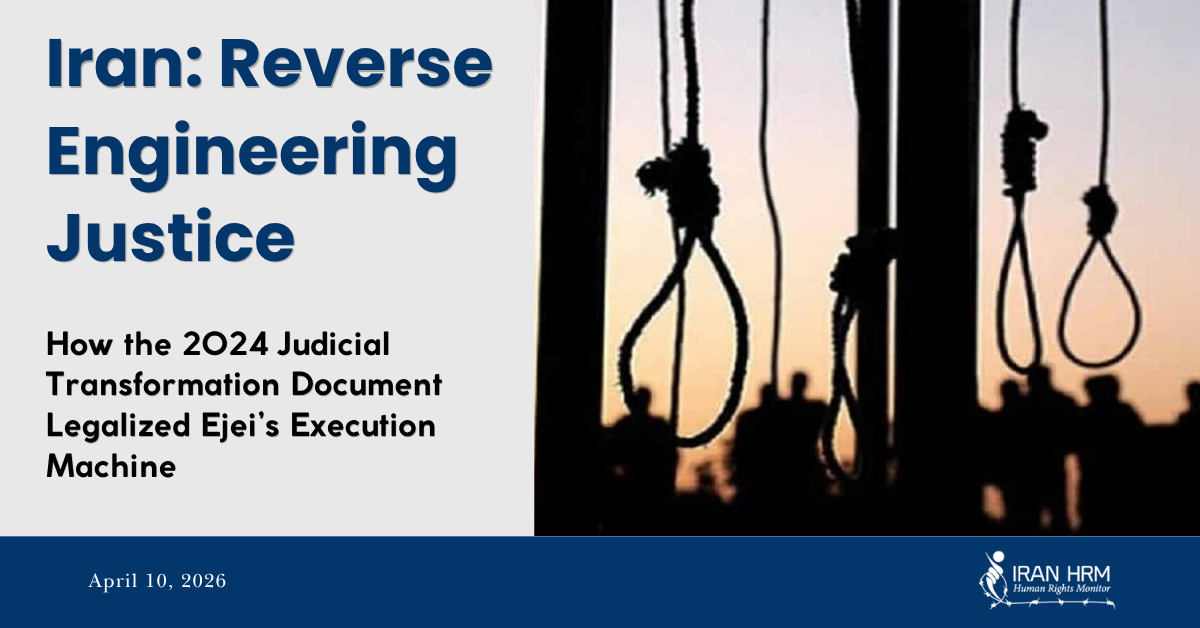
How the 2024 Judicial Transformation Document Legalized Ejei’s Execution Machine
Legal Introduction: Criminal Intent and Joint Criminal Enterprise (JCE)
According to international criminal law standards, crime against humanity is established when attacks against civilians are “systematic” and based on an “organizational policy.” The “2024 Judicial Transformation and Excellence Document” serves as the primary evidence proving this policy. This document was designed not for reform, but to transform the Judiciary into a component of the regime’s war machine for the purpose of suppression. The implementation of this document since its drafting in 2024, particularly during January 2026 uprising to date, indicates an organized plan for the physical elimination of dissidents. The document utilizes state-defined “justice” not for the realization of rights, but as a “Trojan Horse” for the regime’s survival under conditions of nationwide protests or wartime scenarios.

Evidence-Based Analysis of the Transformation Document (Structural Evidence of Crime)
An examination of the provisions of this document reveals how the judicial structure has been engineered for suppression. The Judicial Transformation Document does not directly use terms such as “suppressing protesters” or “confronting foreign media.” However, the security language and concepts within sections of the document—such as “Cognitive Warfare,” “Disruption of Public Order,” “Cyberspace Threats,” “Security Offenses,” and “Psychological Security”—are deceptive terms that have provided the legal foundation for the physical elimination of opponents.
- Criminalizing Truth: Under the titles of “Safeguarding Psychological Security,” “Countering Cognitive Warfare,” and “Acquiring Evidence in Cyberspace,” the document has transformed media activities and information dissemination into “security offenses.” These clauses provide the legal basis for the brutal suppression of journalists and citizens who have dared to narrate events from 2024 to the present.
- Security Integration and the Elimination of Judicial Independence: The document’s emphasis on “facilitating access for security agents (Zabetan) to information” and “strengthening cooperation with security agents” has effectively led to an unprecedented increase in the authority of security agencies over political and media cases. This clause eliminates judicial oversight and transforms the judge into an executor of the interrogators’ will.
- Execution Machine and Civil Espionage: The clauses regarding “Optimizing the handling of crimes against security,” “Decisive confrontation with disruptors of public order,” and “Utilizing public capacities for crime detection” form the bedrock for creating a social espionage army and issuing accelerated death sentences.
Operational Appendix: Direct Commands (Smoking Gun)
The organic link between the “Transformation Document” and the commands of senior officials clearly proves criminal intent:
- Direct Command of Gholam-Hossein Mohseni-Ejei (Mizan – April 7, 2026): In an explicit directive addressed to his First Deputy (Khalili), he declared:
“Our sentences, Mr. Khalili, must be issued more frequently. Both regarding the confiscation of assets and the issuance of death sentences—you must truly accelerate these.” When the head of a power, prior to due process, orders an “increase” in execution statistics, the Judiciary has officially turned into a “mass killing enterprise.” Utilizing the label of “pseudo-coup” for popular uprisings used by Eje’i in his statements serves only to justify the use of “wartime laws” and the execution of protesters under the title of “enemy agents.”
- Confession of First Deputy Khalili (ILNA – April 6, 2026): Affirming that the Transformation Document must not remain merely a plan, he explicitly confessed:
“Previously, during crises such as the 12-day war (First attack on Iran by Israel in June 2025), the judicial system faced a lack of laws… however, with the special diligence of the Head of the Judiciary and the cooperation of the Parliament, we were able to draft and promulgate new laws to rectify past legal gaps.” This confession proves that the regime first reconstructed the legal structure to “make suppression possible.” Khalili’s recent remarks are a historical document of the leadership’s criminal intent. He openly admits that the judiciary previously lacked the “laws” for suppression, but now, with the ratification of the “Law for Intensifying the Punishment for Espionage” and the provisions of the Transformation Document, all legal barriers to rapid executions have been removed. His emphasis on shifting quickly from detention to indictment represents nothing less than the official announcement of the “end of fair due process.”
The Paradox of Impudence: Invoking International Law to Cover Crimes
While the Iranian regime violates the most fundamental principles of the International Covenant on Civil and Political Rights (ICCPR), the Attorney General impudently invokes the “Principle of Universal Jurisdiction” and the Shanghai Cooperation Organization to prosecute foreign officials (ILNA – April 7, with the headline: Request from Iran’s Attorney General to the Prosecutors of the Shanghai Cooperation Organization for judicial cooperation in the pursuit of American and Zionist war criminals).
This is a diversionary strategy: by utilizing legal simulation and filing complaints against others, the regime seeks to portray itself as a “victim” and “law-abiding,” while continuing its crimes against humanity and the slaughter of political prisoners under the cover of an internet blackout. While 17 political executions were carried out in the entirety of 2025, the Islamic Republic—citing such self-made laws in total violation of international law—executed 6 political prisoners and 4 protesters from the January 2026 uprising in just one week (from March 30 to April 6): Mohammad Taghavi, Akbar Daneshvarkar, Pouya Ghobadi, Babak Alipour, Abolhassan Montazar, and Vahid Bani-Amerian (members of the PMOI/MEK), and Amirhossein Hatami (18 years old), Shahin Vahedparast, Mohammad-Amin Biglari (19 years old), and Ali Fahim (detained protesters from the January 2026 uprising).
Gross Violation of International Treaties
This “transformed” judicial structure is a tool for the continuous violation of Articles 6 and 14 of the ICCPR and the Convention on the Rights of the Child. The imminent executions of Mohsen Eslamkhah (a child offender and a protest detainee of Mahsa’s uprising in 2022) and Benyamin Naghdi (a 26-year-old athlete from Shiraz and a detainee of the January 2026 protests) are direct outputs of this suppression machine, which has nullified the right to defense and the presumption of innocence in advance.
Conclusion: The Necessity of International Intervention
The “2024 Transformation Document” proves that the suppressions following the 2026 uprising are not coincidental reactions but the result of a Reverse Engineering of Justice. Given that the Iranian Judiciary is now officially acting as a “party to a war against the people,” the Judiciary of the Islamic Republic is no longer a civil institution but a “Belligerent” that must be dealt with according to international laws. The international community is obligated, under the principle of the Responsibility to Protect (R2P) and Universal Judicial Jurisdiction, to intervene and prevent this organized crime against humanity.