How the ruling regime in Iran centralizes judiciary power and restricts independence through structural control
Judiciary is a fundamental institution in legal systems worldwide, tasked with safeguarding citizens’ rights, addressing grievances, and administering justice. A core principle underlying this institution is its independence from other branches of power; such independence cannot be realized without the principle of separation of powers. Under this principle, political authority is distributed among different institutions to prevent concentration and enable mutual oversight.

In Iran’s legal framework, the Constitution formally recognizes the separation of powers. Article 57 identifies the legislative, executive, and judicial branches as the governing authorities. However, the same article stipulates that these branches operate “under the absolute authority of the Supreme Leader.” Furthermore, Article 110 grants the Supreme Leader extensive powers, including determining general state policies, supervising their implementation, and appointing the head of the judiciary.
This legal framework raises a fundamental question: when the highest judicial authority is appointed by the Supreme Leader, and all branches operate under centralized supervision, how can judicial independence be defined, and what is the judiciary’s actual position within the structure of power?
This question can be examined through a recurring pattern. In 1988, following a decree issued by Ruhollah Khomeini, approximately 30,000 political prisoners, many of whom had already been tried and were serving sentences or had completed them, were executed in a short period outside standard judicial procedures. This event has been documented in international reports, including those of the UN Special Rapporteur Javaid Rehman, as a large-scale extrajudicial execution and a crime against humanity.
In recent years, executions have continued on a significant scale. According to available data, at least 2,167 executions were recorded in 2025.
At present, alongside rising regional tensions, judicial measures have accelerated. Within one week, at least 10 political prisoners and protesters were executed. At the same time, officials have reported the arrest of thousands across the country on charges such as “espionage” and “collaboration with hostile entities.” Multiple reports indicate expedited proceedings, restricted access to legal counsel, and the implementation of sentences through opaque processes.
Within this context, on 17 Farvardin 1405 (6 April 2026), Gholamhossein Mohseni Ejei emphasized the need to accelerate the issuance and enforcement of death sentences against what he described as “agents of the enemy.” He also highlighted “ensuring the security of the system” as a primary priority of the judiciary. These statements indicate that key punitive policies are determined at the highest level and transmitted throughout the judicial apparatus.
This stands in contrast to the preamble of the Constitution, which describes the judiciary as a system intended to protect people’s rights, prevent deviations, and operate on the basis of justice and integrity, free from unhealthy relations or influences.
These developments demonstrate that examining violations without analyzing the structure of judicial decision-making is insufficient. This report focuses on the structure and functioning of the judiciary in Iran, emphasizing the legal framework, institutional design, and procedural practices that shape arrest, prosecution, sentencing, and execution.
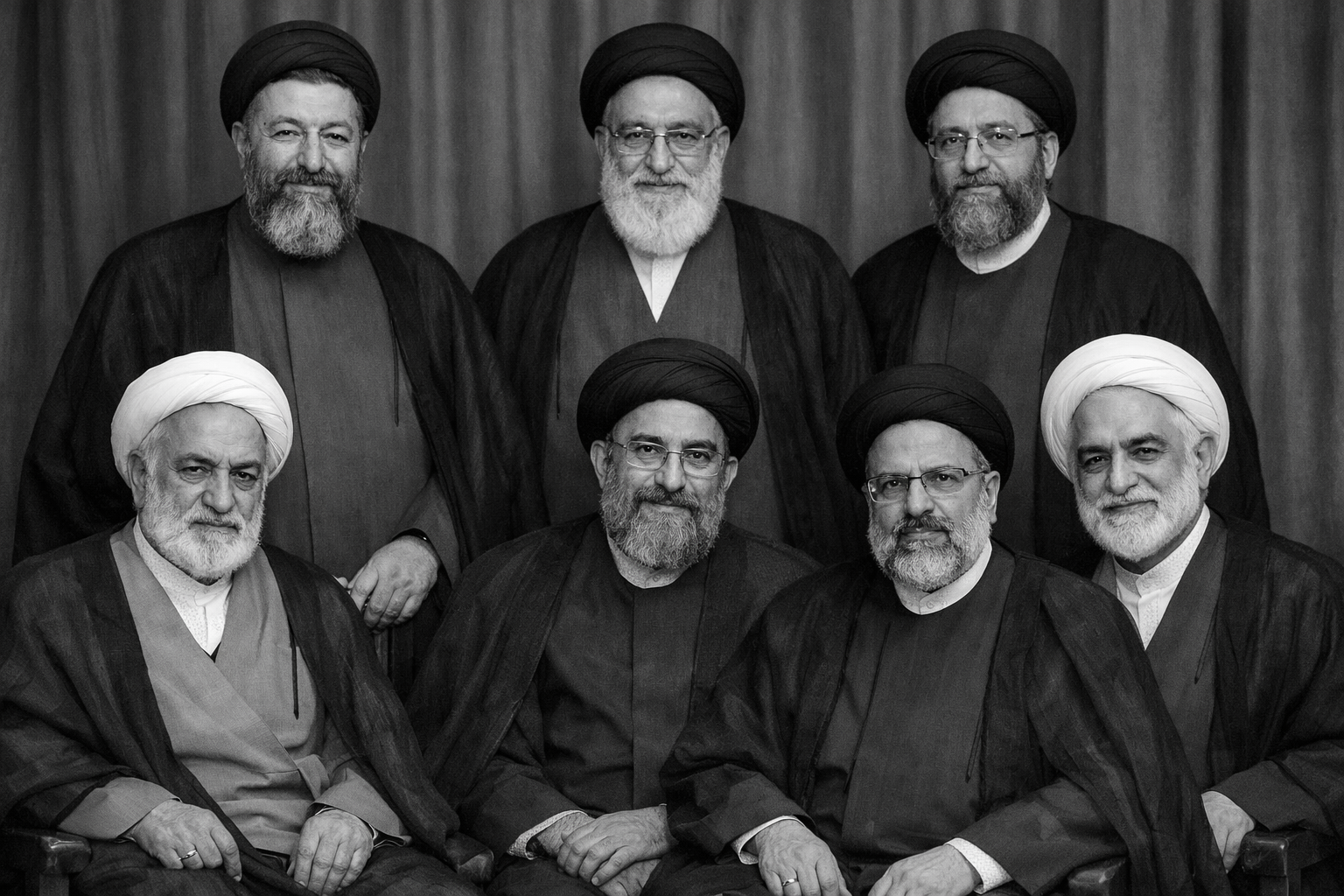
Heads of the Judiciary of the Islamic Republic of Iran (since its establishment): Mohammad Beheshti (1980–1981); Abdul‑Karim Mousavi Ardebili (1981–1989); Mohammad Yazdi (1989–1999); Mahmoud Hashemi Shahroudi (1999–2009); Sadeq Amoli Larijani (2009–2019); Ebrahim Raisi (2019–2021); Gholam‑Hossein Mohseni‑Eje’i (2021–present).
Background and Legal Framework of the Judiciary in Iran
Judicial independence is a fundamental principle of public law, intrinsically linked to the separation of powers. Its realization requires the absence of interference by other branches in judicial proceedings.
Under Articles 107 and 110 of the Constitution, the Supreme Leader holds extensive authority, including setting general policies and supervising their implementation. Among these powers is the appointment of the head of the judiciary, who exercises decisive authority over the judicial system.
Thus, while the Constitution defines the judiciary as an independent institution, it simultaneously places it within a structure in which its highest authority is appointed by the Supreme Leader. This duality forms the basis for assessing the judiciary’s actual position within the power structure.
Appointment of the Head of the Judiciary; The Origin of Structural Dependence
According to Article 157 of the Constitution, the head of the judiciary is directly appointed by the Supreme Leader for a five-year term. In the appointment decree of Gholamhossein Mohseni Ejei on 1 Tir 1400 (22 June 2021), emphasis was placed not only on legal qualifications but also on ideological criteria such as deploying “committed and revolutionary forces” and maintaining a “transformative approach.” This combination indicates that the appointment is aligned with broader state directives, establishing a vertical relationship between the judiciary and the apex of power.
Structural Transformation; From Collective Council to Centralized Leadership
Before the 1989 constitutional revision, the judiciary was administered by a High Judicial Council.
Mohammad Beheshti played a key role in establishing the post-revolution judicial system, including the formation of Revolutionary Courts.
Abdolkarim Mousavi Ardebili served during a period in which mass executions of the 1980s, including those of 1988, took place, alongside public statements supporting expedited handling of opposition cases.
Following 1989, the system shifted to a centralized model under the Supreme Leader, enabling more direct control over judicial decision-making.
Mohammad Yazdi (1989–1999) introduced structural changes, including the removal of certain prosecutorial mechanisms and the establishment of general courts, reducing layers of oversight.
Mahmoud Hashemi Shahroudi (1999–2009) presided over proceedings that were described by observers as “show trials,” with reports of coerced confessions.
Sadegh Amoli Larijani (2009–2019) oversaw a period marked by increased executions and was placed under international sanctions for human rights violations.
Ebrahim Raisi (2019–2021), whose past role in the 1988 events received significant attention, led the judiciary during a period in which death sentences were issued against protesters.
Gholamhossein Mohseni Ejei (2021–present) has continued policies emphasizing rapid judicial processing and strict punishment in political and security-related cases. He has stated: “We will act without leniency against those who act against the security of the system.”
On 7 April 2026, he further stated: “Sentences must be issued more extensively, both regarding asset confiscation and death penalties; these must be expedited.”
Concentration of Authority; Accumulation of Power at the Top
The head of the judiciary holds authority over key judicial appointments. In Mordad 1402 (August 2023), Gholamhossein Mohseni Ejei appointed Mohammad Jafar Montazeri as Head of the Supreme Court and Mohammad Movahedi Azad as Prosecutor General. These appointments demonstrate that decision-making at the highest level remains centrally controlled.
Lack of Oversight; Absence of Accountability
Alongside this concentration of power, there is no effective mechanism for oversight. According to statements by Abolfazl Aboutorabi, members of parliament lack the authority to question or intervene in judicial matters, indicating a legal vacuum. The Minister of Justice also holds only administrative coordination responsibilities and does not oversee judicial performance. This suggests that the head of the judiciary operates largely outside institutional accountability frameworks.
Hierarchical Structure; Administrative and Judicial Control
The judiciary operates within a hierarchical structure aligned with centralized authority. Official data indicates that in 2017, at least 78 judges were suspended and 170 dismissed. Cases such as the removal of Mahmoud Saadat and Majid Shakari illustrate that judicial careers remain dependent on higher-level decisions. This creates a vertical chain of authority in which judicial independence is structurally constrained.
Control over Judicial Outcomes; Limitation of Judicial Independence
Under Article 477 of the Criminal Procedure Code, the head of the judiciary may overturn rulings deemed contrary to Islamic law. In the case of Mohammad Javad Vafaei-Sani, a death sentence was overturned twice. Similarly, death sentences issued after the November 2019 protests were annulled under this provision and referred for retrial. These cases demonstrate that even final judicial decisions remain subject to centralized authority.
Analytical Conclusion of Chapter One
The structure of the judiciary in Iran reflects a system based on direct appointment by the Supreme Leader, concentration of authority in the head of the judiciary, and hierarchical control over judicial personnel. This model produces a top-down decision-making process in which institutional independence and accountability are structurally limited.
Article 61 of the Constitution defines the judiciary as operating according to “Islamic criteria” in administering justice. However, in practice, these criteria have resulted in a range of punishments including stoning, flogging, amputation, and other severe penalties, in some cases raising serious concerns regarding violations of fundamental rights, including the right to life and human dignity.
This structural framework provides the foundation for understanding how the judicial system in Iran operates in practice; a dynamic that will be further examined in the next chapter through the processes of selection, training, and control of judges.