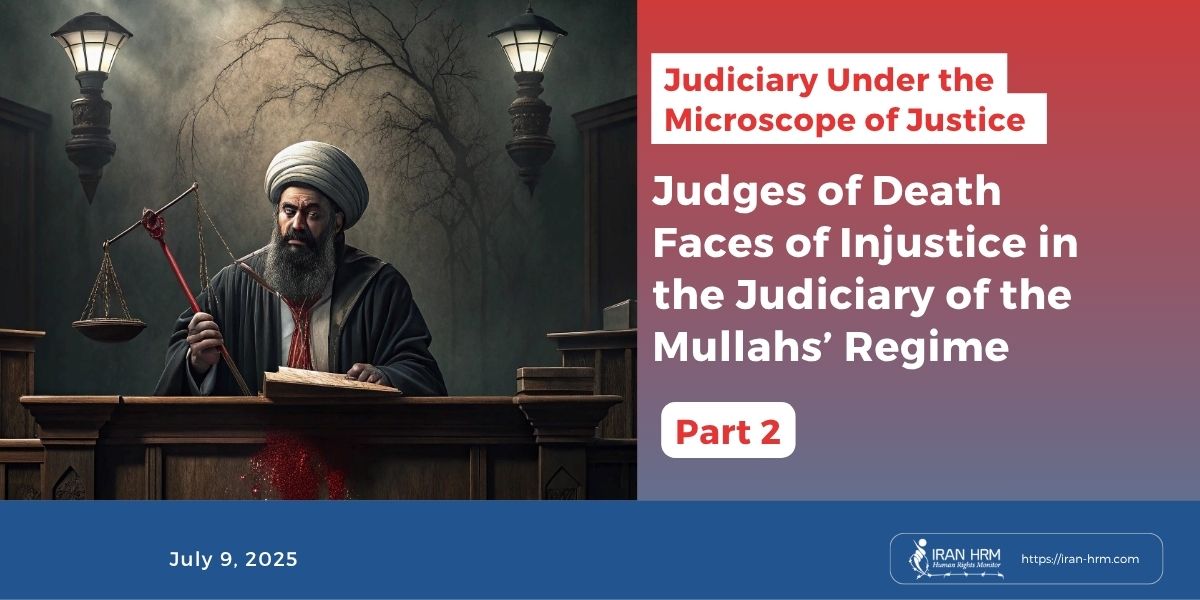
Judges of Death – Faces of Injustice in the Judiciary of the Mullahs’ Regime
Introduction
In the collective memory of the Iranian people, the word “judge” no longer evokes a sense of justice, law, or impartiality. Instead, it conjures a terrifying image of fear, oppression, and death. This shift in meaning is not accidental; in the mullahs’ regime, judgment has not served the law but has become complicit in systematic crimes. The term “Judges of Death” has emerged from within the people of Iran to describe those dark figures in the judiciary who have directly participated in the execution, torture, and harsh sentencing of political and ideological prisoners. These figures have written their verdicts in blood, and their names are intertwined with the nation’s darkest nightmares.

How Were the “Judges of Death” Formed?
Beginning in the 1980s, the ruling regime, relying on Sharia judges appointed by Khomeini, established courts that respected neither civil law nor the principles of fair trial. Death sentences were issued within minutes—without defense attorneys, without evidence, and without due process. In this framework, judges served as religious and political arms of repression rather than custodians of justice.
Over time, this practice not only persisted but was institutionalized, becoming one of the pillars of the regime’s continuity. As faces changed, the structure remained. From Khalkhali to Salavati, judgment became synonymous with death.
Key Figures Among the Judges of Death
The following table presents a brief overview of prominent figures who symbolize this bloody judiciary. In upcoming reports, each of these names will be analyzed in depth in dedicated profiles.
| Name | Key Role | Years of Activity | Sample Actions |
| Sadegh Khalkhali | Sharia Judge of the Revolution, Lawless Judge | 1979–1982 | Thousands of summary executions, street executions, destruction of heritage sites |
| Hossein-Ali Nayyeri | Head of the Death Commission | 1988–2024 | Signing thousands of death verdicts within minutes |
| Ebrahim Raisi | Member of Death Commission, President | 1988–2023 | Participation in 1988 massacre, death sentences for 2019 & 2022 protesters |
| Saeed Mortazavi | Press Prosecutor, Kahrizak Judge | 1990s–2000s | Killing of Zahra Kazemi, crimes in Kahrizak detention center, press bans |
| Mohammad Moghiseh (Nasseri) | Revolutionary Court Judge | 2009–2024 | Harsh sentences for post-election protesters, close collaboration with interrogators |
| Abolqasem Salavati | Known as “the second Khalkhali” | 2009–present | Death sentences for 2022 uprising protesters, judicial torture, forced confessions |
| Ali Razini | Mashhad Revolutionary Judge, ally of Lajevardi | 1980s–1990s | Mass executions, key role in securing security-based judiciary |
The Role of Security Agencies in Directing the Judiciary
Most of these judges were not independent by any standard. They were either directly connected or closely aligned with the Ministry of Intelligence, the IRGC Intelligence Organization, or the Supreme Leader’s Office. In many cases, the sentences were drafted by security institutions, and judges of courts like the Revolutionary Court or the Special Clergy Court simply implemented them. This structure transformed the judiciary from an instrument of justice to an ideological and political weapon.
Testimonies from Survivors
- A survivor of the 1988 massacre: “Nayyeri wouldn’t even look us in the eyes. He would just ask, ‘Are you still firm in your position?’ If you said yes, your fate was sealed.”
- A political prisoner from the 2000s: “Judge Moghiseh told me: Either confess or walk to the gallows.”
Legal Analysis
According to Article 6 of the International Covenant on Civil and Political Rights (ICCPR), the death penalty is only permitted under extremely limited conditions and after a fair trial. In all of these cases, the “judges of death” blatantly violated this foundational principle.
These actions—especially during the 1988 massacre and the 2022 protests—can be categorized as crimes against humanity under Article 7 of the Rome Statute.
The Bloody Record of the Judges of Death
Profiles of Key Figures: Legal Background and Documented Crimes
- Sadegh Khalkhali
First Sharia Judge of the Revolution – symbol of executions without trial
– Issued dozens of death sentences in Tehran, Kurdistan, and Khuzestan
– Destroyed cultural sites and shrines
– Publicly declared his disdain for legal processes - Mohammadi Gilani
Head of Revolutionary Court, Guardian Council Member
– Sentenced his own sons to death for political activity
– Hundreds of executions and flogging sentences in the 1980s
– Theologically justified torture - Gholamhossein Mohseni-Ejei
Special Prosecutor for the Clergy, Minister of Intelligence, Chief Justice
– Directly responsible for execution orders and long-term imprisonment of activists
– Accused of torture and forced confessions in the 1990s–2000s
– Silent partner in the 1988 massacre, and suppressions in 2009 & 2022 - Abolqasem Salavati
Known as “Judge of Death” during the 2022 Uprising
– Sentenced Mohsen Shekari and Majidreza Rahnavard to death
– Collaborated with IRGC in obtaining forced confessions
– Issued sentences of flogging, life imprisonment, and exile - Mohammad Moghiseh (Nasseri)
Head of Ward 209 in Evin, Revolutionary Court Judge
– Directly involved in torture
– Issued mass sentences after 2009 uprising
– Died under suspicious circumstances in 2025 - Hossein-Ali Nayyeri
Head of 1988 Death Commission
– Conducted summary trials lasting minutes
– Co-signed death sentences with Raisi and Pour-Mohammadi
– Died under regime-imposed silence - Ebrahim Raisi
Death Commission member, Supreme Leader-appointed President
– Involved in 1988 massacre
– Signed death sentences during 2019 and 2022 uprisings
– Died in helicopter crash, May 2025 - Saeed Mortazavi
Press Prosecutor, Kahrizak case
– Responsible for death of Zahra Kazemi
– Kahrizak detainee deaths and abuses
– Banned from judiciary but never properly prosecuted - Ali Razini
Mashhad Judge, Death Commission Member
– Ordered rapid executions during uprisings
– Worked closely with Lajevardi during 1980s repression
– Killed by a servant in 2025 - Asadollah Lajevardi
Tehran Revolutionary Prosecutor, known as “Butcher of Evin”
– Personally tortured political prisoners
– Issued and executed death sentences himself
– Killed by a 1980s survivor
Conclusion and Call to Action
The judges of death are not merely judicial functionaries; they are architects of state-sponsored repression. It is imperative to document their crimes precisely and pursue international legal accountability.
We call on the UN Human Rights Council to establish an independent fact-finding commission to investigate the role of the Iranian judiciary in systematic human rights violations and to pursue prosecution of these judges of death in international courts.