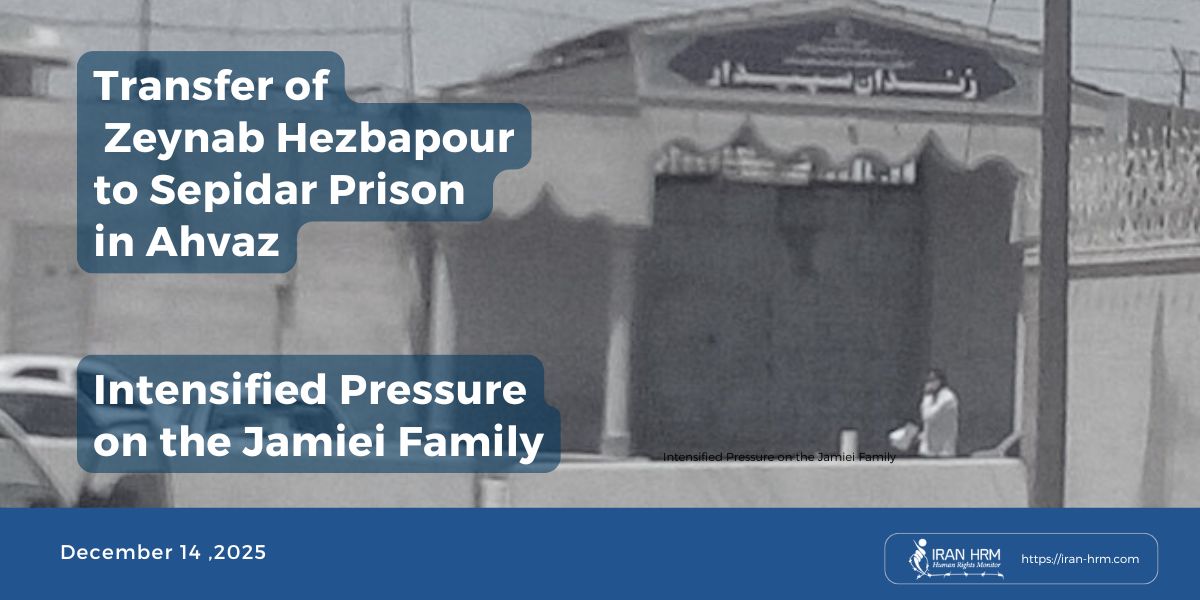
Zeynab Hezbapour, the wife of Masoud Jamei, a political prisoner sentenced to two death penalties, has been transferred to the women’s ward of Sepidar Prison in Ahvaz to serve a 15-year prison sentence. Her transfer comes at a time when her daughter, Nahid Jamei, is also facing a 12-year prison sentence; verdicts that, according to reports, were issued through a process lacking the standards of a fair trial.

The transfer of Zeynab Hezbapour represents the latest link in a chain of mounting security and judicial pressure on the family of Masoud Jamei, a political prisoner who, after nearly two years of imprisonment, is still being held in Sheiban Prison in Ahvaz in critical physical condition and without access to specialized medical treatment. The severity of his health situation has raised serious concerns about the possibility that he may lose his life before the implementation of his death sentence.
Heavy Sentences for the Wife and Daughter
Zeynab Hezbapour had previously been sentenced to 15 years in prison in a security-related case by a Revolutionary Court on charges of “membership in insurgent groups.” At the same time, Nahid Jamei, the 24-year-old daughter of the family, has been sentenced to 12 years in prison by Branch One of the Ahvaz Revolutionary Court.
Informed sources report that the handling of these cases was carried out without adherence to the principles of fair trial, and that the defendants were denied effective access to an independent lawyer. Court sessions were held in a highly securitized atmosphere, and the defendants were not provided with a genuine opportunity to present an effective defense.
Expansion of Pressure on Other Family Members
Security pressure has not been limited to Zeynab Hezbapour and Nahid Jamei. According to reports, two other daughters of the family, Delal and Roghayeh Jamei, have also been subjected to interrogation and security prosecution in recent months. This development has intensified concerns about collective measures being taken against the family of this political prisoner and has drawn the attention of human rights activists.
Observers note that simultaneously subjecting multiple members of a single family to arrest, prosecution, and heavy sentences is an indication of the growing use of familial pressure as a tool of control and punishment.
Arrest of Masoud Jamei and the Course of His Case
Masoud Jamei was arrested on 10 Mordad 1402 (August 1, 2023) by security forces and transferred to the central detention facility of the Khuzestan Intelligence Department. After the interrogation phase, he was transferred to Sheiban Prison in Ahvaz. During the same period, his wife and three daughters were also arrested and subjected to interrogation.
Reports indicate that family members were subjected to pressure and threats during interrogations and were denied access to legal counsel during the investigation phase. These conditions raised concerns from the outset regarding the fairness of the judicial process in this case.
Two Death Sentences Issued Against Masoud Jamei
Branch One of the Ahvaz Revolutionary Court, presided over by Judge Adibi-Mehr, has sentenced Masoud Jamei to two death penalties and one year of discretionary imprisonment. The charges brought against him include “corruption on earth,” “membership in insurgent groups,” and “assembly and collusion with the intent to overthrow the system.”
Jamei is 48 years old, married, and the father of four children. Prior to his arrest, he worked as a guard at oil wells for the National Iranian Oil Company.
Critical Health Condition and Denial of Medical Care
Masoud Jamei’s health condition is reported to be extremely alarming. He suffers from malignant stomach cancer and, in addition, from multiple serious illnesses, including liver and kidney failure, severe internal infections, high blood pressure, and chronic neurological headaches.
According to reports, poor prison nutrition and the lack of adequate medical care have led to the worsening of his illnesses and the development of fatty liver disease. Despite his critical condition, prison authorities and security bodies have prevented his transfer to medical facilities outside the prison, while the limited medical services available inside the prison are incapable of addressing his life-threatening condition.
Concerns Over the Repetition of a Pattern of Collective Punishment
The case of Masoud Jamei, Zeynab Hezbapour, and their children has been described by observers as a clear example of the expansion of a pattern of “collective punishment” against the families of political prisoners. The issuance of heavy sentences against the wife and child of a prisoner sentenced to death, alongside the denial of vital medical care to the prisoner himself, has resulted in far-reaching human and social consequences.
The continuation of this trend has intensified concerns about increasing pressure on the families of political prisoners and the use of judicial and security mechanisms to exert pressure extending beyond the individual accused.