Report on the Systematic Violation of Prisoners’ Rights: Threats of Mass Executions and Forced Transfers Under Fire
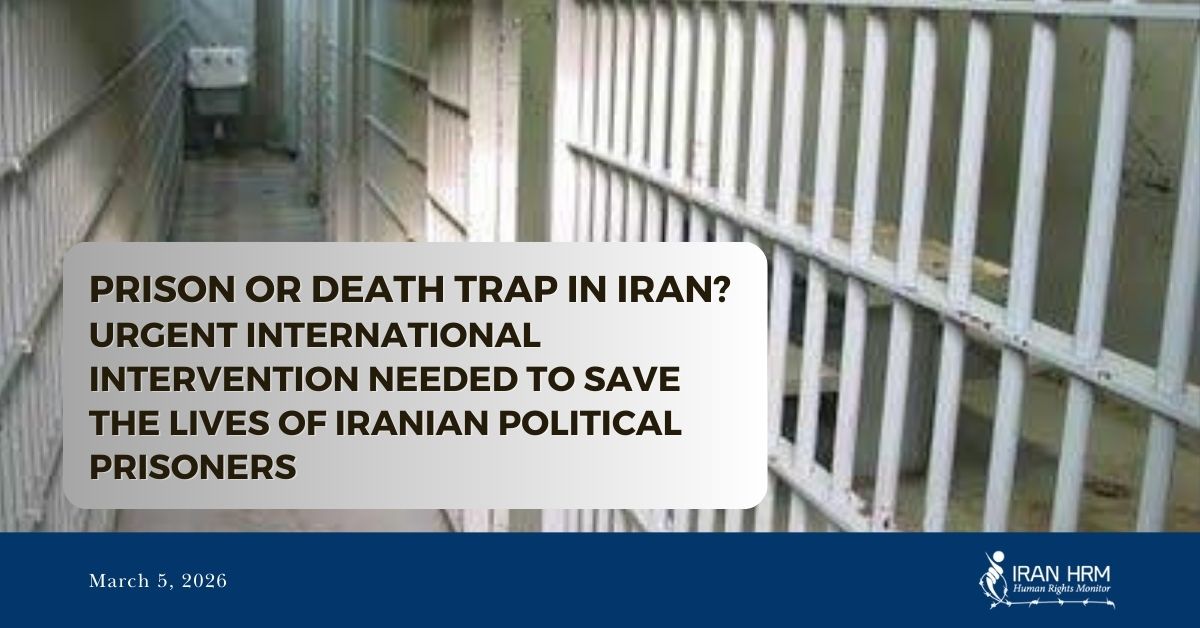
During military conflicts, especially bombardments, prisoners are among the most vulnerable populations. The security of prisoners, particularly political prisoners, during periods of military tension is a matter that demands immediate action from the international community and human rights organizations. Due to the nature of detention centers and severe physical restrictions, prisoners lack the possibility of emergency evacuation or independent access to safe shelters. In the event of such attacks, they are effectively trapped in a closed, defenseless space.

Mahabad Prison
On Tuesday, March 3, following the bombardment of a Basij center of the Revolutionary Guards (IRGC) near Mahabad Prison, prisoners protested their continued detention in war conditions. As a sign of protest, some set fire to their blankets; however, instead of being moved to a shelter or a safe location, or being released on bail, this protest was suppressed by the entry of Special Forces and the firing of tear gas.
Holding prisoners in the vicinity of strategic military centers during wartime constitutes the effective use of them as “human shields” and is a flagrant violation of Article 28 of the Fourth Geneva Convention.
Currently, prisoners are caught between two perilous situations: the danger of attacks near their place of detention on one hand, and security crackdowns inside the prison on the other.
Evin Prison
On Tuesday, March 3, the area surrounding Imam Hossein University and parts of the wall of Evin Prison were targeted by missile strikes, resulting in the destruction of a section of the prison wall. As of the time of this report, accurate information regarding the health status of the prisoners and the extent of potential damage is not available amid yet again another internet blackout.
Furthermore, according the Human Rights Monitor (HRM) sources, families of prisoners at Evin have announced that the head of the prison has reported a plan for the forced transfer of some prisoners. According to them, this decision was met with opposition from the prisoners, and the issue of threats and coercion for the transfer has created new concerns regarding their status.
Based on family statements, the head of Evin Prison informed the prisoners’ representative that financial prisoners will be transferred to Fashafuyeh Prison (known as Greater Tehran Prison). Additionally, political prisoners and foreign nationals will be transferred to Qom Prison. The transfer of foreign nationals to environments with lower security is a violation of the right to personal security and the principle of non-discrimination in international law. This action reflects an approach that, instead of protecting the life of the prisoner as a human being with rights, leads to the “Arbitrary Endangerment of Life,” which stands in absolute contradiction to the principle of “Inherent Dignity.”
Analysis of the situation also indicates that the plan for forced transfer to centers outside of Tehran is more of a “punitive and security” project than a “protective” measure to save lives. The prisons in Fashafuyeh and Qom not only lack the minimum shelter standards for wartime conditions, but the transfer to these areas is aimed at breaking the core resistance of protesting prisoners, creating division among their ranks, and distancing political prisoners from news hubs in the capital. This action places prisoners in environments with less supervision and higher vulnerability, making family access to information about the health of their loved ones virtually impossible.
According to family reports, in addition to the external threats arising from war conditions, internal restrictions have also increased. They have reported an intensification of punitive treatments, restricted communication with the outside world, and an even heavier security atmosphere within Evin Prison.
The spouse of a political prisoner, Mostafa Mohammad Hassan, warned about this forced transfer in a post on X:
“Now they have told the prisoners of Evin that financial prisoners are to be taken to Greater Tehran Prison and political prisoners and foreign nationals are to be taken to Qom Prison… Regarding this news, I must say that the prisoners’ representative spoke with the head of the prison and said: ‘Even if it leads to a clash with the guards, we will not leave this place!’ Although the past has shown they transfer prisoners even with batons and beatings.”
Qezel Hesar Prison
Reports from Ghezal Hesar Prison also indicate that families of prisoners have gathered in front of the facility. Witnesses from this prison have reported that the head of the prison, in response to protests regarding the authorities’ inaction in war conditions and their indifference toward prisoners’ lives, used tear gas inside the wards. Furthermore, there are rumors within the prison that carrying out mass executions at this prison is probable, which has heightened the concerns of families. Ghezal Hesar is one of the permanent locations for executions.
The bitter and bloody experience of the summer of 1988 has shown that the security apparatus of the Islamic Republic utilizes the closed and isolated space of prisons during times of crisis, military tension, and political isolation for settling scores and carrying out mass executions; a scenario whose shadow of terror now looms over Ghezal Hesar Prison. This matter increases the sensitivity of the situation and the necessity for monitoring by international observers a hundredfold.
As noted in previous reports, such treatment of prisoners under war conditions violates many domestic laws of the Islamic Republic and international laws. Firing tear gas in the enclosed space of a ward (in Mahabad and Qezel Hesar), especially while prisoners are in fear of bombardment, is a clear instance of “simultaneous psychological and physical torture.”
We call upon human rights organizations and the international community to take action before it is too late and to compel the Iranian regime to fulfill its responsibilities. Given the current sensitive conditions, the following must be implemented immediately:
Urgent Call to Action
We call upon the UN High Commissioner for Human Rights, the Special Rapporteur on the situation of human rights in Iran, and all international organizations advocating for prisoners’ rights to:
- Immediate Diplomatic Intervention: Exert pressure on the authorities of the Islamic Republic to prevent prisons from becoming “death traps” under the guise of war conditions.
- Mandatory Release or Furlough: Immediately release or grant furlough to political, ideological, and financial prisoners whose continued detention in these conditions has no security justification.
- Cessation of Punitive Transfers: Any prisoner relocation must be conducted under the supervision of independent committees with the genuine goal of ensuring life safety (such as transfer to standard shelters), rather than exile to the deserts of Fashafuyeh and Qom.
- Restoration of Communication Lines: The right of prisoners to access telephones and visits to alleviate the concerns of their families is a non-derogable right that must be guaranteed immediately.
The time for action is now, before an irreversible humanitarian catastrophe occurs.