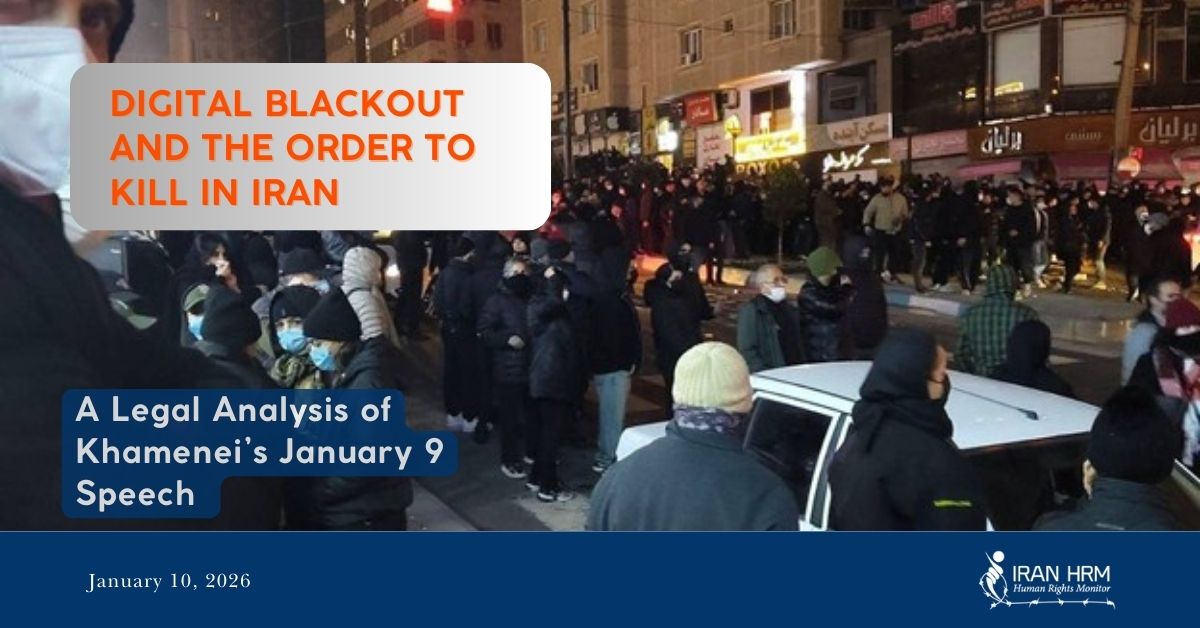
On the twelfth day of the nationwide uprising in January 2026, the Islamic Republic regime has initiated a new phase of confrontation against the collective will of the Iranian people through a combination of “Digital Terrorism” and an “Explicit Order for Suppression.” Ali Khamenei’s speech yesterday in Qom was not a religious oration but an operational manual for the regime’s killing machine, issued amidst an atmosphere of “absolute information blackout.”

1. The Order for Naked and blatant Suppression Under the Guise of Religion
On January 9, 2026, using rhetoric that directly violates Articles 19 and 20 of the Universal Declaration of Human Rights, Ali Khamenei labeled protesters as “a bunch of vandals,” “mercenaries,” and “harmful elements.” By stating, “We will not back down against the vandals,” he effectively gave the final green light to the Islamic Revolutionary Guard Corps (IRGC) and repressive forces to use combat weapons.
From the perspective of international law, when the highest official of a country labels his protesting and unarmed citizens as “terrorists” and “insurgents” (Baqi), he lays the groundwork for crimes against humanity, and the direct responsibility for any bloodshed lies with him personally.
Excerpt from Ali Khamenei’s Speech (Qom – January 9, 2026) and the Supplementary Judicial Order: “The security forces—whether in the Law Enforcement Command (FARAJA), the Basij, or the IRGC—must be in the field with full authority. There must be no backing down against the vandals and those who deprive the people of security; these are not protesters; they are hired mercenaries and agents of the enemy. The judiciary is obligated to deal with the main elements and leaders of these riots with decisiveness and without the slightest leniency.” Immediately following this speech, Gholamhossein Mohseni-Ejei, the Chief of the Judiciary, issued a directive to judicial authorities nationwide, stating: “Following the Supreme Leader’s remarks, judges are duty-bound to issue deterrent sentences and the maximum punishment for the primary elements of the riots with utmost speed, decisiveness, and without any legal leniency.” (Sources: IRNA News Agency, Fars state-run news agency)
2. Internet Shutdown: Engineering a Massacre in Silence
Concurrent with this speech, technical reports and sources from the Iranian Resistance indicate a total and nationwide shutdown of international internet in Iran. This action goes beyond simple censorship; it is a “security preparation” for a bloody crackdown.
- The Experience of November 2019: History has shown that internet shutdowns in Iran are always a prelude to widespread killings in the streets to prevent the documentation of crimes.
- Violation of the Right to Life: Cutting off communication tools during a crisis makes it impossible for the wounded to access medical aid and for families to know the fate of their loved ones, which constitutes a clear example of collective psychological torture.
- Verified Statistics of Martyrs and Detainees
According to reports from Iran Human Rights Monitoring (Iran HRM), the dimensions of the catastrophe have been verified as follows:
- Number of Deceased: At least 54 protesters (including at least 9 children) have been killed by direct fire from security forces. The death toll is significantly higher and will be announced after further verification.
- Mass Arrests: More than 2,200 people have been arrested in various cities, many of whom are held in secret detention centers (such as Soroush in Mashhad) undergoing torture for forced confessions.
- Points of Conflict: The scope of the uprising has expanded to more than 285 locations across the country, indicating the failure of the regime’s strategy of fear and terror.
- Legal Warning to the International Community
Khamenei’s speech, coinciding with Chief Justice Mohseni-Ejei’s order for “swift and decisive trials,” has sounded the alarm for mass executions. According to international law:
- The use of combat weapons against peaceful gatherings is a blatant instance of a crime.
- Depriving detainees of independent legal counsel and a fair trial is a violation of Article 14 of the International Covenant on Civil and Political Rights (ICCPR).
Conclusion:
Today, Iran stands at a historic turning point. By ordering “not to back down,” Khamenei effectively shouted the regime’s strategic failure in the face of the uprising. The internet shutdown is a desperate attempt to hide the rage of millions of people who, according to Resistance sources, shook the foundations of the sovereign power on the evening of January 8. The international community must not allow the internet blackout to become a “license for massacre.”
Urgent Call and Obligations of the International Community to Prevent Another Massacre
- Referral of the Case to the Security Council: The international community is duty-bound to immediately refer the case of gross and systematic human rights violations in Iran—especially the recent enforced disappearances and extrajudicial executions—to the UN Security Council so that international deterrent measures can be taken.
- Dispatching an Emergency Fact-Finding Mission: Immediate dispatch of international delegations to conduct unsupervised visits to prisons such as Evin, Fashafuyeh, Karaj, and particularly secret detention centers (like Soroush) to prevent torture and the execution of death sentences for detainees.
- Facilitating Free Access to the Internet: We call on the UN, member states, and the International Telecommunication Union (ITU) to condemn the “cyber siege” and take immediate technical measures to provide free international internet access to the people of Iran to prevent crimes committed in silence.
- Applying Universal Jurisdiction: Identifying and internationally prosecuting officials of secret detention centers, prison heads, and commanders of suppression involved in the torture and murder of protesters, based on the principle of universal jurisdiction.
- Stark Condemnation of “Swift Trials”: The international community must apply maximum diplomatic pressure to halt judicial orders for “swift and decisive trials,” as these orders effectively mean issuing death sentences without following any legal due process.
- Breaking the Silence Against Suppression: We warn that any silence or delay in a decisive international response within the framework of global laws is equivalent to granting a license to the regime to repeat atrocities such as the 1988 massacre.
The world is responsible; the internet blackout must not be the silence before a massacre.