Absolute Concentration of Power, Systematic Suppression of Protests, Use of the Death Penalty, and Command Responsibility at the Highest Level
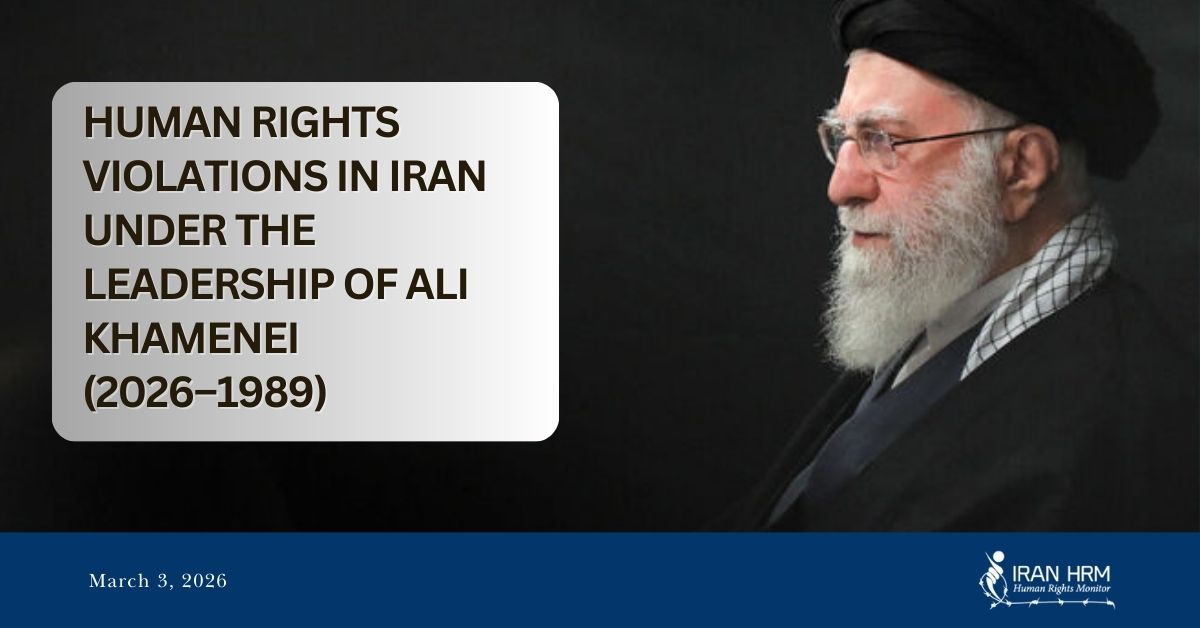
From June 1989 to 2026, Ali Khamenei has occupied a position that, under the Constitution of the Islamic Republic of Iran, grants him ultimate authority over the armed forces, the Islamic Revolutionary Guard Corps (IRGC), the Basij, the judiciary, state broadcasting, and key supervisory institutions. This unparalleled concentration of power places him at the apex of the country’s political, security, and judicial chain of command.

Within such a structure, decisions concerning the use of lethal force, responses to nationwide protests, judicial policies including the implementation of capital punishment, and large-scale security mechanisms cannot reasonably be conceived without the awareness and will of the highest authority of the state.
Over these three decades, a consistent pattern is observable:
- Suppression of public protests through live ammunition and mass arrests;
- Repeated use of the death penalty at rates unprecedented in global comparison;
- Documented reports of torture, forced confessions, and systematic denial of medical care to detainees;
- Nationwide internet shutdowns during critical periods to obscure the scale of violence;
- Structural impunity for officials involved in these violations.
This trajectory reflects the functioning of a centralized power structure in which the “preservation of the regime” is defined as the absolute priority.
Official statements and speeches by Ali Khamenei during protest periods — describing demonstrators as “seditionists,” “rioters,” or “mohareb” (those who wage war against God), and calling for “decisive” and “uncompromising” action — demonstrate alignment between the state’s rhetoric and the operational conduct of security forces on the ground.
The persistence of this pattern over more than three decades raises serious questions of command responsibility under international law; a standard based on effective control over subordinate forces, awareness of violations, and failure to prevent or punish perpetrators.
What follows in this report provides an analytical framework for understanding a sustained model of repression in which state power has consistently been prioritized over the fundamental rights of citizens.
Part One – Concentration of Power and the Pattern of Suppression of Nationwide Protests (1999–2026)
1-Structural Concentration of Power and the Chain of Command
Under the Constitution of the Islamic Republic of Iran, the Supreme Leader serves as Commander-in-Chief of the Armed Forces and appoints the commanders of the IRGC, the Basij, the Army, the Law Enforcement Command (Faraja), the Head of the Judiciary, and the head of the state broadcasting organization. Half of the Guardian Council members are directly appointed by him, while the remaining half are nominated through the Head of the Judiciary, who is himself appointed by the Leader.
This mechanism centralizes effective control over military, security, and judicial structures at the highest level.
Within such a framework, decisions regarding the use of lethal force against protesters, the treatment of detainees, and the level of accountability imposed on security forces are linked to the leadership position within the chain of command.
Since 1999, nationwide protests have occurred at several key moments; each time, they have been met with a similar operational pattern.
2-The 1999 Uprising
On 18 July 1999, security forces and plainclothes agents attacked the Tehran University dormitories, marking a turning point in the government’s response to student protests. Reports documented widespread beatings, property destruction, and the arrest of approximately 1,400 individuals. Several deaths were reported, along with cases of enforced disappearance.
Subsequently, the protests were labeled “sedition,” and the security crackdown intensified. This episode consolidated the pattern of security labeling prior to coercive intervention.
3-The 2009 Uprising
Following the 12 June 2009 presidential election, large-scale protests erupted in Tehran and other cities.
On 19 June 2009, Ali Khamenei declared in his Friday sermon:
“If political elites seek to violate the law, they themselves will be responsible for the bloodshed and violence.”
Following this speech, the presence of Basij and security forces in the streets expanded. Reports indicated dozens killed, thousands arrested, and torture in detention facilities such as Kahrizak.
In December 2009, authorities declared that they would “extinguish the eye of sedition.” The label “sedition” became the official framework legitimizing security suppression.
4-The 2019 Uprising
On 15 November 2019, nationwide protests erupted following a sudden increase in fuel prices. Reuters reported that Ali Khamenei told security officials in a meeting:
“The Islamic Republic is in danger. Do whatever is necessary to end it.”
In the following days, widespread use of live ammunition was reported. Amnesty International confirmed at least 323 deaths; Reuters reported approximately 1,500 fatalities. Thousands were arrested.
Simultaneously, internet access was almost entirely shut down nationwide, obstructing independent reporting on the scale of the crackdown. Khamenei described protesters as “thugs” and “malicious.”
5-The 2022 Uprising
In September 2022, nationwide protests erupted following the death of Mahsa Amini in custody and spread to dozens of cities.
Ali Khamenei described the protests as “riots” and “enemy plots” and praised Basij forces for confronting demonstrators.
Human rights organizations documented the deaths of hundreds, including dozens of children. The use of pellet guns and mass arrests was reported. At the same time, heavy sentences and several executions linked to protest cases were carried out.
6-The 2025–2026 Uprising
In late 2025 and January 2026, widespread protests emerged amid deep economic crisis and currency collapse. Reports indicated extensive military deployment, use of heavy weapons, and severe internet disruption.
On 9 January 2026, Ali Khamenei stated:
“Security forces must be present in the field with full authority.”
On 17 January 2026, he added:
“The Iranian nation must break the backs of the seditionists.”
Casualty figures vary and require independent verification; however, the scale of killings in the streets, mass arrests, and the intensity of the security response in this period have been described in certain UN and Amnesty International reports as potentially amounting to crimes against humanity.
Analytical Conclusion of Part One
Across the uprisings of 1999, 2009, 2019, 2022, and 2025–2026, recurring elements are evident:
- Security labeling of protests;
- Public statements by the Leader calling for decisive action;
- Deployment of IRGC, Basij, and Faraja forces;
- Use of live ammunition at critical moments;
- Mass arrests;
- Nationwide internet shutdowns in recent years;
- Lack of effective accountability for perpetrators.
The persistence of this pattern over more than three decades reflects a structure of unaccountable centralized power in which the use of security instruments against public protest has become an entrenched component of governance.
Yet the repression visible in the streets represents only one layer of control; the following section examines how the judiciary, the prison system, and the systematic use of capital punishment have institutionalized this pattern within the legal and penal framework.