Over the past three weeks since the nationwide uprising began in Iran, the country has witnessed one of the most extensive and violent waves of state repression in decades. As protests have spread, the Islamic Republic’s security, judicial, and military apparatuses have responded with unprecedented speed and brutality—resorting to mass arrests, torture, executions, and the violent and lethal suppression of demonstrators. Eyewitness testimonies, official reports from state-controlled media, and statements by senior regime officials together paint a shocking picture of the current situation in the country.

Official Government Positions: Unrestrained and Unashamed Endorsement of Repression
In recent days, officials of the Islamic Republic have not only made no effort to deny the repression but have openly and threateningly emphasized the continuation of harsh measures. These statements make clear that the suppression of protesters is not an aberration or a momentary reaction, but rather part of a deliberate, organized state policy.
Interview with Ali Salehi on IRINN TV – 17 January 2026
In an interview broadcast on 17 January 2026 on IRINN TV, Ali Salehi, responding to the U.S. President’s call to halt executions, stated sharply:
“Our response to rioters is firm, deterrent, and direct.”
He added: “Indictments have been issued in a large number of cases related to the protests, and these cases have been sent to court.”
These remarks demonstrate that the judiciary not only has no intention of reducing the intensity of repression but is accelerating the issuance and implementation of severe sentences.
Khamenei’s Speech – 27 Dey 1404 (17 January 2026)
In a televised speech on January 17, the Supreme Leader of the Islamic Republic once again emphasized the need for harsh measures against protesters. He stated:
“Officials must swiftly punish domestic offenders.”
He referred to “international criminals,” claiming they were behind the ‘sedition.’
And most significantly, for the first time he admitted that “several thousand people” had been killed in the recent protests—yet, in the regime’s habitual pattern of deflecting responsibility from itself, its leadership, and its security forces, he attributed the killings to external actors.
This admission—reported only by international media and still absent from any official publication inside Iran—reveals the vast scale of the killings carried out against protesters.
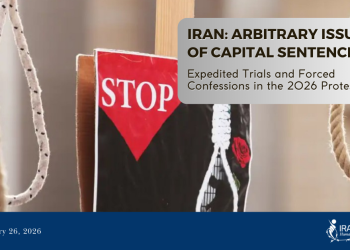
Wave of Executions: One Execution Every Two Hours
During the first two weeks of the protests, from December 28, 2025, to January 11, 2026, at least 143 people were executed. But in the third week, the pace of executions escalated dramatically:
10 January – 11 executions
Carried out in the prisons of Khorramabad, Kermanshah, Hamedan, Dezful, Nahavand, Karaj (Central), and Aligudarz.
11 January – 9 executions
In the prisons of Borujerd, Qom, Ardabil, Qazvin, Tabriz, Arak, Semnan, and Bandar Abbas.
12 January – 12 executions
In the prisons of Gorgan, Nishapur, Dorud, Zanjan, Saveh, Kerman, Kashan, Nowshahr, and Isfahan.
Execution of a woman: Arta Saei, in Nowshahr Prison.
13 January – 14 executions
In the prisons of Birjand, Ilam, Ahvaz, Yazd, Jiroft, Borazjan, Bam, Khaf, Gonabad, Sanandaj, and Lakan (Rasht).
Execution of a woman: Akram Rezaei, in Lakan Prison, Rasht.
14 January – 18 executions
In the prisons of Mahabad, Kashmar, Shahr-e Kord, Bojnurd, Sabzevar, Adelabad (Shiraz), Bushehr, Chabahar, Damghan, Malayer, Quchan, Ferdows, and Esfarayen.
15 January – 4 executions
In the prisons of Behbahan, Mahshahr, Sari, and Taybad.
In just six days, 68 executions were recorded, excluding Jan. 16 and 17, whose figures have not yet been released—the total number reaches 211 executions in three weeks of the uprising, meaning one execution every two hours.
The rising hourly average of executions clearly demonstrates that the regime has no intention of reducing its repression; on the contrary, it is intensifying it as time goes on.
Mass Arrests: The Regime’s Own Admissions Reveal the Scale of Repression
The scale of arrests has become so vast that even state-controlled media have been forced to acknowledge parts of it. Last week, reliable sources inside the country, reported that over 50,000 people have been detained.
Gilan Province – On Jan. 17, the Tasnim News Agency acknowledged the arrest of 1,500 people in Gilan Province, quoting provincial SSF commander Hossein Hasanpour, who stated that 50 detainees were being charged with “leading the protests.”
Mashhad – On Jan. 17, the newspaper Hamshahri confirmed the arrest of 110 people in Mashhad, quoting the Chief Prosecutor of Razavi Khorasan Province, who stated that the arrests were “related to the protests.”
Ministry of Intelligence – In a statement issued during the third week of the uprising, the Ministry of Intelligence announced the arrest of 12 Baha’i citizens and the summoning of 13 others in the provinces of Razavi Khorasan, Tehran, Kerman, Yazd, Sistan and Baluchestan, Alborz, Kermanshah, and Mazandaran. The Ministry explicitly stated that these arrests and summonses were “related to the nationwide protests of 1404.”
Additional arrests reported in state media include:
- Tehran – 4 arrests?!
- Shahriar and Semnan – 3 arrests?!
- Ardabil, Rasht, Tehran – 3 arrests?!
(Charges: “disturbing public order and security,” “setting fire to government buildings.”) - Karaj – 5 arrests?!
(Charge: “damaging a police station and police vehicles.”) - Marvdasht – 1 arrest?!
These figures represent only the tip of the iceberg. Field reports indicate widespread night raids, enforced disappearances, torture, and families left without any information about their loved ones.
Night Raids and Torture in Khuzestan: Detailed Accounts
A new wave of night-time arrests has been reported in Khuzestan Province:
- 9 – Ramhormoz:
Omid Pazaveh was arrested at 4 a.m. after security forces raided his family home without presenting a judicial warrant. He was taken to an undisclosed location. - 10 – Ramhormoz:
Mahan Khoshesteh was arrested in a similar operation. He was subjected to severe physical abuse, resulting in a broken jaw, and his condition has been described as critical. Due to overcrowding of detainees, he was transferred to Ahvaz. His family has received no information about his whereabouts or medical condition.
Families report that none of the detainees have been allowed phone calls, and their daily attempts to obtain information from SSF headquarters have been ignored.
Killings Inside Hospitals: Attacks on Wounded Protesters Under Medical Care
The available images constitute clear evidence of organized state violence against citizens targeted solely for participating in protests—violence that has extended not only into the streets but also into hospital settings.
The individuals shown were alive and receiving medical treatment when brought to healthcare facilities. Visible medical indicators—such as airway tubes, urinary catheters, cardiac monitoring electrodes, and signs of emergency resuscitation—demonstrate that they were undergoing active treatment.
Under established medical and legal protocols, if a patient dies naturally in a hospital, all medical equipment must be removed and the body properly prepared for transfer to the morgue. The transfer of bodies while still connected to medical equipment, in violation of all hospital procedures, strongly suggests that these individuals were killed while under medical care.
Eyewitness Testimonies: A Direct Picture of Crimes Against Humanity
Behesht-e Zahra Cemetery – Tehran
- “Since this morning (14 January), the crowd has become so overwhelming that the issue of payment for releasing the bodies of protesters to their families has been dropped. They’re not even charging for burial costs anymore and say they will hand over the bodies more quickly.”
- “Since this morning, they’ve started placing the fingers of unidentified bodies on a scanner. A photo, national ID number, and name appear on a monitor in front of a large group of people. If a name you recognize appears, it means your loved one has been killed.”
- “A family came to collect a body. They were told they had two options:
One form states the body belonged to an active Basij member and will be registered as a martyr.
The other form requires them to sign that three individuals—whom they had never seen—killed their child, and they must demand their execution.”
(A coercive tactic to shift responsibility for potential executions of detained protesters onto families of victims.)
Shiraz – Thursday, Jan. 8
“On Thursday, Jan. 8, people in Shiraz marched toward the state broadcasting building, where security forces attacked and opened fire on demonstrators.”
Nationwide Accounts of Widespread Protests and Brutal Repression
“People were out in the streets in unprecedented numbers, in cities both large and small.”
“Many cities would have fallen if armed regime forces had not opened fire on the people.”
“For the first time, entire families joined the protests—from grandparents to grandchildren.”
“If they hadn’t massacred people, the regime would have fallen. There were so many people that with stones and slingshots alone, the job would have been finished that Friday.”
“Tell the whole world they opened fire on everyone that Friday.”
Tehran – A City in Crisis
“No one can comprehend how catastrophic the situation is inside the country, especially in Tehran.”
“They roam the city. Whenever someone’s child is killed, they tell the family to declare that ‘terrorists’ killed them so the regime can register them as martyrs and allow a funeral banner and ceremony, but the people resist.”
Eastern Iran – Mashhad
“A massacre on the scale of the Mahshahr marshes has taken place.”
(Referring to the November 2019 crackdown, when security forces surrounded protesters who had taken refuge in the marshes near Mahshahr and opened fire using heavy weapons and armored vehicles.)
“A Revolutionary Guard agent was calmly aiming for people’s heads.”
Western Iran – Kermanshah
“Authorities are refusing to hand over the bodies of those killed in the protests.”
“They have imposed harsh conditions for burial.”
“Security forces force families to bury their loved ones between 3 and 5 a.m., allowing only immediate family members to attend.”
Shahreza, Isfahan Province – Use of Military-Grade Weapons
“The violence in Shahreza has taken on the scale of warfare. Eyewitnesses say regime forces deployed shoulder-fired launchers (RPGs) against civilians. Municipal workers spent the entire night washing blood from the streets.”
“To reduce the official death toll, the regime has abandoned bodies in the outskirts of Shahreza. Families are pressured to declare their children Basij members in order to retrieve the bodies, but many refuse.”
“Hospitals are overwhelmed, and wounded protesters are dying after avoiding treatment out of fear of arrest.”
Marvdasht – Over 100 Killed
“For two days, the city was completely in the hands of the people until the regime deployed heavy military forces and opened fire, imposing martial law. The death toll is estimated at over 100.”
“Regime forces chased down a young athlete from Marvdasht who had escaped arrest in the street and killed him inside his home with a direct shot to his head.”
Ardabil
“Reports indicate that around 200 people have been killed in Ardabil.”
Testimony of Robina Aminian’s Mother
“Robina was shot from behind at close range at her head. The family was taken to a location near her university, where they saw dozens—if not hundreds—of young people who had been killed, most between 18 and 22 years old, with visible gunshot wounds to the head and neck.”
“It wasn’t just my daughter; I saw hundreds of bodies with my own eyes.”
“After much struggle, they finally handed over Robina’s body, but our home in Kermanshah was surrounded, and we were not allowed to hold a funeral. We were forced to bury her on the road between Kermanshah and Kamyaran.”
“To this day, we have not been allowed to hold any memorial or mourning ceremony.”
The Responsibility the World Must Shoulder
What is unfolding in Iran today is not a temporary crisis but a full-scale humanitarian catastrophe. The government, using every instrument of repression—from mass executions and widespread arrests to direct gunfire on protesters, enforced disappearances, night-time burials, and killings inside hospitals—is systematically destroying the fundamental rights of its citizens and, by its own admissions, committing crimes against humanity.
The scale of these atrocities places an unprecedented responsibility on the international community. Silence and inaction in the face of such crimes amount to complicity. To prevent the further escalation of this catastrophe, the following actions are urgently required:
- Immediate deployment of independent UN fact-finding missions to investigate killings, arrests, and executions on the ground
- Referral of the case of widespread human rights violations and crimes against humanity in Iran to the UN Security Council
- Activation of international justice mechanisms to hold perpetrators and commanders accountable
- Coordinated political, legal, and diplomatic pressure to halt executions and state violence
- Unconditional release of all individuals detained during the protests and an end to torture and enforced disappearances
- Support for the families of victims and protection of their rights to truth, mourning, and justice
- Rigorous, independent documentation to prevent the destruction of evidence and enable future prosecutions
- Taking decisive measures for the immediate release of detained protesters.
Until these measures are not taken, the humanitarian catastrophe in Iran will not only continue but deepen with each passing day.