The Strategy of “Denial” as a Tool of Repression
Following the widespread protests in January 2026, the Judiciary of the Islamic Republic of Iran has established a new strategy based on “serial and coordinated denials.” The unprecedented volume of these denials does not indicate adherence to the law, but rather signals a profound lack of transparency and the calculated use of the “preliminary investigation phase” to isolate defendants and deprive them of their right to defense.

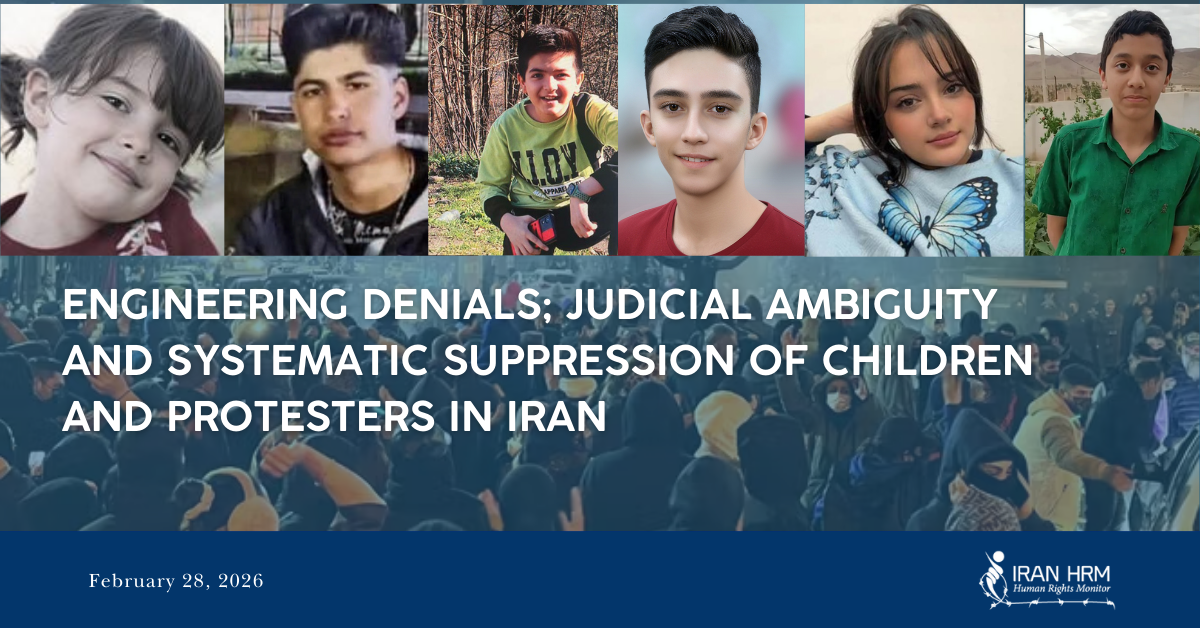
The Case of Mahsa Sarli, 12 years-old: Criminalizing Childhood
According to a report by Rokna News Agency on February 24, 2026, judicial authorities, while denying the issuance of a death sentence for Mahsa Sarli (12 years old), officially confirmed:
“The named individual has a judicial case and is in custody due to charges related to recent events… The charges against this individual are cited as ‘Propaganda against the state’ and ‘Membership in a group or association with the intent to disrupt national security’.”
Legal Analysis: The case of 12-year-old Mahsa Sarli constitutes a violation of both multiple international laws and the domestic statutes of the Islamic Republic of Iran.
I – Criminal Responsibility of a 12-Year-Old under Iranian Law
- The Inadmissibility of Prosecution for Security Crimes: Under the 2013 Islamic Penal Code (IPC):
- Individuals aged 9 to 15 do not bear adult criminal responsibility.
- In the event of an offense, only “security and educational measures” are applicable, not criminal trial and punishment.
- Conclusion: Assigning security charges to a 12-year-old lacks legal merit, and her trial in a Revolutionary or Security Court is entirely unlawful.
II – Charge of “Propaganda Against the State”
- Legal Inapplicability to a Minor: Under Article 500 of the IPC, this charge requires:
- Criminal intent (mens rea).
- Understanding the consequences of the behavior.
- The capacity for political analysis.
- Conclusion: A 12-year-old, from a developmental psychology perspective, lacks the capacity for complex political intent. Legally, such intent cannot be presumed. Any political expression by a child falls under the Right to Freedom of Expression, not a security crime.
III. Charge of “Membership in a Group with Intent to Disrupt National Security”
- Statutory Impossibility: Under Article 498 of the IPC, this crime requires:
- Conscious membership or formation.
- Security-based goal setting.
- Organizational planning or coordination.
- Conclusion: A child lacks the legal capacity for “organized membership” or the intent to “disrupt national security.” This charge is fundamentally void and legally unassignable.
IV – Violations of the Convention on the Rights of the Child (CRC)
As a signatory, Iran is bound by the CRC. Key violations include:
- Article 37: Prohibition of arbitrary detention of children.
- Article 40: Right to a specialized juvenile justice system, age-appropriate treatment, and prohibition of securitized approaches.
- Articles 13 & 15: Rights to freedom of expression and assembly.
- Article 3: The principle of the Best Interests of the Child.
V – Violation of Iran’s Code of Criminal Procedure
- By law, a child must be immediately transferred to a Juvenile Prosecution Office.
- Interrogation of children by security agents (Zabetan) is prohibited.
- Trials must occur in a Juvenile Court with a specialized counselor, a lawyer, and parents present.
- Conclusion: If the child is in security detention or tried in a Revolutionary Court, the process is entirely illegal.
VI – Violation of the Principle of Proportionality:
The securitized treatment of a 12-year-old is incompatible with the principles of juvenile rights, contradicts the goal of rehabilitation, and is considered an illegitimate state act.
Summary Findings:
The charges brought against the 12-year-old child encompass several severe violations:
- Inability to attribute security-related offenses to a minor.
- Absence of criminal responsibility for political or national security crimes.
- Direct violation of the Convention on the Rights of the Child (CRC).
- Violation of the domestic Islamic Penal Code (IPC).
- Violation of the Code of Criminal Procedure.
- Disregard for the principles of Developmental Psychology and the legal requirement of Criminal Intent (Mens Rea).
Conclusion: Legally, this case is entirely subject to annulment (voidable), and the continued detention or trial of the child lacks any valid legal basis.
The Puzzle of Coordinated Denials and the Deprivation of Defense
On February 24 and 25, 2026, dozens of state-affiliated media outlets coordinated a wave of denials regarding death sentences to keep cases in a state of “ambiguity.”
- Violation of Adjudication Standards: Holding defendants in the “preliminary investigation” phase for prolonged periods constitutes Arbitrary Detention under Article 9 of the ICCPR, as individuals are deprived of access to independent counsel and specific case details.
- Significance of Article 9 for Minors:
- Detention of children must be a last resort and for the shortest possible duration (CRC).
- Security detention without access to lawyers or parents violates both Article 9 of the ICCPR and Articles 37 and 40 of the CRC.
Admission of the Continued Detention of Minors
According to a report by Rokna, the Judiciary Spokesperson stated on February 23, 2026, while labeling protesters under the age of 18:
“There are a few individuals who committed criminal acts, and they remain in detention while their cases are being processed.”
- Legal Analysis: Labeling protesters under 18 as “criminals” before a conviction in a competent court is a violation of the Presumption of Innocence enshrined in Article 14 of the ICCPR.
The Case of the Kiani-Vafa Brothers: Justice Sacrificed for Speed
Asadollah Jafari, Chief Justice of Isfahan Province, denying the issuance of death sentences stated on February 23, 2026 (published February 25), regarding Saman, Arman, and Rahman Kiani-Vafa:
“The case of these three individuals is still in the prosecution office and the investigation stage… The Isfahan Judiciary is processing the cases of rioters with speed, precision, and decisiveness.”
- Legal Analysis: Emphasizing “speed” in cases involving capital punishment violates Article 14(3) of the ICCPR, which guarantees “adequate time and facilities for the preparation of a defense.”
- In capital cases, international standards mandate:
- Any hastiness in adjudication,
- Any limitation on the time or means of defense,
- Any pressure to accelerate proceedings,
Directly violates the right to an effective defense.
Article 14, Paragraph 3 [of the ICCPR] stipulates that the accused must:
- Have adequate time to study and examine the case file.
- Be able to consult with their legal counsel.
- Be able to prepare defense evidence and call witnesses.
- Have meaningful access to the evidence and documents used against them.
If the court or judicial authorities emphasize “speed”—particularly in capital cases—these rights are effectively extinguished.
The UN Human Rights Committee has repeatedly emphasized that capital cases must adhere to the highest standards of fair trial. Any unjustified acceleration is a flagrant violation of the Covenant, which allows no exceptions even for “security cases” or “emergencies.”
Application of this Principle in Political or Security Cases:
In cases of a political or national security nature, governments often prioritize “expediency” or “speed.” However:
- The ICCPR provides no exceptions or exemptions for national security cases regarding the right to a fair trial.
- Even in times of public emergency, the principle of a fair trial is non-derogable (cannot be suspended or restricted).
- In capital cases (those involving the death penalty), any restriction on the time allotted for defense is doubly unlawful under international standards.
Therefore, any insistence by the court or judicial authorities on the “speed of proceedings” constitutes a flagrant violation of the Covenant.
Conclusion: Denial as a Precursor to Sentencing
Coordinated denials of death sentences regarding the Kiani-Vafa brothers across numerous state outlets are a strategic attempt to saturate the media space and quell international outcry. This tactic allows the Judiciary to complete an unfair trial process in silence during the investigation phase.
Urgent Demands Based on International Conventions
- Legal and Familial Access (Article 14 ICCPR & Article 37 CRC): We demand immediate pressure on Iran to allow unconditional access for independent lawyers, and access for human rights bodies to the families of Mahsa Sarli and the Kiani-Vafa brothers without fear of reprisal. Concealing a detainee’s status from their family constitutes Psychological Torture.
- Cessation of Child Detention (Article 37 CRC): We call upon the UN Committee on the Rights of the Child to compel Iran to immediately release minors isolated in security detentions under the vague pretexts of “preliminary investigations” and “criminal charges.”
- Prohibition of Forced Confessions (Article 7 ICCPR & CAT): Given the ambiguity of the prosecution stage, the international community must demand guarantees that no verdict be issued based on confessions extracted within the isolated environment of preliminary investigations.