Situation Overview
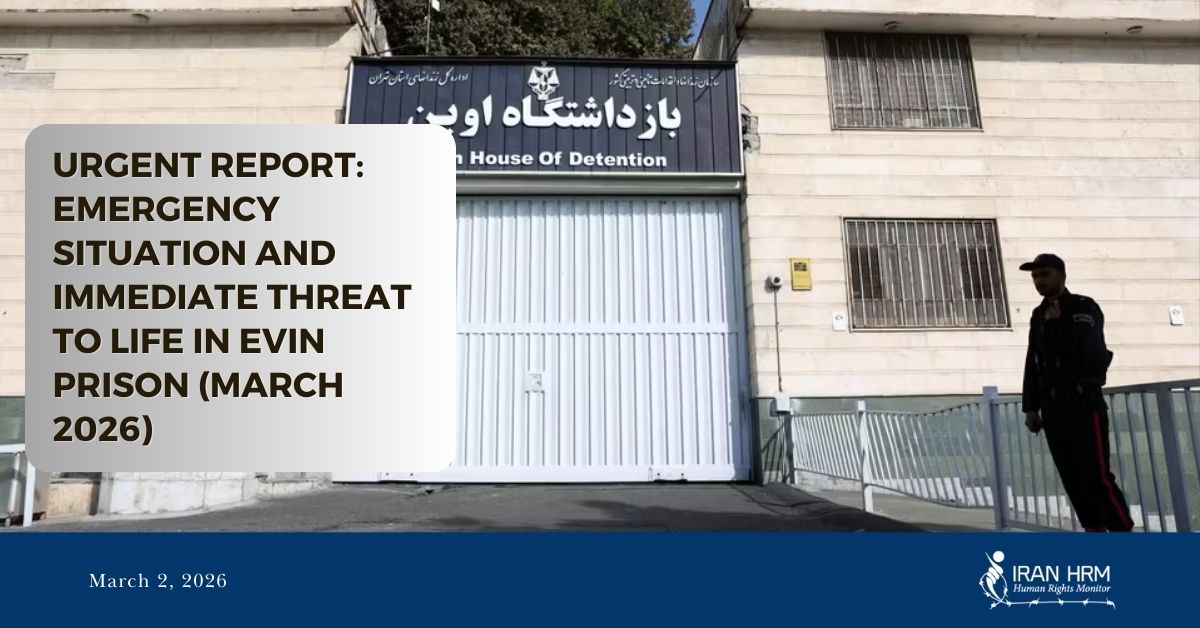
Field reports and credible sources indicate a total collapse of the administrative and management structure at Evin Prison coinciding with the escalation of military conflicts. According to available evidence, administrative personnel have abandoned their posts, effectively ceasing all supervision over the provision of prisoners’ essential life-sustaining needs. This situation has placed hundreds of political and ideological prisoners—who are confined in a closed environment with no means of self-defense or means to provide themselves – in grave and immediate danger.

Humanitarian Crisis: Starvation and Deprivation of Necessities
- Women’s Ward and Ward 7: Reports confirm that food distribution has been entirely halted. In several wards, only negligible amounts of bread have been provided.
- Cessation of Services: The closure of the prison commissary (store) and the total lack of accountability from officials have eliminated any possibility for prisoners to self-provide basic biological needs.
- Violation of Human Dignity: Abandoning prisoners without food in a confined space from which they cannot exit constitutes a flagrant example of “Inhuman and Degrading Treatment.”
International Legal Framework (Violations of International Law)
When prisoners in Evin are deliberately locked in wards, abandoned by guards, and left without food or care—including political prisoners—international law strictly and explicitly prohibits such conditions. This is no longer merely “misconduct”; it constitutes a severe violation of human rights and, under these circumstances, is classified as inhuman treatment or torture.
The key legal provisions prohibiting these conditions are as follows
I. Article 6 of the ICCPR – The Right to Life
The state is obligated to ensure that no one is arbitrarily exposed to the risk of death. Abandoning prisoners without food, water, or medical care—while preventing their exit—is a direct violation of the Right to Life, even if death has not yet occurred.
II. Article 7 of the ICCPR – Prohibition of Torture and Inhuman Treatment
Leaving prisoners in a state of starvation, without medical care, and in the face of imminent danger falls squarely within the definition of inhuman treatment and torture.
III. The United Nations Standard Minimum Rules for the Treatment of Prisoners (The Nelson Mandela Rules)
- Rule 1: Human dignity must be respected at all times.
- Rules 22–26: The state is strictly obligated to provide adequate food, water, and medical care.
- Rule 43: The deprivation of a prisoner’s basic needs is absolutely prohibited.
Convention Against Torture (CAT)
If the state’s actions are intentional (e.g., deliberate abandonment by guards), this constitutes torture and cruel, inhuman punishment, causing severe physical and mental suffering.
Article 10 & Article 9 of the ICCPR
The state has a “Positive Obligation” to ensure the physical and psychological security of detainees. Relinquishing this duty is a flagrant violation of the security of the person.
Why is this a “Gross Violation”?
The state exercises total control over prisoners; the prisoners have no means of self-defense or exit. The state has a positive obligation to provide essentials. Abandonment effectively exposes them to “Constructive Death,” disease, and extreme suffering.
Under international law, this situation can be characterized as:
- Constructive death (Indirect killing)
- Torture through deprivation
- Systematic inhuman treatment
- Violation of the right to life
Regarding political prisoners, legal sensitivity is heightened because:
- The nature of their detention is typically political.
- Their treatment is subject to rigorous oversight by international bodies.
- Depriving them of food and care can constitute political persecution.
- Such conduct can be examined within the framework of “Crimes Against Humanity” if it is widespread or systematic.
In the situation described, the most critical provisions of international law that have been violated include:
- Article 6 of the ICCPR (Right to Life)
- Article 7 of the ICCPR (Prohibition of Torture)
- Article 10 of the ICCPR (Humane Treatment of Prisoners)
- The Nelson Mandela Rules (Provision of food, water, and medical care) – United Nations Office on Drugs and Crime (UNODC)
- Convention Against Torture (CAT)
This situation is legally of the utmost gravity and is actionable at the international level.
Invocation of Domestic Law: Resolution No. 211 of the Supreme Judicial Council
Iranian domestic law has anticipated such circumstances; failure to implement these laws constitutes “Criminal Omission.”
Resolution No. 211 (Dated January 12, 1987 / Dey 22, 1365):
In emergency situations arising from war, this regulation explicitly mandates the Judiciary to protect prisoners’ lives through:
- Immediate conversion of custodial orders and granting of Urgent Parole.
- Maximum leniency in accepting bail or sureties to evacuate wards.
- Temporary Release of Low-Risk Prisoners: Prosecutors are mandated to release prisoners who do not pose a threat to society until the emergency is lifted.
- Transfer of high-risk prisoners to standardized safe shelters.
- Violations of the Constitution of the Islamic Republic of Iran:
- Article 22: Immunity of life and dignity from violation.
- Article 38: Prohibition of torture (deprivation of food/water is a form of torture).
- Article 39: Prohibition of the violation of the dignity of detainees.
- Article 156: The Judiciary’s duty to restore public rights and implement justice. This situation demonstrates a dereliction of duty and the failure to uphold [or restore] the rights of prisoners.
IV. Law on Respecting Legitimate Freedoms and Protecting Citizens’ Rights (2004):
This law is one of the most significant domestic instruments regarding the rights of prisoners. Key articles that have been violated include:
- Article 6 — Officers must treat suspects and prisoners with humanity.
- Article 9 — Holding individuals in inappropriate and inhuman conditions is prohibited.
- Article 14 — Depriving prisoners of their fundamental rights is prohibited.
- Article 15 — Officers are obligated to ensure the health and security of the prisoner.
- Executive Regulations of the Prisons Organization:
This regulation contains the most detailed provisions regarding the treatment of prisoners. Key articles that have been violated include:
- Article 87 — Prisoners must receive sufficient, healthy, and appropriate food.
- Article 102 — Prisoners must have access to safe drinking water.
- Article 113 — The prison is obligated to ensure environmental hygiene and the health of the prisoners.
- Article 117 — Prison officials are mandated to be present in the wards and provide supervision.
- Article 120 — It is prohibited to abandon the place of detention of prisoners without a designated substitute or guard.
- Article 234 — Any inhuman, degrading, or health-threatening behavior toward a prisoner is prohibited.
Locking the ward doors and abandoning prisoners without supervision constitutes a gross violation of these articles.
- The Islamic Penal Code
Under the current situation, the conduct of prison officials can fall under several criminal categories:
- Article 570 — Any government official who prevents individuals from exercising their rights stipulated in the Constitution is considered a criminal.
- Article 579 — Any government agent who commits torture or orders it shall be punished.
- Article 614 — Anyone who intentionally causes serious injury to another shall be subject to punishment.
- Articles 290 and 291 — An “Omission” (failure to act) that leads to death or injury can be legally classified as murder or quasi-murder (manslaughter).
Abandoning prisoners in conditions where there is a high probability of death or serious injury constitutes a “Criminal Omission.”
- The Prisons Organization Law (Passed in 1985 / 1364)
This law also defines explicit responsibilities for the prison system:
- Article 1 — The objective of the prison is rehabilitation and education, not inflicting harm.
- Article 2 — The prison is obligated to provide for the primary and basic needs of the prisoner.
- Article 5 — Prisoners must be provided with food, hygiene, and medical care.
Legal Summary
The abandonment of prisoners in Evin without food, water, care, and the presence of officers, under Iranian domestic law, constitutes:
- Violation of the Right to Life
- Inhuman Treatment and Torture
- Criminal Omission (Failure to act)
- Violation of Citizens’ Rights
- Violation of the Executive Regulations of the Prisons Organization
- Violation of Multiple Articles of the Constitution
From a legal standpoint, this creates both criminal and administrative liability for prison officials and high-ranking authorities.
Lack of Accountability to Prisoners’ Families
The lack of transparency and the failure of officials to respond to families gathered outside the prison has exacerbated the dimensions of this crisis. Given the history of fires and previous attacks on Evin, any delay in evacuation or in ensuring the security of prisoners could lead to a mass killing (massacre) resulting from famine or military conflict.
Violations of Domestic and International Law in Failing to Respond to Families
The conduct of officials in refusing to provide any information to the families gathered in front of Evin Prison, in addition to intensifying the humanitarian crisis, is a clear violation of a set of domestic and international legal obligations. This situation is analyzable at several legal levels:
1) Violation of the Domestic Laws of the Islamic Republic of Iran
- Article 32 of the Constitution: The government is obligated to immediately inform the family of the reason for detention and the status of the detained individual.
- Article 34 of the Constitution: The right to seek justice and legal recourse is guaranteed for all; lack of accountability deprives individuals of this right.
- Article 39 of the Constitution: Any violation of the honor and dignity of prisoners is prohibited; keeping families in the dark constitutes an affront to the dignity of both the prisoner and the family.
- Law on Respecting Legitimate Freedoms and Protecting Citizens’ Rights (2004):
- Articles 5 and 6: Officers are obligated to provide humane treatment and transparent information.
- Article 14: Depriving a prisoner of basic rights and keeping the family uninformed is prohibited.
- Executive Regulations of the Prisons Organization:
- Articles 182, 183, and 187: The prison is obligated to facilitate contact, information sharing, and family access to the prisoner’s status.
- Article 570 of the Islamic Penal Code: Any government official who prevents the exercise of rights stipulated in the Constitution is subject to punishment.
2) Violation of Iran’s International Obligations
As a member of the International Covenant on Civil and Political Rights (ICCPR), Iran is mandated to implement its provisions:
- Article 9 (ICCPR): Families must be informed of the place of detention and the status of the detainee; forced ignorance is a violation of this article.
- Article 7 (ICCPR): Keeping families uninformed of the fate of their loved ones is classified as psychological torture under international law.
- Article 10 (ICCPR): Humane treatment of prisoners requires transparency and the provision of information.
- UN Declaration on the Protection of All Persons from Enforced Disappearance: Failure to provide information about a prisoner’s status is a key indicator of Enforced Disappearance.
- The Nelson Mandela Rules:
- Rules 7 and 68: The prison is obligated to inform the family of the prisoner’s status and ensure communication.
3) Legal Consequence: Risk of Entering the Domain of “Enforced Disappearance”
When:
- Prisoners are in a dangerous situation,
- Families are kept uninformed of their status,
- And the government refuses to be accountable, This situation can be analyzed under international law within the framework of Enforced Disappearance; one of the most severe human rights violations that triggers the state’s serious international responsibility.
Immediate Demands and Call to Urgent Action
Given the grave danger to the lives of prisoners, the total severance of communication with their families, the lack of transparency from officials, and the recurring pattern of prisoner rights violations in Iran, a set of immediate and non-deferrable actions must be demanded by human rights organizations. These demands are not based on political concerns, but rather on the non-derogable principles of human rights and the binding obligations of the Islamic Republic of Iran under both domestic and international law:
1) Immediate Dispatch of an Independent Fact-Finding and Monitoring Mission
This demand is based on Articles 6 and 7 of the ICCPR (Right to Life and Prohibition of Torture), the Nelson Mandela Rules, and numerous reports regarding the pattern of arbitrary detentions and inhuman treatment in Iran. In circumstances where prisoners are abandoned without food, water, or care, independent monitoring is an urgent necessity to prevent a humanitarian catastrophe.
2) Guaranteeing Immediate Access for Families to Information and Communication with Prisoners
This demand is raised based on Article 9 of the ICCPR (Right to be informed of the place of detention), Article 32 of the Iranian Constitution, and the Law on Respecting Legitimate Freedoms and Protecting Citizens’ Rights. Keeping families in ignorance regarding the fate of their loved ones constitutes psychological torture under international law and, in severe cases, amounts to enforced disappearance.
3) Immediate Provision of Food, Water, Medicine, and Medical Care
This demand is grounded in Article 10 of the ICCPR (Humane treatment of prisoners), the Convention Against Torture (CAT), and the Executive Regulations of the Prisons Organization. Abandoning prisoners in conditions where they cannot provide for their basic needs is a direct violation of the Right to Life and a clear instance of inhuman treatment.
4) Compelling Authorities to Accountability and Transparency
This demand is based on Articles 34 and 39 of the Constitution, Article 570 of the Islamic Penal Code, and Iran’s international obligations regarding transparency and accountability. Failure to respond in dangerous conditions is a flagrant violation of citizenship rights and a direct threat to the lives of prisoners.
5) Diplomatic Pressure for the Implementation of Resolution 211 Compelling the Judiciary to immediately release political and ideological prisoners who are classified as “low-risk prisoners.”
6) Guaranteeing Physical Security A call to the authorities of the Islamic Republic to return to their legal duties in securing the wards or to open the doors to prevent a disaster in the event of a military attack.
Final Summary
In conditions where prisoners in Evin are facing grave danger and families are met with silence and a lack of accountability, immediate action by human rights organizations is a vital necessity. These demands are founded upon the fundamental principles of human rights, Iran’s international commitments, and domestic laws. Any delay in monitoring, informing, and securing the safety of prisoners could lead to an irreversible humanitarian disaster.