Law Enforcement Command of the Ruling Regime in Iran; Internal Security and Social Control
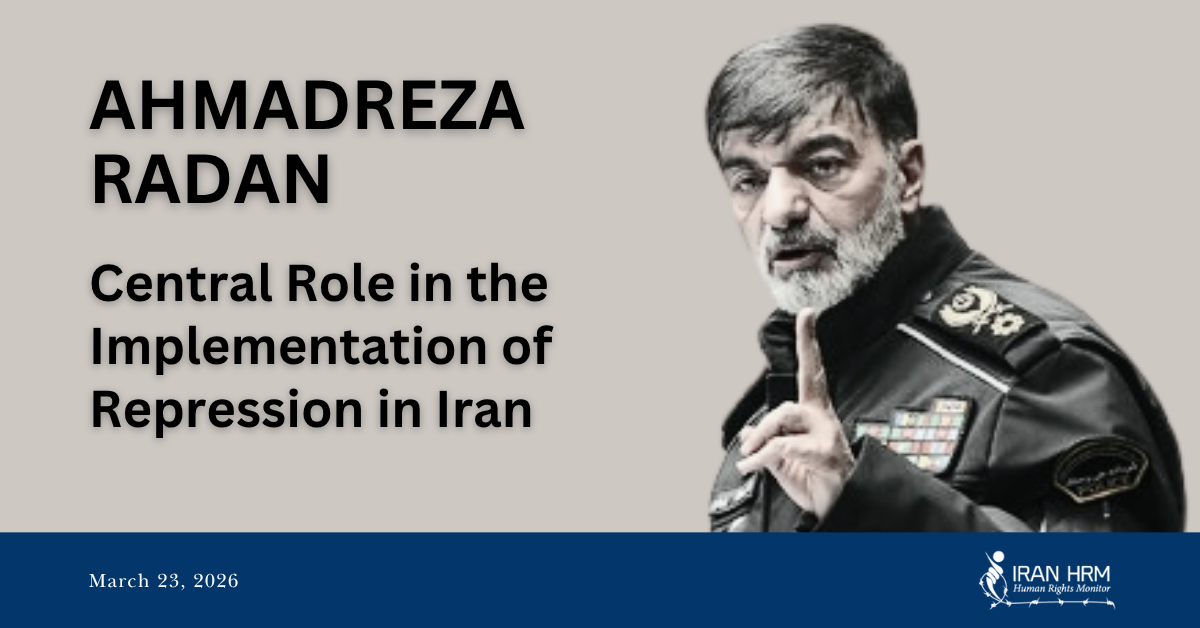
Ahmadreza Radan, the Commander-in-Chief of the Law Enforcement Command of the ruling regime in Iran (FARAJA), is considered one of the key figures in the country’s internal security structure, whose record is closely associated with the management and implementation of repressive policies against citizens, particularly in the context of nationwide protests.

An examination of his background, positions, and performance indicates that his role has not been limited to administrative command, but has extended to the design, direction, and operational execution of policies that have resulted in widespread violations of fundamental rights.
Background and Formation of a Security Role
Ahmadreza Radan was born in 1963 in Isfahan and began his activities in the early 1980s within the Basij and later the Islamic Revolutionary Guard Corps. His presence in conflict zones, particularly in Kurdistan during the Iran–Iraq war, formed his initial experience in security and military domains.
In the 1990s, alongside the transfer of IRGC personnel into the Law Enforcement Force, Radan entered this institution and gradually assumed command responsibilities in various positions, particularly in provinces with security sensitivities such as Kurdistan and Sistan and Baluchestan.
This career trajectory laid the foundation for his role as a security commander experienced in managing internal unrest.
Role in Consolidating a Repressive Pattern within the Police Force
Radan’s tenure as commander of Greater Tehran (2006–2008) represents a turning point in his record. During this period, initiatives under the title of “social security” were implemented, involving widespread and often violent confrontations with citizens, particularly women, in relation to compulsory hijab.
These initiatives were accompanied by mass arrests, street-level enforcement, and social pressure, reflecting the extension of security-oriented approaches into the daily lives of citizens. Reports from this period also documented public and degrading treatment of detainees in urban spaces, systematically violating human dignity.
Documented Cases of Human Rights Violations and Radan’s Direct Role
- Kahrizak Detention Center and Deaths of Detainees (2009)
During the 2009 protests, Radan, in his position as deputy commander of the Law Enforcement Force, played a key role in decision-making and implementation of security policies. The transfer of detainees to Kahrizak detention center, recognized as an unlawful facility, took place during this period.
At this facility, individuals including Mohsen Ruholamini, Amir Javadifar, Mohammad Kamrani, Ramin Aghazadeh Gahremani, and Ahmad Nejati-Kargar died as a result of torture, beatings, and inhumane conditions.
Testimonies from survivors refer to the role and presence of law enforcement officials in the processes of arrest and interrogation. Radan’s subsequent statements expressing no regret for his actions during that period indicate acceptance of the adopted approach.
- “Social Security Plan” and Violation of Human Dignity (2006–2008)
During Radan’s command in Tehran, policies were implemented that led to widespread confrontation with citizens in social domains.
Within these plans, public parading of detainees in degrading conditions was reported, used as a tool for social pressure. These actions drew serious human rights criticism due to violations of human dignity.
At the same time, enforcement measures against women for non-compliance with compulsory hijab intensified, and surveillance of citizens’ dress became widespread.
- Implementation of the “Noor Plan” and Intensified Repression of Women (2022–Present)
Following Radan’s reappointment in 2022, policies related to compulsory hijab intensified under frameworks such as the “Noor Plan.”
Human rights reports indicate that under these policies, women and girls have faced arbitrary arrests, physical violence, psychological pressure, and various forms of harassment.
In one reported case in 2025, violent treatment of two teenage girls provoked widespread reactions. Radan’s response, describing the conduct of officers as merely “unprofessional,” reflects the official approach to such incidents.
There have also been reports of degrading punishments imposed on women within this framework.
- Role in Protest Suppression and Mass Arrests (Particularly 2025)
During nationwide protests in recent years, particularly in 2025, forces under Radan’s command were on the front lines in confronting protesters and suppressing, killing, and arresting them.
Reports indicate widespread use of force, including direct shooting and the killing of thousands of people in the streets, including children, the elderly, and bystanders, as well as the arrest of tens of thousands across the country. Many detainees were transferred to facilities where access to basic rights was restricted, and families were left without information about their relatives.
This pattern is consistent with trends observed in previous protests.
Official Statements and Security Framing of Protests
On 10 March 2026 (19 Esfand 1404), Ahmadreza Radan stated in a televised interview:
“If someone comes to the street at the will of the enemy, we do not see them as a protester; we see them as the enemy.”
He further emphasized: “All our forces are ready with their fingers on the trigger.”
These statements reflect a framework that defines civil protests as security threats and creates conditions for the use of lethal force.
International Sanctions and Condemnations Against Ahmadreza Radan
Ahmadreza Radan has been specifically included in sanctions lists of several countries due to his direct role in human rights violations, including suppression of protests, arbitrary arrests, torture, and implementation of repressive policies against women:
United States (2010):
For his role in suppressing the 2009 protests and the Kahrizak events;
Asset freeze and financial restrictions
🔗 https://sanctionssearch.ofac.treas.gov/Details.aspx?id=12251
European Union (2011):
For arbitrary arrests, torture, and role in protest suppression;
Travel ban and asset freeze
🔗 https://eur-lex.europa.eu/legal-content/EN/TXT/?uri=CELEX:02011D0235
Canada (2024):
For direct involvement in repressive policies against women and girls;
Entry ban and asset freeze
🔗 https://www.canada.ca/en/global-affairs/news/2024/09/canada-imposes-sanctions-on-five-iranian-officials.html
Australia (2026):
For his role in violent suppression of protests;
Travel ban and financial restrictions
🔗 https://www.dfat.gov.au/news/news/20-persons-and-3-entities-listed-under-autonomous-sanctions-regulations-2011-iran
Conclusion
An examination of Ahmadreza Radan’s record shows that at various stages, including the 2009 protests, his command in Tehran, the protests after 2022, and the events of 2025, he has occupied positions in which decisions and policies led to violations of fundamental rights.
The recurrence of this pattern over more than a decade indicates a direct link between command authority and operational implementation of security policies. Available documentation suggests that his conduct has not been incidental, but rather part of a continuous process involving use of force, mass arrests, and restriction of citizens’ rights.
Within this framework, Ahmadreza Radan, as a central figure in the internal security structure, holds a key position in assessments related to accountability in the field of human rights.
These articles shed light on the backgrounds of regime officials across ministries and security institutions involved in repression and human rights violations.