Engineering Crimes Against Humanity and Political Killings Under the Shroud of War
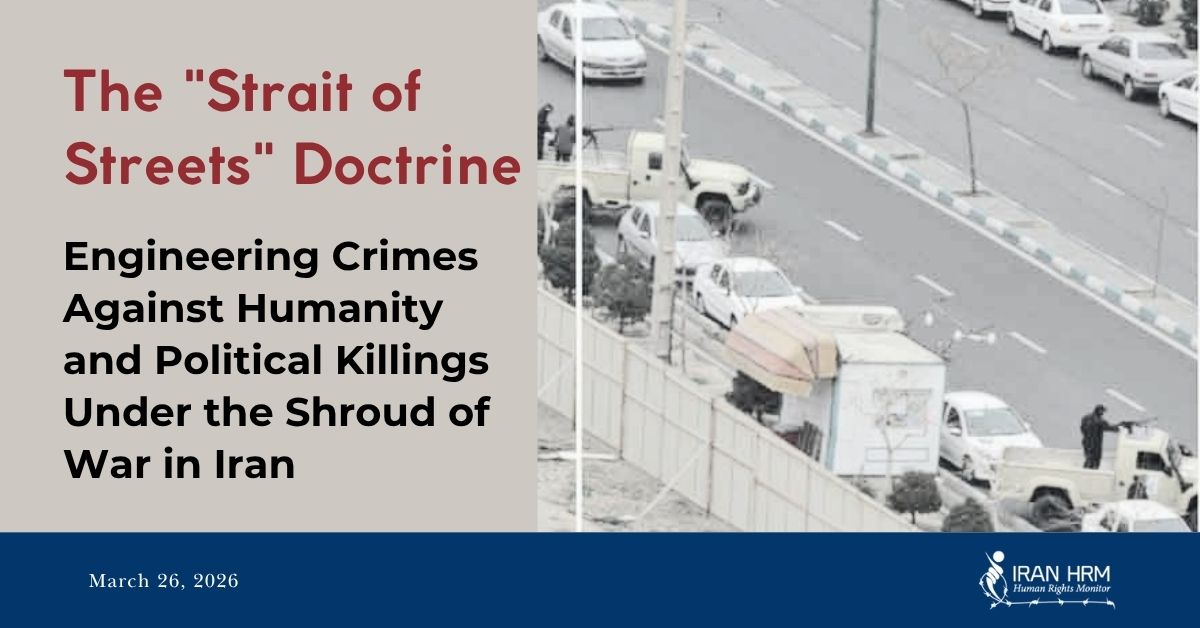
While regional tensions have reached their peak, internal narratives from Islamic Republic reveal that the “primary enemy” is not at the borders, but in the streets of Iran. Alireza Al-Davoud, a figure close to the regime’s security and media apparatus, stated with unprecedented bluntness: “More important than the Strait of Hormuz is the Strait of the Streets’; Streets are our Strait of Uhud.” (Note for readers: The Strait of Uhud is a historical Islamic military reference to a strategic mountain pass where a lapse in defense led to a near-fatal defeat for early Muslims. By invoking this, the regime identifies the “Streets” as its final, non-negotiable stronghold, the loss of which would mean the total collapse of the system.)

These remarks transcend mere metaphor; they introduce a survival doctrine: a transition from the “rule of law” to a “state of war against citizens,” where the preservation of power justifies the systematic killing of the people.
Militarization of Cities: Combat Deployment in Public Spaces
Official reports from March 23 and 24, 2026 indicate a transformation of the police presence into a full-scale combat posture. General Masoud Mossadegh, Commander of the FARAJA Special Units, announced extensive missions under the label of the “Imposed Ramadan War.” According to him, “covert and overt patrols and continuous checkpoints have been activated nationwide to confront ‘mercenaries’.” (Defa Moqaddas news agency, Asr-e Iran – March 23, 2026).
Simultaneously, Police Spokesman General Montazer-al-Mahdi confirmed the scale of this militarization with specific figures: the deployment of 1,463 special checkpoints and the utilization of 15,000 motorized and vehicular patrol units. He emphasized that over 129,000 personnel from various units have been stationed around the clock to control the situation in the streets. (Safhe-ye Eghtesad – March 24, 2026).
This unprecedented military mobilization within cities serves as evidence of the Islamic Republic’s profound fear of a renewed eruption of public anger and constitutes a flagrant violation of the Right to Liberty and Security of Person (Article 9 of the ICCPR). It demonstrates that in the event of any protest, the Islamic Republic is prepared to repeat the mass killings of January 2026.
Spy-Manufacturing and the Criminalization of Technology
Under the shroud of internet blackouts and the fog of war, the regime has launched a wave of mass arrests under the pretext of “espionage” to criminalize all forms of information dissemination:
- Ministry of Intelligence: Announced the arrest of 97 individuals on charges of links to Israel and 45 others in the provinces of Qazvin and West Azerbaijan.
- FARAJA: Arrested 6 individuals in Tehran on terrorism charges, claiming the discovery of incendiary materials.
- IRGC and Intelligence: Arrested a total of 104 citizens in the provinces of Khorasan Razavi, Markazi, Golestan, Hormozgan, and Yazd for “sending coordinates of military sites” and communicating with media outlets.
In this context, the possession of equipment such as “Starlink“ has been deliberately criminalized as espionage. These actions are a direct violation of Article 19 of the Universal Declaration of Human Rights (Freedom of Expression) and Article 14 of the ICCPR (Right to a Fair Trial); these broad charges are merely a cover for the political and physical purging of opponents during a news blackout. In many of these cases, detainees are denied access to legal counsel, and their confessions are extracted under duress and unknown conditions. The broadcasting of forced confessions is used as a tool to legitimize these arbitrary arrests.
Mock Executions and Systematic Torture
The criminal core of this repression machine is the use of medieval torture to extract forced confessions. Peyvand Naeimi, a Baha’i citizen held in Kerman Prison, has been subjected to “two mock executions” and brutal torture after two months of arbitrary detention. Officials have accused him of involvement in the events of January 8 and the killing of a Basij member, despite evidence showing he was arrested prior to that date and had no means of being present at the scene. The broadcasting of his forced confession on February 1 was solely intended to create the legal pretext for his execution.
These pressures, alongside the rapid execution of protesters like Saleh Mohammadi (a 19-year-old wrestling champion), Saeed Davoodi, and Mahdi Ghassemi—who were hanged in Qom on March 18 in public—complete the “fear engineering” puzzle. Saleh Mohammadi stated in court that his confessions were obtained under torture; however, the judiciary, in violation of Article 7 of the Covenant (Prohibition of Torture), used these invalid admissions as the basis for state-sponsored murder.
Ms. Mai Sato, the UN Special Rapporteur, emphasized in a message on X: “I have received ‘deeply concerning’ information about the execution of individuals who participated in nationwide protests; an issue that could indicate a direct link between the death penalty and political repression.”
Pressure on Religious Minorities
In the continued campaign against the Baha’i community, the following has been reported:
- Over 60 days have passed since the arrest of five Baha’i citizens in Mashhad: Payam Faridian, Sepehr Koushkbaghi, Erfan Tabatabaei, Rabie Maleki, and Navid Zarrebin. These individuals were arrested at their homes or workplaces in January and remain in Vakilabad Prison in a state of limbo. Despite persistent inquiries by their families, no clear information regarding their cases or legal status has been provided.
- Nita Babanejad and her son, Parsa Emadi, two Baha’i citizens living in Isfahan, were arrested at their home on March 5 by Intelligence agents. Ms. Babanejad was transferred to the intake ward of Dowlatabad Prison, while Mr. Emadi was taken to the Isfahan Intelligence Detention Center. They remain in arbitrary detention on charges of “propaganda against the state.”
- In Mashhad, Afarin Bashash, a Baha’i citizen, has been detained since January and remains in Vakilabad Prison in a state of legal uncertainty.
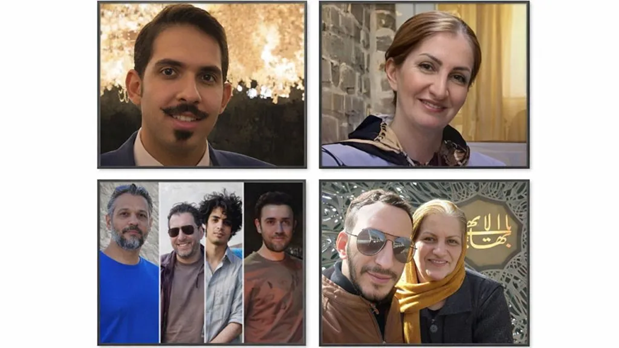
The lack of access to due process and prolonged detention constitute clear examples of inhuman treatment and a violation of Articles 9 and 14 of the International Covenant on Civil and Political Rights.
Analysis of the Repression Sequence and Survival Priority
The analysis of the Islamic Republic’s recent chain of actions—from designating the “Strait of Streets” and deploying a 129,000-strong army in public spaces to the wave of arbitrary arrests under the cover of internet blackouts and war, and finally, the use of mock executions and the killing of protesters—reveals a horrific reality: the Islamic Republic places no value on fundamental human rights or the lives of its citizens. While in times of war and international crisis, the inherent duty of any state is to protect its citizens and maintain national cohesion, the Islamic Republic has turned the “Street” into a battlefield against its own nation.
When a regime officially calls the “streets” its “Strait of Uhud” and mobilizes 129,000 troops to confront citizens, the message to the world is clear: the killing of the Iranian people is a core strategy for the survival of this government.
This planned sequence proves that the Islamic Republic views its primary enemy not on foreign fronts, but in the demands of the Iranian people. The regime is willing to embolden its killing machine against defenseless people, protesters, and religious minorities to preserve its core power, even in the midst of military conflict. This approach is a textbook example of state terrorism and systematic crimes against humanity, disregarding every moral, human, and legal boundary for its own survival.
The Necessity of Urgent Action and Ending Impunity
The international community and human rights organizations must not allow wartime rhetoric and the systematic cutting of the internet to serve as a cover for the physical purging of opponents and protesters. When the Islamic Republic officially calls the streets its “Strait of Uhud” and mobilizes 129,000 troops to confront citizens, the message to the world is clear: the killing of the Iranian people is a core strategy for the survival of this government—a government for which human rights, civil rights, and international law hold no value.
Any inaction in the face of this organized deprivation of life constitutes a tacit endorsement of a killing machine that recognizes no limits in its crimes against humanity to remain in power. Now is the time to activate the mechanism of “Universal Jurisdiction” to end the impunity of the commanders and perpetrators who seek their survival in the blood of citizens and the repression of minorities.