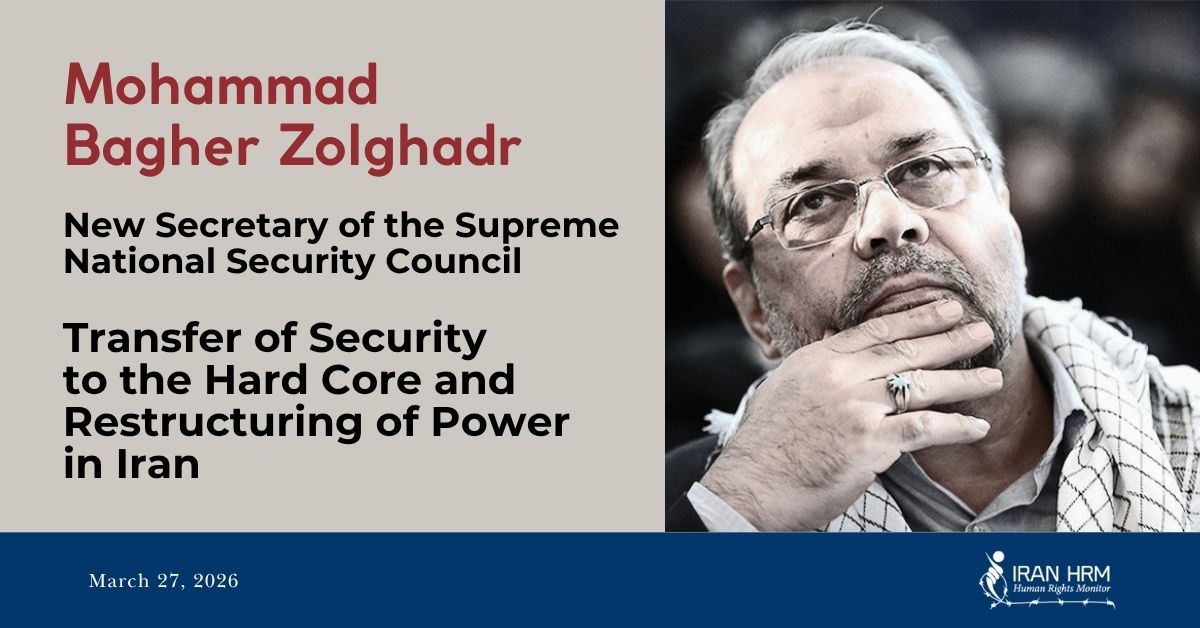
Transfer of Security to the Hard Core and Restructuring of Power in Iran
How this appointment reflects the shift of decision-making authority from the government to military-security structures and the intensification of centralized power during crisis conditions
The appointment of Mohammad Bagher Zolghadr as Secretary of the Supreme National Security Council cannot be understood merely as an administrative change. It has taken place at a time when the power structure in Iran is facing simultaneous crises in internal security, regional tensions, and political challenges.

An examination of this development indicates that the appointment is part of a broader process of restructuring the security decision-making system; a process in which the role of governmental and elected institutions in security affairs is diminishing, while the influence of the hard core military-security establishment is expanding.
In this context, Zolghadr’s appointment can be interpreted as a transfer of crisis management to figures with long-standing experience in designing and implementing security mechanisms and suppressing internal dissent.
Bagher Zolghadr; A Behind-the-Scenes Figure of the Hard Core Power Structure
Mohammad Bagher Zolghadr, born in 1954 in Fasa, is a senior IRGC commander and a long-standing figure within Iran’s security apparatus. From early involvement in armed groups before 1979 to senior positions in the IRGC, Ministry of Interior, and judiciary, his career reflects sustained influence in the design and enforcement of the regime’s security policies.
Mohammad Bagher Zolghadr is regarded as one of the oldest and most influential security figures within the Iranian power structure; a figure whose role is less visible at the executive level and more prominent within layers of strategic decision-making and security design.
His record shows that he has played key roles across several core areas in shaping and directing the security apparatus:
- Among the founders of the Islamic Revolutionary Guard Corps (IRGC)
- Commander of the Ramadan Headquarters
- Architect of proxy networks in Iraq
- A key designer of internal security structures
- Involved in engineering the 2005 election
- A member of the hard core decision-making structure
Unlike many IRGC commanders known for operational roles, Zolghadr has largely functioned as a behind-the-scenes strategist, playing a central role in designing overarching security and political mechanisms.
Role in the Ramadan Headquarters and the Formation of Proxy Warfare
Zolghadr was one of the principal commanders of the IRGC’s Ramadan Headquarters; a structure recognized as one of the earliest centers for extraterritorial operations.
In the 1980s, the Ramadan Headquarters functioned as:
- A center for planning external operations
- A platform for organizing proxy forces
- A core unit for developing asymmetric warfare
Within this framework:
- Proxy networks in Iraq were established
- Extraterritorial operations were designed and executed
- The model of proxy warfare was institutionalized
This experience positioned Zolghadr as one of the key strategists in the regime’s regional security policy.
Role in Internal Security and Political Engineering
In the 2000s, Zolghadr moved directly into the internal security structure, where his role in managing the domestic political environment became more pronounced.
One of his most significant roles was in the so-called “Basirat” plan during the 2005 presidential election. Under this plan:
- The IRGC and Basij were mobilized in an organized manner
- Electoral processes were influenced
- Mahmoud Ahmadinejad rose to power
This episode demonstrates that Zolghadr is not merely a military figure, but a strategic political-security planner operating at a high level.
Role in the Strategic Security Council and the Design of a New Security Structure
One of the most critical aspects of Zolghadr’s role lies in his position within the Strategic Security Council, a key body within the regime’s hard core.
Prior to recent developments, this council was headed by Brigadier General Gholamali Rashid, with Zolghadr serving as his deputy. Following Rashid’s death and amid escalating security crises—particularly concerns over infiltration at the highest levels—the importance of this council increased significantly.
In this context, Zolghadr played a central role in designing and restructuring the security system.
The council’s functions include:
- Designing overarching security strategies
- Coordinating security institutions
- Creating and restructuring security frameworks
These responsibilities highlight Zolghadr’s position at the core of strategic security decision-making.
Why Zolghadr? Context of Appointment in Crisis Conditions
Recent developments indicate that the Iranian power structure is moving toward greater concentration of authority in the security domain in response to escalating crises.
In this process, the Supreme National Security Council has gradually shifted from being a coordinating body among branches of government to a structure increasingly dominated by institutions affiliated with the IRGC and security networks.
This shift, combined with the reduced role of the president in security decision-making and the growing influence of military-security institutions, reflects a broader relocation of power within the system.
Under such conditions, appointing a figure like Zolghadr—with decades of experience across the IRGC, Ministry of Interior, and judiciary—indicates a need for an individual capable of consolidating this concentration of power both operationally and structurally.
Zolghadr as Both Product and Architect of the Hard Core Security System
Based on documented records, Mohammad Bagher Zolghadr’s professional trajectory reflects a continuous presence within the core structures of security decision-making; a trajectory through which he evolved from an operational actor into one of the principal architects of the regime’s security system. This trajectory can be understood through several key stages:
- Entry into early security structures
Zolghadr began his activities in 1979 within the Revolutionary Committees, specifically in the intelligence unit, a structure that played a central role in consolidating security control in the immediate post-revolutionary period. He subsequently joined the IRGC and, during the Iran-Iraq war, was responsible for training IRGC forces. This stage marked the beginning of his role in shaping military and security structures.
- Designing extraterritorial operations and proxy forces
In the 1980s, with the establishment of the Ramadan Headquarters under his command, Zolghadr played a key role in organizing extraterritorial operations and coordinating with proxy forces in Iraq. This structure later became one of the foundations of the regime’s regional strategy based on proxy warfare.
- Consolidation within top military command
During the leadership of Ali Khamenei, Zolghadr was appointed as head of the IRGC Joint Staff and later served for eight years as Deputy Commander-in-Chief of the IRGC. This period solidified his position at the highest level of military decision-making.
- Involvement in internal security structures
In the 1990s, Zolghadr’s name emerged in connection with security structures involved in politically sensitive cases, including the so-called chain murders. This reflects his presence within critical layers of internal security decision-making.
- Direct management of internal security
In 2005, Zolghadr was appointed Deputy Minister of Interior for Security and Law Enforcement, where he played a direct role in managing internal security and controlling protests.
- Role in engineering political processes
Referring to the 2005 election, he stated:
“Through a complex and multi-layered design, principlist forces were able to win the election.”
This statement indicates organized intervention in political processes and highlights his role in shaping electoral outcomes.
- Expansion of Basij and social control mechanisms
As Deputy of the Armed Forces General Staff for Basij Affairs, Zolghadr contributed to expanding this paramilitary force and strengthening its role in various aspects of social control.
- Institutionalization of security policies through the judiciary
In 2010, Zolghadr moved to the judiciary, where he held key positions, including Strategic Deputy. During this period, he contributed to shaping judicial policies in a way that increasingly aligned legal processes with security objectives, effectively institutionalizing repression.
Restructuring of the Security System; Centralization of Decision-Making
Current trends indicate a shift toward greater centralization within Iran’s security structure, accompanied by a decline in the role of intermediary institutions.
Within this framework, the Supreme National Security Council is increasingly integrated into a centralized decision-making network dominated by military and security institutions.
This transformation limits the role of elected bodies and strengthens the influence of non-accountable security actors.
Implications of the Appointment
Zolghadr’s appointment carries significant implications for both the structure of power and the human rights situation:
- Increased concentration of power within security institutions
- Reduced role of elected bodies
- Expansion of security-oriented governance
- Greater likelihood of repression in response to protests
Record of Armed Operations and Extraterritorial Activities
Prior to the revolution, Zolghadr was involved in armed operations. In 1978, Paul Grimm was killed in Ahvaz in an operation attributed to the Mansouroun group.
In subsequent years, his role in establishing the Ramadan Headquarters and extraterritorial IRGC structures became significant.
In the 1992 Mykonos assassination case in Berlin, a German court attributed responsibility to senior levels of the Iranian regime’s security apparatus. Structural analysis indicates that some perpetrators were linked to networks associated with the Ramadan Headquarters.
Security-Judicial Nexus; Formation of a Repression Cycle
Zolghadr’s career illustrates the formation of a coordinated system between security and judicial institutions, in which arrest, prosecution, and political consolidation operate within a unified framework.
This pattern has contributed to weakening judicial independence and restricting fair trial guarantees.
International Sanctions
Zolghadr is listed under United Nations Security Council Resolution 1747 (2007) and is subject to sanctions. He is also sanctioned by the United States, the European Union, the United Kingdom, and Canada.
Human Rights Analysis
Zolghadr’s record is in conflict with fundamental principles of international law, including:
- The right to life
- Freedom of expression and assembly
- Prohibition of torture
- The right to a fair trial
Conclusion
The appointment of Mohammad Bagher Zolghadr reflects a structural transformation in Iran’s security decision-making system, in which crisis management is increasingly concentrated within the hard core military-security establishment.
His record demonstrates a continuous role across three levels:
- Designing security structures
- Implementing repressive policies
- Institutionalizing these policies
This continuity positions him as a key figure in the persistence and intensification of systemic repression in Iran.