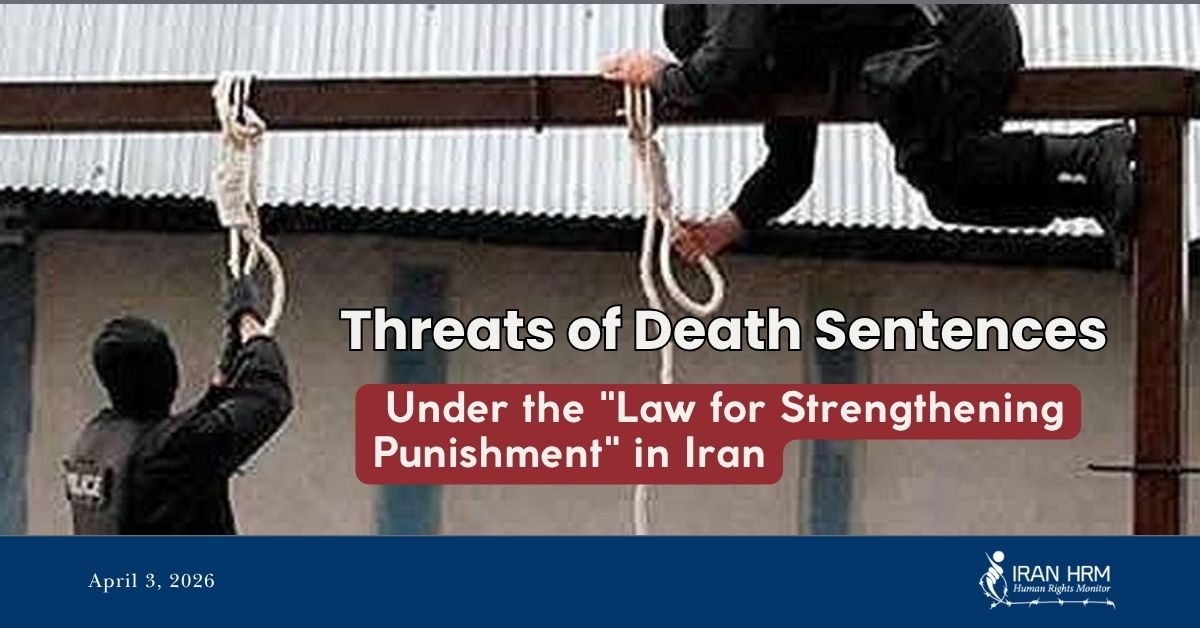
While global attention is fixed on transborder military tensions, the judicial apparatus of the Islamic Republic is accelerating at an unprecedented pace, transforming the “law” into a weapon for the mass killing of domestic dissidents. Recent statements by senior judicial officials, including Gholam-Hossein Mohseni-Eje’i and Asghar Jahangiri, represent an “official declaration of war“ against citizens who attempt to report information or express dissent amidst war and a global internet blackout in Iran. This report presents evidence of an organized operation aimed at the physical elimination of hundreds of protesters under the guise of vague charges such as “espionage” and “collaboration with hostile states”—a process that transcends judicial procedure and constitutes a clear instance of political genocide in the 21st century.

The Islamic Republic Intensifies Repression: The Sword is Drawn
Asghar Jahangiri, the spokesperson for the Judiciary, stated on March 31, 2026 (11 Farvardin 1405), according to ILNA:
“According to Article 1 of the Law for Strengthening Punishment for the Crime of Espionage and Collaboration with the Zionist Regime and Hostile States, such as the United States government, any operational action for the Zionist regime and hostile groups intended to endanger national security and interests shall carry the penalty of execution and seizure of all assets.”
Jahangiri continued:
“In this 9-article law, three new subjects have been introduced. The first is ‘operational actions,’ which includes any terrorist acts, destruction of sites, and actions that lead to killing and creating fear and panic in society, all of which carry the death penalty and asset seizure.”
Jahangiri further emphasized that the law mandates the death penalty and asset seizure for “any intelligence activity“ as well. He added:
“Furthermore, those who create panic through the publication of ‘fake news’ or media activities and cause the ‘strengthening of the enemy’ shall be sentenced to Grade 5 punishments (2 to 5 years of imprisonment). This applies to normal conditions; however, during wartime, these punishments are intensified by up to three grades.” ((Equivalent to elevating the penalty from Grade 5 to Grade 2 [15–25 years of imprisonment]; just one step away from the maximum legal penalty and a clear instance of “legislating repression” by reclassifying media activity as a high-security crime during wartime)
Escalating Threats
Jahangiri added in his remarks:
“In this regard, the General Prosecutor’s Office, in cooperation with security and intelligence agencies, has taken extensive measures across the country to identify the assets of individuals abroad who send information to the enemy. To date, 200 indictments have been issued in this field; some cases have been sent to court, and a number will be sent soon. According to the emphasis of the Head of the Judiciary, there will be no leniency in this period for individuals collaborating with the enemy… For individuals who provide ‘coordinates’ to the enemy through photography or videography, the punishment for espionage—which is execution and confiscation of all assets—shall apply under the Law for Strengthening Punishment for Espionage.”
A Confession to Political Purging
The Judiciary spokesperson’s confession regarding the issuance of 200 indictments under the new law reveals an organized operation designed to paralyze dissidents through asset seizures and concurrent threats of execution. This procedure transcends judicial action; it is a form of ‘systematic terrorism’ in which the law has been weaponized for state-sanctioned murder. Jahangiri’s absolute disregard for international law demonstrates the regime’s resolve to purge any dissenting voice under the guise of ‘espionage’.
A Reminder of Judicial Intent
These threats were identically echoed on March 29, 2026, by Mohseni-Eje’i, the Head of the Judiciary. According to the Judiciary Media Center (reported by ILNA):
Eje’i stated that “professional and specialized work in identifying and introducing ‘traitorous elements and patriots-sellers’ to the judiciary and their immediate trial plays a very effective role in ensuring the ‘psychological security’ of the people and cutting the espionage chain of the American-Zionist enemy… Asset confiscation is one of the prescribed punishments for these elements… Another punishment is execution, and in this regard, after precise judicial review and reaching a final verdict, no leniency or compromise will occur.”
Legal Analysis: Violations of International Law by the Islamic Republic
The aforementioned actions and statements constitute a flagrant and systematic violation of several articles of the International Covenant on Civil and Political Rights (ICCPR), which Iran is obligated to uphold:
- Violation of Article 6 (Right to Life): International standards dictate that the death penalty must only be reserved for the “most serious crimes,” involving intentional killing. Categorizing media activity, photography, or sending news as capital offenses is a direct violation of this article.
- Violation of Article 14 (Fair Trial): Eje’i’s threat of “immediate trials” and “no leniency” effectively eliminates judicial independence and tramples upon the defendant’s right to a defense and the principle of presumption of innocence before the trial even begins.
- Violation of Article 19 (Freedom of Expression): Assigning imprisonment and execution for what the regime labels “fake news” or “media activity” is a transparent suppression of the freedom of expression and information.
- Violation of the Principle of Legality: The use of vague terms like “giving coordinates” or “strengthening the enemy” allows the state to characterize any form of civil activism as espionage, contradicting international legal standards.
The Surge of New Political Executions
Immediately following Eje’i’s threats, political executions intensified. Between March 30 and April 2, 2026, the Judiciary announced the execution of five political prisoners:
- Akbar Daneshvarkar and Mohammad Taghavi (March 30)
- Babak Alipour and Pouya Ghobadi (March 31)
- Amir-Hossein Hatami, an 18-year-old arrested protester (April 2)
While most of the world has designated the IRGC as a terrorist organization, the Iranian Judiciary labeled these political prisoners as “terrorists and enemy agents” to justify their executions based on Eje’i’s and Jahangiri’s statements.
Mass Arrests under “Enemy Mercenary” and “National Security” Labels
Note the following arrests reported by a single state media outlet (ILNA) starting from March 29, 2026:
- Golestan Province: Mehdi Razaghi-Nejad, the provincial prosecutor, announced the identification and arrest of 117 “internal mercenaries.” (March 31)
- Isfahan Province: Mohammad Mousavian, the General and Revolutionary Prosecutor, announced the arrest and asset seizure of 35 “elements and main supporters” linked to the “US-Zionist enemy.” (March 30)
- Saba Battery Incident: The Judiciary Media Center announced that the “main element” who filmed and sent footage of the attack on the Saba Battery factory to “hostile networks” and “expressed joy” was identified and arrested. (March 30)
- Media/Social Media: The Judiciary announced that cases have been opened for 20 other individuals collaborating with satellite networks, Telegram pages, and social media accounts linked to the enemy, with orders to seize the assets of those residing abroad. (March 29)
- Ardabil Province: The Ministry of Intelligence announced the arrest of 3 “mercenaries” in Khalkhal linked to a “terrorist group guided by the Zionist regime.” (March 29)
The Killing Machine in Ambush
The Islamic Republic’s killing machine, under the ‘Law for Strengthening Punishment,’ directly targets the lives of citizens. By reclassifying civic activism and information-sharing as capital offenses, this law has obliterated the line between ‘expressing an opinion’ and ‘espionage’ to facilitate state-sanctioned murder. Alongside these death sentences, the issuance of 200 indictments for asset seizures reveals the massive scale of a political purge aimed not only at physical elimination but also at the total paralysis of dissidents both home and abroad. The accelerated executions of recent days and mass arrests across the country testify to an ‘internal special operation’ conducted behind the fog of war. In this state of emergency, the judiciary has become a direct arm of the security apparatus for systematic repression; any global silence will effectively serve as a green light for these legalized atrocities.”
International Responsibility: A Call for Urgent Action
The international community, the United Nations, and the Special Rapporteur, Ms. Mai Sato, must respond immediately. International responsibility for this crisis includes:
- Immediate Halt of the Killing Machine: All-encompassing diplomatic pressure to revoke all death row indictments issued under the inhumane “Law for Strengthening Punishment for Espionage.”
- Official Condemnation of the Law: This law must be formally presented and condemned in the UN General Assembly as a document for the systematic violation of human rights.
- Support for Civil Activists and Informants: Compelling the Islamic Republic to immediately release all individuals detained for media activities or sending photos and videos.
- Accountability for the Perpetrators: Placing the names of Mohseni-Eje’i and Asghar Jahangiri on international sanction lists and initiating criminal investigations into their actions under Universal Jurisdiction.
The killing of human beings must not become “routine news” on the sidelines of war. The responsibility to prevent this catastrophe lies with the awakened consciences of the world, the United Nations, and international human rights bodies.