Accelerating Executions: Beyond a Judicial Procedure
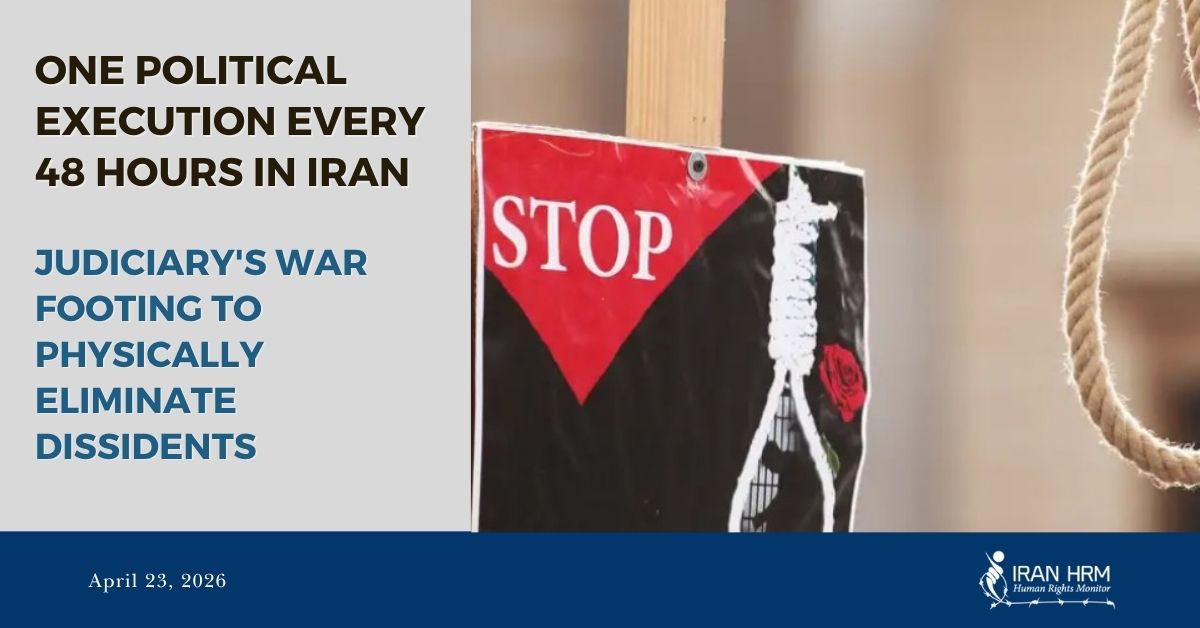
During this past week, not a single day has passed without Mohseni-Eje’i, the Head of the Judiciary of the Islamic Republic, emphasizing the acceleration of issuing and implementing death sentences. Unfortunately, these threats have been largely ignored by the international community and global human rights bodies. As a result, from March 19 to this very day (April 22), 17 individuals have been executed on purely political grounds.

This means 17 political executions within a span of 35 days—one execution every 48 hours. This figure represents more than half of the total political executions recorded in the entire year of 2025. Such a staggering escalation should have provoked a global outcry and triggered immediate international action to compel the Islamic Republic to halt all executions, particularly those of political prisoners and participants of the December 2025/January 2026 nationwide protests.
The Judiciary’s War Footing; Moving from Rule of Law to “Security-Based Elimination”
Mohseni-Eje’i has explicitly stated that the Judiciary has taken a “war footing” and that the “normal routine” should no longer govern legal cases. This shift in rhetoric is a formal declaration of the transition from a facade of the “rule of law” to a state of “security-based elimination.” When a high-ranking judicial official orders that investigations previously taking 10 days be finalized within hours, and mandates that interrogators conduct “indictments” inside the prisons, it signifies the total collapse of fair trial standards. In this new structure, the Judiciary no longer functions as an adjudicatory body but as an operational-security unit whose mission is not justice, but the “physical neutralization” of dissidents in the shortest possible time.
Ongoing Incitement
As recently as today, according to the Mehr News Agency (affiliated with the Ministry of Intelligence), Mohseni-Eje’i stated: “Decisive and legal action against traitors and collaborators of the enemy must continue.” Based on his previous statements, it is widely understood that “decisive action” is synonymous with the confiscation of property, the issuance of death sentences, and their immediate implementation.
Documentation of the Killing
Political Executions Recorded: March 19 to April 22, 2026
| No. | Full Name | Execution Date | Execution Location |
| 1 | Mehdi Ghasemi | March 19, 2026 | Public (Qom) |
| 2 | Saleh Mohammadi | March 19, 2026 | Public (Qom) |
| 3 | Saeed Davoodi | March 19, 2026 | Public (Qom) |
| 4 | Akbar Daneshvarkar | March 30, 2026 | Qezel Hesar |
| 5 | Mohammad Taghavi | March 30, 2026 | Qezel Hesar |
| 6 | Pouya Ghobadi | March 31, 2026 | Qezel Hesar |
| 7 | Babak Alipour | March 31, 2026 | Qezel Hesar |
| 8 | Amirhossein Hatami | April 3, 2026 | Qezel Hesar |
| 9 | Vahid Bani-Amerian | April 4, 2026 | Qezel Hesar |
| 10 | Abolhasan Montazar | April 4, 2026 | Qezel Hesar |
| 11 | Mohammadamin Biglari | April 5, 2026 | Qezel Hesar |
| 12 | Shahin Vahedparast | April 5, 2026 | Qezel Hesar |
| 13 | Ali Fahim | April 6, 2026 | Qhezel Hesar |
| 14 | Hamed Validi | April 20, 2026 | Karaj Central Prison |
| 15 | Mohammad Masoum-Shahi | April 20, 2026 | Karaj Central Prison |
| 16 | Amir-Ali Mirjafari | April 21, 2026 | Unknown |
| 17 | Mehdi Farid | April 22, 2026 | Unknown |
Critical Note: The continued execution of prisoners in undisclosed locations (Cases 14 to 17) goes beyond an administrative lapse; it signals a dangerous pattern of enforced disappearance prior to execution. The failure to announce the location of the execution prevents any civil or legal oversight and reinforces the conclusion that these sentences are being carried out in extrajudicial settings and secret wards. It is also to be mentioned that many of the locations listed above has not been announced by the Islamic Republic’s Judiciary but has been obtained through informed sources.
Paving the Way for Mass Arrests and Widespread Suppression
The threats issued by Eje’i act as a “green light” for an increase in arbitrary arrests and mass suppression. In this regard, Ahmadreza Radan, the Commander of the Police Force (FARAJA), has announced the arrest of at least 1,800 citizens. In a media interview, he stated that over 700 of these individuals were detained as “opposition elements” or linked to social media networks. Furthermore:
- Over 400 people were arrested for collecting and publishing images and information regarding “impact sites” (operational data).
- Over 100 people were detained on charges of association with “terrorist groups.”
- Over 200 people were arrested for using “technical tools” for “destructive activities.”
All these charges, as defined by the Police Commander, fall under the categories that the Head of the Judiciary intends to punish with death through “accelerated” and extrajudicial proceedings. A notable shift in this wave of arrests is the reclassification of charges: while detainees were previously charged with protest-related offenses, they are now facing accusations of “espionage,” “contact with foreigners,” and “collaboration with opposition groups.” This clearly demonstrates the regime’s exploitation of ongoing conflict zones to mask its violation of the right to life.
Legal Analysis: A Dark Record of Human Rights Violations
The Islamic Republic continues its campaign of suppression and killing with impunity, systematically violating the following principles:
- Prohibition of Cruel and Inhuman Punishment (Article 5, UDHR): Public executions (Cases 1-3) constitute psychological torture of society and a blatant degradation of human dignity.
- Violation of the Right to Life (Article 3, UDHR): Rapid executions lacking any due process are a fundamental violation of the right to life.
- Violation of the Presumption of Innocence (Article 11, UDHR): Mass accusations of “espionage” and “terrorism” without legal evidence prior to a fair trial.
- Violation of Personal Liberty and Security (Article 9, UDHR): Widespread arrests without transparent information violate the individual security of citizens.
- Violation of the Right to a Fair Trial (Article 10, UDHR): Lack of judicial transparency and restricted access to counsel invalidate the legal process.
- Violation of Freedom of Expression (Article 19, UDHR): Crackdowns on digital activity and the criminalization of information sharing.
Denouncing International Silence
The silence of international institutions in the face of this accelerated killing machine is not merely ineffective—it acts as a green light for the continuation of crimes against humanity. If the global community does not replace its current inaction with deterrent measures and decisive accountability under the principle of Universal Jurisdiction, the historical responsibility for this “Cycle of Elimination” will rest squarely on the shoulders of those who claim to be global defenders of human rights.
Before the corridors of Iran’s prisons transform into even larger slaughterhouses, the time has come for international will to shift from “endless concern” to “decisive action.” Today, silence equals complicity. History will testify that in the face of this organized and institutionalized slaughter, those who did not stand up with authority to demand accountability and prevention stood, instead, alongside the perpetrators.