For Iran, execution is not a legal punishment; it is the primary language through which the sovereignty communicates with the people. It is the language of intimidation, designed to paralyze the will of a nation that has risen for its freedom. For this regime, execution acts as oxygen for a dying patient—one who feels the suffocation of an impending popular uprising.

For this reason, over the past week—amidst a foreign war—the regime has executed nine political prisoners, including six members of the Mojahedin-e Khalq (MEK/PMOI) Resistance Units: Mohammad Taghavi, Akbar Daneshvarkar, Babak Alipour, Pouya Ghobadi, Abolhassan Montazar, and Vahid Bani-Amerian. Additionally, three detained protesters from the January 2026 uprising—Amir-Hossein Hatami (18), Mohammad-Amin Biglari (19), and Shahin Vahedparast—were sent to the gallows.
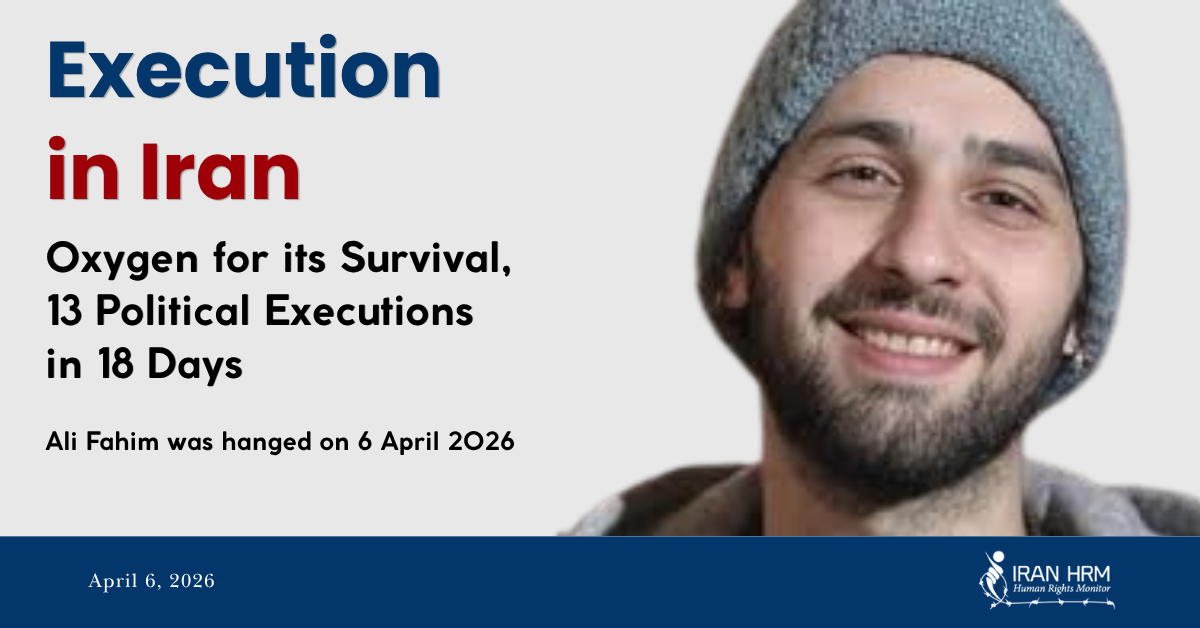
Today, Monday, April 6, 2026—the first day of the current week—the Mizan News Agency (the official mouthpiece of the Judiciary) announced that Ali Fahim (30), a co-defendant of the aforementioned protesters and the fourth individual from that group of five, has also been executed. In this same case, Abolfazl Salehi Siavashani remains in imminent danger of execution.
Violation of Due Process and Crime Scene Engineering
The Mizan News Agency cited Ali Fahim’s charges as “participation in an operation to attack a restricted military site to seize an armory and theft of war weapons in January.” However, leaked reports and videos of the incident provide a narrative starkly different from the official one, raising serious doubts about the judicial process and the death sentences issued. Despite the official narrative of “arson at a Basij base,” footage analyzed by defense attorneys reveals:
- Individuals in plainclothes push people into the building and locking the doors from the outside.
- Audible screams of “Don’t push!” and the desperate cries of a woman shouting, “Open the door!”
- Individuals who managed to save themselves by jumping from upper-story windows were immediately arrested by security forces.
This evidence demonstrates a flagrant violation of Article 14 of the International Covenant on Civil and Political Rights (ICCPR) and the “Presumption of Innocence.” These sentences were based solely on forced confessions obtained under torture—a violation of Article 38 of the Iranian Constitution and Article 7 of the ICCPR.
War: A Cover for Crimes Against Humanity
The regime is seeking survival by exploiting the atmosphere of war and by cutting off the global internet to silence the voice of Iran. Recent statements by regime officials expose the Criminal Intent of the sovereignty to convert a wartime environment into an opportunity for political score-settling. Ayatollah Mohammadi Laeini (Tabarestan TV Network, April 3, 2026), emphasizing the continuation of war, stated: “No one should talk about the end of the war; no one should decide for themselves the fate of the war. No one is whispering about a ceasefire, compromise, or negotiation; everyone wants the war to continue.” Furthermore, Zaker stated on the News Channel (March 24): “More important than the Strait of Hormuz is the ‘Strait of the Street’; we must protect this Strait of Uhud in the streets.”
These statements confirm that the regime’s priority is not external war, but internal suppression. The statistics are staggering: in entirety of 2025, the number of political executions was 17. However, in just the last 18 days (from March 19, 2026, to today), that number is 13 political executions—nearly one every day and a half, and 16 since the onset of 2026 almost equal to all political executions during 2025. This can be described as nothing less than a “Political Purge” or a “Political Massacre“ under the shadow of war.
Summary Table of Executions
| No. | Name (Last – First) | Age | Execution Date | Prison | Source | Description (Charges) |
| 1 | Ardestani – Ali | N/A | Jan 7, 2026 | Unknown | IRNA (IRI’s official Media) | Espionage (Accused of collaborating with Mossad) |
| 2 | Sabet Esmailpour – H. | N/A | Jan 28, 2026 | Unknown | Mizan (Judiciary Media) | Espionage (Accused of collaborating with Mossad) |
| 3 | Keivani – Kourosh | N/A | Mar 18, 2026 | Unknown | Mizan / Tasnim | Espionage (Iranian-Swedish Dual Citizen) |
| 4 | Mohammadi – Saleh | N/A | Mar 19, 2026 | Qom (Public) | NCRI / Iran HRM | Political (January 2026 Protester) |
| 5 | Davoudi – Saeed | N/A | Mar 19, 2026 | Qom (Public) | NCRI / Iran HRM | Political (January 2026 Protester) |
| 6 | Ghassemi – Mehdi | N/A | Mar 19, 2026 | Qom (Public) | NCRI / Iran HRM | Political (January 2026 Protester) |
| 7 | Daneshvarkar – Akbar (Shahrokh) | N/A | Mar 30, 2026 | Qezel Hesar | NCRI / Iran HRM | Political (Affiliation with MEK/PMOI) |
| 8 | Taghavi Sangdehi – Mohammad | N/A | Mar 30, 2026 | Qezel Hesar | NCRI / Iran HRM | Political (Affiliation with MEK/PMOI) |
| 9 | Alipour – Babak | N/A | Mar 31, 2026 | Qezel Hesar | NCRI / Iran HRM | Political (Affiliation with MEK/PMOI) |
| 10 | Ghobadi – Pouya | N/A | Mar 31, 2026 | Qezel Hesar | NCRI / Iran HRM | Political (Affiliation with MEK/PMOI) |
| 11 | Hatami – Amir-Hossein | 18 | Apr 2, 2026 | Qezel Hesar | NCRI / Iran HRM | Political (January 2026 Protester) |
| 12 | Bani-Ameryan – Vahid | 33 | Apr 4, 2026 | Qezel Hesar | NCRI / Iran HRM | Political (Affiliation with MEK/PMOI) |
| 13 | Montazer – Abolhassan | 66 | Apr 4, 2026 | Qezel Hesar | NCRI / Iran HRM | Political (Affiliation with MEK/PMOI) |
| 14 | Biglari – Mohammad-Amin | 19 | Apr 5, 2026 | Qezel Hesar | NCRI / Iran HRM | Political (January 2026 Protester) |
| 15 | Vahedparast Kolour – Shahin | N/A | Apr 5, 2026 | Qezel Hesar | NCRI / Iran HRM | Political (January 2026 Protester) |
| 16 | Fahim – Ali | 30 | Apr 6, 2026 | Qezel Hesar | Iran HRM / IHRC | Political (January 2026 Protester) |
Final Warning
We remind the international community and the bodies responsible for safeguarding human rights that on March 19, Iran Human Rights Monitor (Iran HRM) announced a list of political prisoners facing execution, including 13 protesters from the January 2026 uprising and 59 other political prisoners. Due to the global internet shutdown in Iran and the resulting inability to track death sentences for the 50,000 detainees of the recent uprising, this list is undoubtedly only the “tip of the iceberg.” It can be stated with absolute certainty that these sentences were based on forced confessions under torture, without access to chosen counsel or case files, and in total violation of the presumption of innocence.
Currently, Abolfazl Salehi Siavashani stands at the top of the list of prisoners in immediate danger of execution. Today, the silence of the international community and global institutions is a “green light” to the regime’s execution machine. Is “Human Rights” merely a hollow shell for these organizations, or can the world’s conscience stop this crime before the rope tightens around the neck of Abolfazl Salehi and others? History will judge whether the world stood with the people against this political cleansing and another crime against humanity by Iran, or whether it remained a passive spectator to this savage slaughter.
If the execution machine is not stopped today, tomorrow human rights will be nothing more than a lifeless word in the archives of history. For Abolfazl and others, time is measured in seconds; tomorrow is too late.