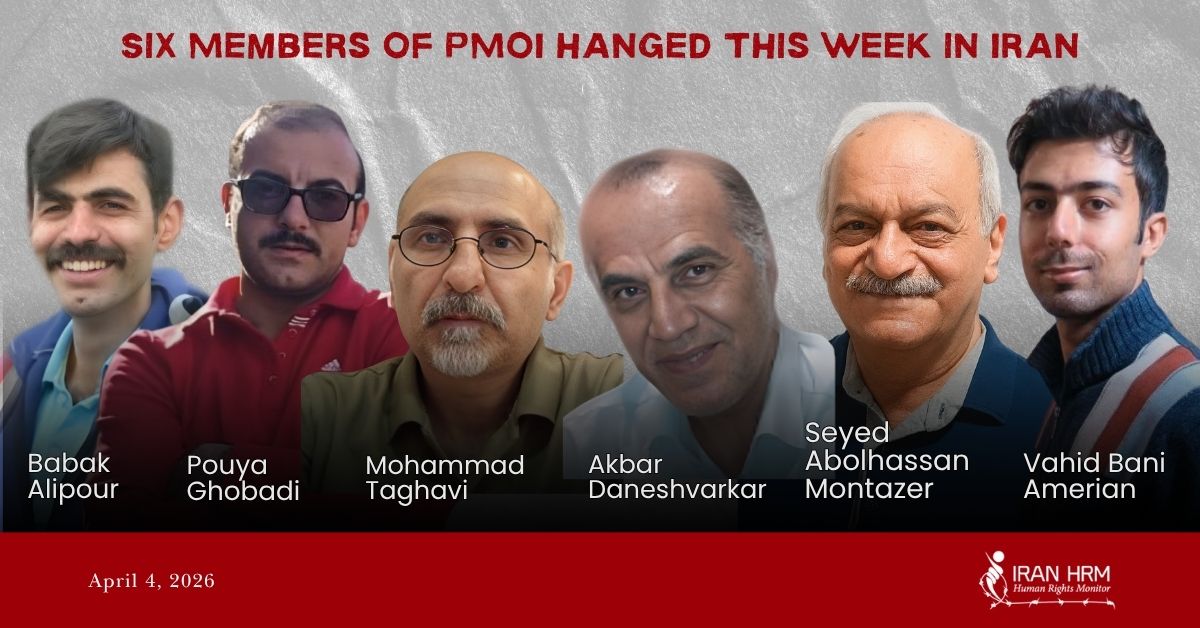
Despite repeated warnings and urgent calls for international intervention, the final two members of a group of six political prisoners—Akbar Daneshvarkar, Mohammad Taghavi, Pouya Ghobadi, Babak Alipour, Vahid Bani-Amerian, and Abolhassan Montazer—were executed by the Islamic Republic this morning. These executions were carried out behind the dark veil of international internet shutdowns and the fog of war.

On April 4, 2026 (15 Farvardin), at 07:30 AM, the official state news agency, IRNA, announced:
“The sentence for two more members of the enemy’s terrorist team was carried out. The Judiciary announced: Abolhassan Montazer and Vahid Bani-Amerian, two terrorists from the Mojahedin-e Khalq (MEK) group who were conducting missions for the aggressor enemy, were hanged after trial and confirmation of the verdict by the Supreme Court.”
https://web.telegram.org/k/#@irna_1313
These executions took place despite a three-day intensive campaign and numerous international appeals. This tragedy vividly illustrates the failure of the international community and human rights organizations to confront the Islamic Republic’s gross violations of human rights.
The Legal Flaw: An Act of Extrajudicial Killing
Hamed, the brother of Vahid Bani-Amerian, revealed in an audio file: “The Supreme Court had found flaws in the case and remanded it to the lower court for corrections. However, we were suddenly faced with the news of the execution of my brother’s four co-defendants.”
Executing individuals while their case is still legally disputed and remanded for corrections is a blatant violation of both domestic and international law, effectively constituting an extrajudicial killing.
The Special Rapporteur’s Alert
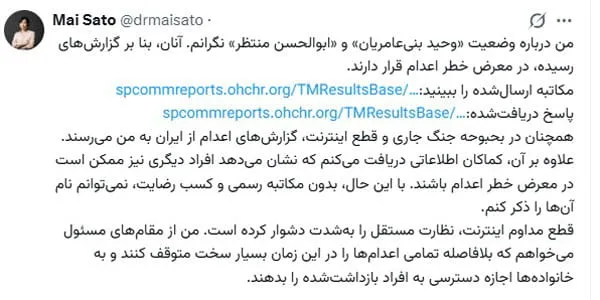
Dr. Mai Sato, the UN Special Rapporteur on the situation of human rights in Iran, expressed grave concern on social media regarding the imminent execution of Vahid Bani-Amerian and Abolhassan Montazer, calling for an immediate halt. This warning followed reports of their transfer to solitary confinement after the execution of their four co-defendants.
I am concerned for Vahid Bani Amerian and Abolhassan Montazer, who are reportedly at risk of execution.
See communication sent: https://t.co/g4lKHQP1oe
Response received: https://t.co/Nw0TcfKTT6
Reports of executions continue to reach me amid the ongoing war and internet…— Mai Sato (@drmaisato) April 3, 2026
 The Systematic Execution of Co-defendants
The process was swift and calculated. Following their transfer from Ward 4 of Ghezel Hesar Prison, the death sentences of Akbar Daneshvarkar and Mohammad Taghavi Sangdehi were implemented on March. On March 31, Babak Alipour and Pouya Ghobadi were also executed. The execution of all six co-defendants within a single week demonstrates a systematic purge aimed at eliminating any remaining witnesses to the judicial torture involved in this case.
- Vahid Bani-Amerian (33): Master’s degree in management, arrested in December 2025. He had spent a total of four years in prison across multiple arrests since 2017.
- Abolhassan Montazer (66): Architect and a former political prisoner from the 1980s. He had been repeatedly arrested in 2018 and 2020 before his final arrest in December 2023.
Hostage-Taking and Collective Punishment of Families
In violation of all international humanitarian laws, the Islamic Republic has not only refused to return the bodies of executed political prisoners to their families, but reports from inside the country indicate that the mother, sister, and brother of the executed political prisoner, Babak Alipour—who were arrested two months ago—are still being held hostage by henchmen.
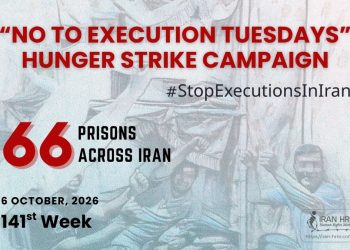
Om-ol-Banin Dehghan, 63, Babak’s mother, was an active participant in the ‘No to Execution Tuesdays’ campaign. She, along with Maryam Alipour (31) and Rouzbeh Alipour (40), was arrested on a street in Tehran on January 26, 2026 (6 Bahman 1404). Babak’s mother and Maryam are currently held in Qarchak Prison in Varamin, and Rouzbeh in Ward 209 of Evin Prison, all are under interrogation. This family was deprived of a final visit and farewell to Babak before he was hanged on March 31, 2026 (11 Farvardin).
This clearly demonstrates the implementation of ‘collective punishment’ by the Islamic Republic.”
Is the International Community Complicit?
When the Islamic Republic faces no accountability for crimes against humanity—such as the political massacres of January 2026—the regime interprets this silence as a green light. When mountains of body bags do not move the conscience of the UN Security Council to refer this regime to international tribunals, the Islamic Republic understands there is no global will to stop its atrocities.
We hope the execution of these six individuals, along with five other recent political executions—including the public hanging of three January 2026 detained protesters in Qom on March 19, 2026—serves as a wake-up call.
- Urgent Referrals: The human rights file of the Islamic Republic must be referred to the UN Security Council for material and practical action.
- Universal Jurisdiction: International courts must invoke Universal Jurisdiction to prosecute the perpetrators of these killings.
- Closure of embassies and the expulsion of the regime’s agents: As a decisive response to state-sanctioned killings.”
During January 2026 uprising, over 50,000 protesters were arrested. Even if a fraction of them faces the death penalty, we are looking at a human catastrophe initiated by these 11 political executions. Seconds are vital.
Act now to hold the Islamic Republic accountable and prevent further executions. Otherwise, the international community is complicit in this slaughter.
We demand an emergency UN session to address the serial execution of political prisoners and to adopt immediate, practical measures to save those still on death row. Defend Human Rights.