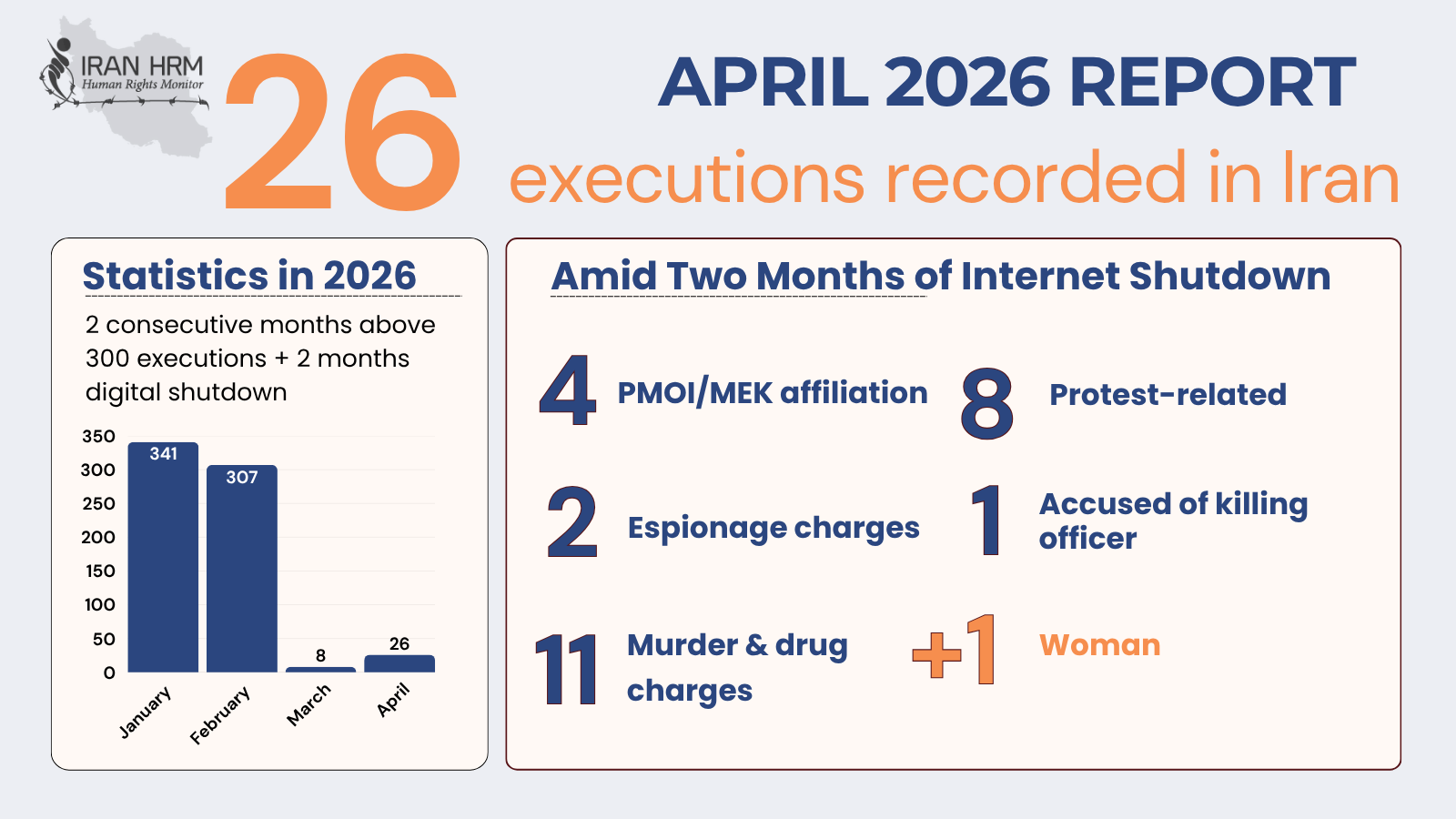
April 2026 witnessed the continued severe violation of human rights across Iran, marked by a high number of execution of political prisoners, arbitrary arrests, and harsh treatment of political prisoners and protest detainees. Iran Human Rights Monitor (Iran HRM) documented at least 26 executions during April, alongside numerous death sentences, deaths under torture in detention, and widespread arrests targeting individuals affiliated with opposition groups and families of political prisoners. These actions reflect increasing efforts by authorities to suppress dissent and maintain control through intimidation and severe punitive measures.

Executions: A Grim Tally
In April 2026, Iran HRM recorded at least 26 executions. These included 4 individuals charged with affiliation to the People’s Mojahedin Organization of Iran (PMOI/MEK), 8 accused of participation in protests, 1 accused of killing an officer, 2 accused of espionage, and 11 (including one woman) accused of murder and drug-related crimes.
This month’s figures contribute to a broader pattern, with 8 individuals executed for alleged affiliation with the MEK and 11 for protest-related charges between late March and the end of April.
Political Executions and Those Linked to the PMOI/MEK
- On April 4, 2026, Vahid Bani-Amerian, 34, an electrical engineer, and Abolhassan Montazer, 67, an architect and long-time political prisoner, were executed by hanging in Qezel Hesar Prison. They were charged with “membership in the PMOI/MEK with intent to overthrow the regime, disrupting national security, conducting operations, preparing explosive launchers, and carrying out multiple actions and explosions across Tehran.”
- On March 30 and 31, 2026, Mohammad Taghavi, Akbar Daneshvar-Kar, Babak Alipour (34), and Pouya Ghabadi (33), all members of the MEK, were executed in Qezel Hesar Prison. They were charged with “armed rebellion through direct involvement in multiple terrorist acts, use of projectile weapons, membership in the MEK, and conducting disruptive acts in support of the organization aimed at overthrowing the regime.” They had been sentenced to death after months of interrogation and torture.
Protest-Related Executions
- On April 2, 2026, Amirhossein Hatami, 18, a detainee from the January 2026 protests, was executed in Tehran on charges of “enmity against God” and “corruption on earth.” He had been arrested in October 2023 in Buin Zahra and subjected to prolonged interrogation and torture. Authorities accused him of attacking a military site and attempting to obtain weapons and ammunition.
- On April 6, 2026, Ali Fahim, 27, was executed in Tehran. He was charged with “attacking a classified military site, destruction and arson, and attempting to access weapons.” He had been sentenced to death by Branch 15 of the Tehran Revolutionary Court.
- On April 25, 2026, Erfan Kiani, a young detainee in Isfahan, was executed. He was charged with “destruction of public and private property, arson, carrying cold weapons, blocking roads, and attacking officers.” He was described as a leader among several individuals and allegedly facilitated street burnings using prepared wooden planks and tires.
- On April 30, 2026, Sasan Azadvar, 21, a karate champion from Isfahan and a January protest detainee, was executed. He was charged with “attacking law enforcement officers with intent to confront the regime, destroying a police vehicle, disrupting national security, and inciting others to riot with the aim of overthrowing the regime.”
- Additionally, on March 19, 2026, Saleh Mohammadi (19), a wrestling champion, along with Mehdi Ghasemi and Saeed Davoudi, were publicly executed in Qom. They were charged with “enmity against God through use of cold weapons in illegal gatherings and riots leading to the killing of law enforcement officers” and “inciting people to violence and killing to disrupt national security.”
Other Executions
In April 2026, one prisoner was executed for killing an officer, two for espionage, and 11 others (including one woman) for murder and drug-related crimes. The lack of transparency and access to accurate information about these cases seriously undermines due process and human rights principles.
Death Sentences
The Iranian government continues to use death sentences as a tool of repression and intimidation:
- On March 31, 2026, the Supreme Court upheld the death sentence of Mansour Jamali, 55, a MEK member, convicted of “enmity against God through membership in the MEK” in Choobindar Prison, Qazvin.
- On April 14, 2026, Mohammadreza Majidi Asl (34), his wife Bita Hemmati, Behrouz Zamani-Nejad, and Kourosh Zamani-Nejad, all detained during the January protests, were sentenced to death and asset confiscation by Branch 26 of the Tehran Revolutionary Court. Charges included “use of explosives and weapons, harming stationed forces, throwing incendiary materials, and disrupting national security.”
- On April 25, 2026, the Supreme Court upheld death sentences for three other youths—Ehsan Hosseinipour, Matin Mohammadi, and Erfan Amiri—accused of attacking a Basij base in Pakdasht with Molotov cocktails, resulting in two Basij members’ deaths.
- Manouchehr Vafaei (28) and Navid Naghi (32) have been sentenced to death for the 2024 killing of two Basij members in Shiraz and are at imminent risk of execution.
Arrests and Arbitrary Detentions
In April 2026, Iranian authorities continued widespread arbitrary arrests, targeting families of political prisoners and supporters of opposition groups:
- On March 29, 2026, Vali Zoghi-Tabar, father of political prisoner Shahin Zoghi-Tabar, was arrested at home and taken to an unknown location despite recovering from surgeries.
- On April 21, 2026, 12 individuals were arrested for alleged ties to the MEK, including Sattar Babaei (57), Mohsen Daghaghleh (22), Sobhan Asparvarini (21), Ali Rajaei (21), Ahmad Ghaedi Rahmati (46), Erfan Abbasi-Far (47), Farzad Fardad (43), Reza Roshani (31), Rajab-Ali Chilan (43), Abolfazl Mojarradi (28), Amir-Mehdi Jalali (24), and Mohammad Goudarzi (35).
- On April 13, 2026, seven political prisoners, including Mir Yousef Younesi (71) and Mehdi Vafaei-Sani (40), were violently transferred from Ward 7 of Evin Prison to solitary confinement in Unit 3 of Ghezel Hesar Prison. Three others were also transferred from Fashafouyeh Prison.
- On April 18, 2026, sisters Akram (54) and Azam Daneshvar-Kar were arrested while seeking their executed brother’s body and transferred to Qarchak Prison.
- On April 4, 2026, Masoumeh Azhini (63), sister of a 1988 massacre victim, was arrested.
- Since January 26, 2026, family members of Babak Alipour have been detained as hostages and denied final contact or burial access after his execution.
Death in Custody
- On April 17, 2026, Abbas Yavari (31), a protest detainee in Shiraz, reportedly died under torture. Authorities claimed suicide, but evidence suggests coercion for forced confessions.
Call to Action
Iran HRM expresses deep concern over escalating human rights violations in Iran and calls on the international community, the UN Human Rights Council, the UN High Commissioner for Human Rights, Special Rapporteurs, and all human rights defenders to:
- Strongly condemn the wave of executions and repression.
- Demand an immediate halt to all executions in Iran.
- Take urgent action to save political prisoners sentenced to death.
- Call for an international fact-finding mission to visit Iranian prisons, especially Ghezel Hesar.
- Demand the immediate and unconditional release of all political prisoners and protest detainees.
Iran HRM emphasizes that silence and inaction by the international community will only enable Iranian authorities to continue violating the fundamental rights of the Iranian people.