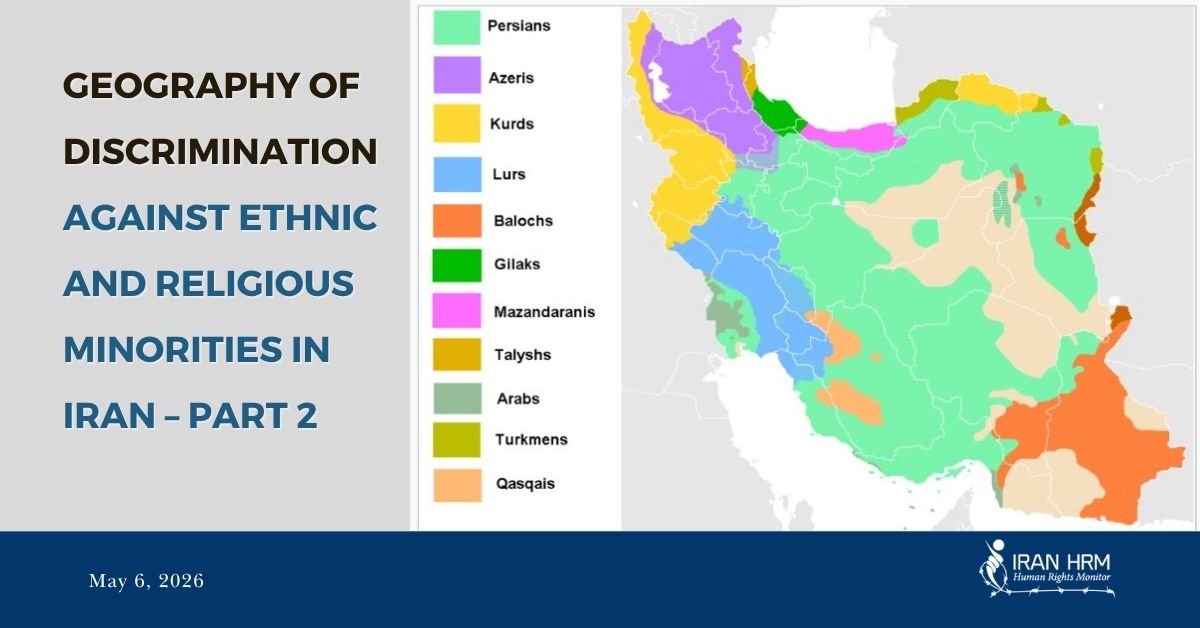
Examining the pattern of repression against Sunni Muslims, Ahwazi Arabs, and Baha’is; from security detentions and concealed executions to expanding pressure on families and civil society
While the first part of this report focused on the securitization of border regions, mass arrests, and the use of the death penalty against Kurdish and Baluch communities, this second part examines additional forms of structural repression targeting ethnic and religious minorities in Iran. Within this framework, opaque detentions, enforced disappearances, restrictions on religious freedom, economic pressure, and social exclusion operate alongside executions and intimidation of families as tools of control and silencing.

Sunni Muslims; Structural Discrimination and Pressure on Religious Clerics
Sunni citizens in Iran, despite limited formal recognition in certain legal contexts, face widespread restrictions in access to senior administrative positions, employment opportunities, religious activity, and freedom of religious expression. These forms of discrimination are particularly pronounced in eastern and border regions.
In numerous cases, religious affiliation has reportedly influenced access to employment, professional advancement, and equal opportunities. Restrictions have also been reported regarding the holding of religious ceremonies, the activities of Sunni clerics, and the establishment or administration of religious centers.
Case Study: Hafez Ataollah Siryazahi
In April 2026, Hafez Ataollah Siryazahi, a Sunni cleric and religious activist, was arrested during a raid by security forces on his home in one of Iran’s eastern cities and transferred to an undisclosed location.
According to published reports, the arrest was conducted without a transparent judicial warrant and involved violent treatment. Media outlets affiliated with the ruling regime in Iran later accused him of “links to hostile networks” through selective and partial narratives.
In the absence of official information regarding his whereabouts and legal status, the case raises concerns related to enforced disappearance, arbitrary detention, and violations of freedom of religion and expression. Articles 18 and 19 of the International Covenant on Civil and Political Rights guarantee the rights to freedom of thought, conscience, religion, and expression, permitting restrictions only under narrowly defined legal and proportional conditions.
The case of Hafez Ataollah Siryazahi reflects increasing pressure on Sunni clerics in Iran, where independent religious activity and engagement with local communities can be reframed as security threats.
Ahwazi Arabs; Arrests, Executions, and Pressure on Families
In Khuzestan Province, Ahwazi Arab activists and Arab citizens have faced accusations such as “membership in separatist groups,” “corruption on earth,” and “links to opposition organizations.” These accusations are often pursued in environments where public access to case files is severely restricted and families are pressured into silence.
Case Study: Adnan Ghabishavi
Adnan Ghabishavi, an Ahwazi Arab political prisoner, was executed in Sepidar Prison in Ahvaz in 2025. His execution was carried out without timely and effective notification to his family and without the safeguards expected prior to the implementation of a death sentence.
Human rights reports indicate that he was held in prolonged solitary confinement and pressured into providing televised confessions. His family was reportedly denied the opportunity for a final visit and deprived of transparent information before the execution.
The implementation of executions without meaningful notification to families, denial of final visits, prolonged solitary confinement, and the possible use of coerced confessions are all inconsistent with international human rights standards and fair trial guarantees in death penalty cases.
The case of Adnan Ghabishavi represents a broader pattern of judicial secrecy in cases involving ethnic minorities. In such cases, families are often deprived not only of effective legal recourse but are themselves exposed to threats, summonses, and restrictions on public communication.
The execution of six Arab prisoners in Ahvaz in 2025 without effective prior notification to their families, along with reports of Arab activists dying in detention under circumstances suggesting torture, indicates that repression against Ahwazi Arabs extends beyond detention itself and includes pressure on families, restrictions on mourning ceremonies, and control over public narratives.
Baha’is; Multi-Layered Repression and the Targeting of Everyday Life
The repression of Baha’is in Iran has a distinct yet equally structural character. Unlike some ethnic minorities whose repression is closely linked to securitized border regions, discrimination against Baha’is is nationwide and operates through legal, economic, educational, and social exclusion.
Because Baha’is are not officially recognized under the Constitution, they are denied equal legal protection. This has created the basis for exclusion from higher education, employment restrictions, confiscation of property, closure of businesses, security-related arrests, pressure on families, and the criminalization of educational and social activities.
Documented cases demonstrate that repression against Baha’is targets not only activists but also everyday life, family structures, children’s education, livelihoods, and social identity.
Payvand Naeimi in Kerman was subjected to solitary confinement, severe pressure, and degrading treatment. Kourosh Ziari and Shoaleh Shahidi faced prolonged uncertainty regarding their place of detention, denial of access to legal counsel, and severe family consequences. Elham Seyadat and Arman Bahrami in Isfahan were arrested without clear warrants and subjected to security interrogations.
In addition, the sentencing of ten Baha’i women in Isfahan to a combined total of 90 years in prison for educational activities reflects the systematic criminalization of education and social engagement within the Baha’i community.
These cases demonstrate that the repression of Baha’is is implemented nationwide through legal exclusion, economic pressure, detention, intimidation, and the destruction of social life rather than through concentration in a specific geographic region.
Pressure on Families; Expanding Repression into Society
In many cases involving minorities, family members themselves become targets of pressure. These pressures include threats, summonses, restrictions on public communication, limitations on mourning ceremonies, denial of visitation rights, delayed return of bodies after executions, and economic pressure through property confiscation or financial restrictions.
In death penalty cases, families are frequently informed only at the final moments or after executions have already taken place. This intensifies psychological suffering and deprives families of the opportunity to pursue legal remedies, request a stay of execution, or hold a final visit.
Pressure on families demonstrates that repression in Iran extends beyond individuals themselves and encompasses their social, familial, and local networks. Particularly in minority-populated regions, this approach serves a deterrent function aimed at suppressing public communication, weakening social solidarity, and controlling public narratives.
International Responses; Persistent Concern and Limited Accountability
Human rights violations in Iran, particularly those affecting ethnic and religious minorities, have repeatedly drawn attention from United Nations mechanisms and international human rights organizations.
The UN Special Rapporteur on the situation of human rights in Iran has highlighted patterns of arbitrary detention, torture, restrictions on fair trial rights, rising executions, and the disproportionate targeting of minorities.
The United Nations Fact-Finding Mission has also documented instances of excessive use of force, mass arrests, violations of human dignity, and structural restrictions targeting protesters and vulnerable groups.
Resolutions adopted by the United Nations General Assembly have reflected continuing concern over the persistence of gross and systematic human rights violations in Iran. However, restrictions on access for international monitoring bodies, lack of full cooperation by authorities of the ruling regime in Iran, and the absence of independent judicial accountability continue to obstruct comprehensive investigations.
Human Rights Analysis; Violations of the Right to Life, Fair Trial, and Non-Discrimination
The patterns examined in this report indicate that the repression of minorities in Iran conflicts with several core principles of international human rights law.
First, the right to life is seriously undermined in cases leading to execution, particularly where judicial proceedings involve ambiguity, coerced confessions, denial of legal representation, or lack of effective notification to families.
Second, fair trial rights are severely weakened in cases shaped within security detention systems and based on vague accusations and alleged confessions.
Third, the prohibition of torture and cruel, inhuman, or degrading treatment is violated in cases involving physical or psychological pressure, prolonged solitary confinement, sleep deprivation, or threats against family members.
Fourth, the principle of non-discrimination is violated where ethnic, religious, linguistic, or geographic identity becomes grounds for suspicion, restriction, detention, or severe sentencing.
Fifth, freedoms of religion, expression, assembly, and social participation have been consistently restricted in relation to Sunni Muslims, Baha’is, and Ahwazi Arabs.
Conclusion and Call to International Mechanisms
Data collected between 2024 and early 2026 indicate that the repression of minorities in Iran has evolved into a structural mechanism in which law, security institutions, economic marginalization, geography, and the judiciary operate in coordination.
Within this framework, ethnic and religious identity, civil activity, residence in border regions, belonging to marginalized communities, or affiliation with unrecognized religious groups can become grounds for detention, security accusations, deprivation of fundamental rights, and even execution.
The cases of Hafez Ataollah Siryazahi, Adnan Ghabishavi, and numerous Baha’i citizens demonstrate that the repression of minorities is not a collection of isolated incidents but part of a sustained and multi-layered pattern extending from detention and economic pressure to executions and intimidation of families.
Under these circumstances, it is essential that the Independent International Fact-Finding Mission on Iran, the UN Special Rapporteur on the situation of human rights in Iran, the Office of the High Commissioner for Human Rights, and international human rights organizations examine cases involving ethnic and religious minorities as part of a broader pattern of structural discrimination, security repression, and violations of the right to life.
These cases require independent documentation, urgent international follow-up, demands for judicial transparency, and inclusion within international accountability mechanisms; particularly in cases involving serious concerns regarding fair trial rights, opaque detentions, enforced disappearances, coerced confessions, and executions.