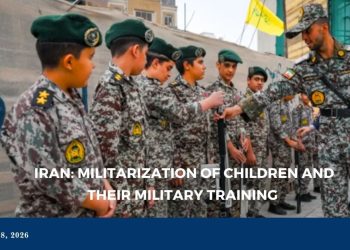
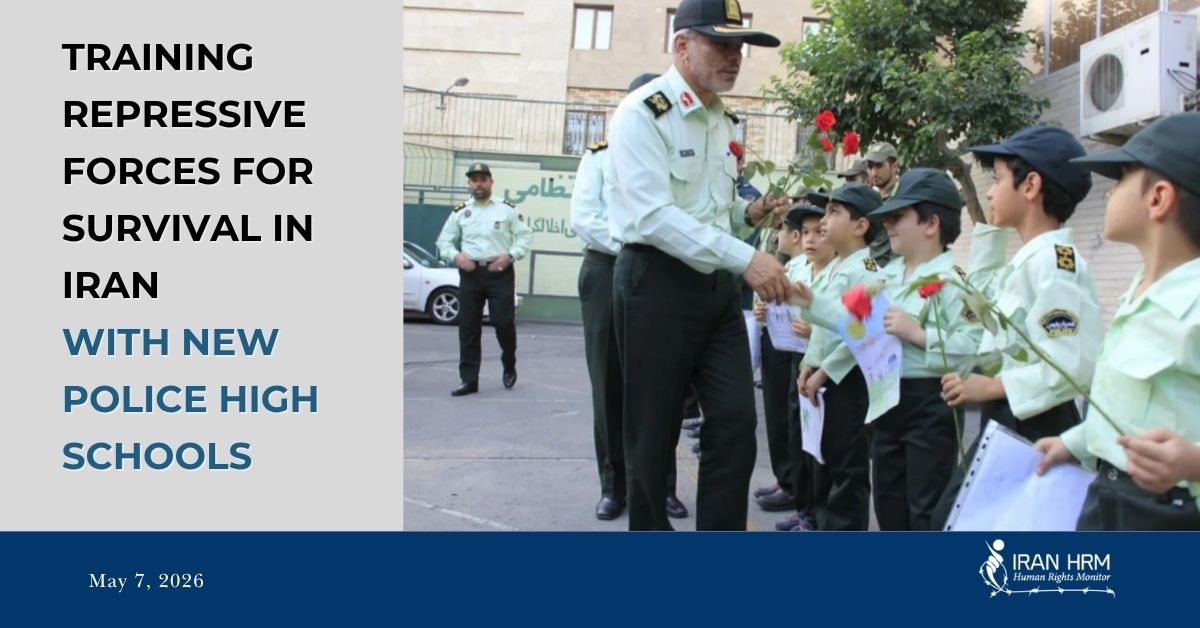
On February 9, 2026, the Mehr News Agency, quoting the Cultural and Social Deputy of FARAJA (the Law Enforcement Command of the Islamic Republic), announced that the country’s first “Police High School” would begin its educational activities in Tehran in October 2026.

Saeed Montazer-al-Mahdi stated: “In line with expanding specialized training and nurturing the future generation and ‘committed forces,’ Police High Schools are being established to identify and cultivate young talent—initially in Tehran and subsequently in several other provinces and counties across the country.”
These remarks, particularly the emphasis on “training the future generation and committed forces,” immediately evoke the legacy of the Haqqani School. Following the 1957 revolution, that institution produced a generation blindly devoted to the Velayat-e Faqih (Guardianship of the Islamic Jurist) and its ensuing culture. From its halls emerged individuals like Ebrahim Raisi, who was directly involved in the 1988 massacre of political prisoners and later became President, and Mohseni Eje’i, the current head of the Judiciary who issues daily orders to accelerate death sentences and their implementation; indeed, since March 19, 2026, we have witnessed the execution of 26 political prisoners.
Now, as Saeed Montazer-al-Mahdi’s admission confirms, these Police High Schools are not designed to train cadres who defend the people and society, but rather to produce “committed forces” for the regime. The world witnessed during the December 2025/ January 2026 (Dey 1404) uprising that forces “committed” to this system are trained for nothing but killing, brutal arrests, and torture.
Accelerating the Training of Repressive Forces: The Flip Side of Accelerated Executions
Just as the Islamic Republic is impatient to execute political prisoners and detained protesters, it has shown no restraint in training its “committed forces.” One week after the Deputy’s remarks, Ahmadreza Radan, the Commander-in-Chief of the Law Enforcement Command, announced the establishment of Police High Schools in Tehran and six other provinces, with the first center accommodating 1,200 students.
This time, Radan spoke without reservation regarding the goal of these centers: “Following public requests… these schools are being launched to expand specialized training and cultivate the next generation of ‘Revolutionary, Velayi, Jihadi, committed, and specialized’ police. These schools utilize an approach that integrates general and skill-based education, fostering a spirit of discipline and readiness for professional policing paths among teenagers.”
Iran’s Children Deprived of Education vs. Free Training for Repressors
While domestic and foreign statistics show that between 900,000 to 2 million children and teenagers in Iran are deprived of education—particularly in marginalized regions like Sistan and Baluchistan, Khorasan Razavi, and Khuzestan—these Police High Schools offer free enrollment. According to 2024-2025 data, 48% of child laborers (totaling 12,663 individuals then) are out of school; many girls remain in a “dream of education” due to forced early marriages, and 15% of children with disabilities are entirely deprived of schooling. Most families cannot afford basic educational costs due to widespread poverty, yet education in these police academies is completely free of charge.
On May 3, Mohammad Hossein Hamidi, the Deputy of Training for FARAJA, stated: “The establishment of Police High Schools has been placed on the agenda as a fundamental strategy toward achieving a ‘professional, trustworthy, and popular’ police force… These are ‘boarding schools’ that provide an ideal environment for nurturing the future generation and a serious step toward building the future commanders and administrative cadres of FARAJA.”
Regarding the “free” nature of these schools, Hamidi added: “The Law Enforcement Command has provided the best facilities and educational benefits for ‘free’ to pious and interested teenagers… This action is an investment in the country’s future.” (Read: an investment in the regime’s survival through systematic repression.)
Luxury Academies for Repression While Children Study in Huts
While children in Sistan and Baluchistan study in makeshift huts (kapars), these Police High Schools are equipped with state-of-the-art scientific laboratories, AI labs, skill-based workshops, top-tier instructors, excellent dormitory facilities, sports complexes including swimming pools, football pitches, and specialized martial arts halls, etc.
The Roadmap for Producing Repression Commanders and Forces: Predatory Recruitment
The Iranian child or teenager, deprived of even the minimum standard of education and facilities in the broader society, is being subconsciously lured into these “luxury” schools. By offering these amenities for free, the regime is effectively engaging in predatory recruitment, targeting low-income families to lead their children into a “slaughterhouse of identity.” This process strips them of their human identity and transforms them into repressive tools—or even commanders of future crackdowns.
By creating this class-based contrast—making public education low-quality and expensive while offering “free and luxury” training for police—the Islamic Republic is exploiting poverty to turn the victim (the deprived child) into the executioner (the repressive force). This plan constitutes a blatant Militarization of Education, which directly contradicts the spirit of the Convention on the Rights of the Child.
The Evolution of the Haqqani Model
The Haqqani School produced the “theoreticians” and “judges” of execution (like Raisi and Eje’i); these high schools, however, are designed to produce the “operational arm” and the “strikers.” The Islamic Republic is completing the chain of repression from the strategic level to the operational level on the streets. Furthermore, by making these schools “boarding” institutions, they completely isolate teenagers from their families and society, placing them in an ideological quarantine for brainwashing to ensure the regime’s survival.
From Words to Action: Halting the Machine of Future Oppression
Heavy investment in training repressive cadres amidst absolute educational poverty proves that this regime’s first and last priority is war against society. Since repression has become part of this regime’s DNA and its “investment for the future,” nothing but continued slaughter can be expected.
In such circumstances, settling for mild statements and “paper condemnations” only grants the regime more time to produce a new generation of executioners. The only way to stop this killing machine is through practical and executive international pressure that directly targets the machinery of repression and its cadre-building arms. Protecting human rights in Iran necessitates moving beyond symbolic gestures and entering an era of practical and punitive actions by the international community and human rights organizations. This regime will stop at nothing for its survival—even if it means leading the future of Iran’s children to the identity slaughterhouse.