The Ongoing Campaign of Repression against Protesters
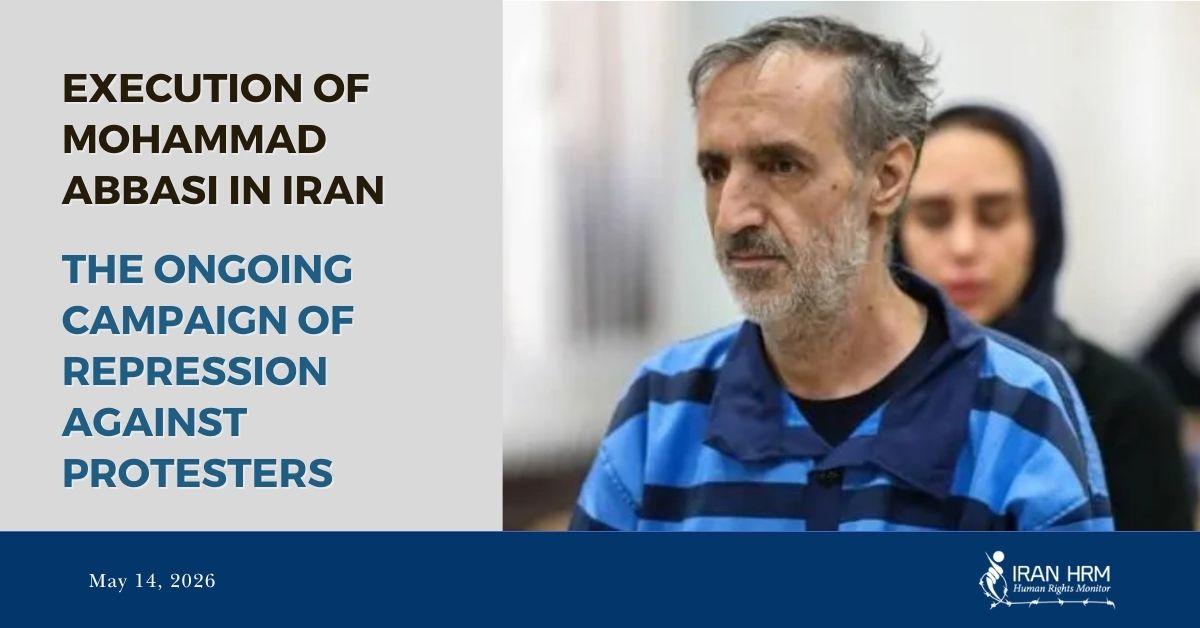
On May 13, 2026 (23 Ordibehesht 1405), Mohammad Abbasi, one of the detainees of the January 2026 (Dey 1404) nationwide protests, was executed. His execution was carried out at dawn in Ghezel Hesar Prison. His death sentence had recently been confirmed by the Supreme Court. On the same date, the Daneshjoo News Agency, quoting the Judiciary, labeled this political execution as “Qisas” (retribution). It identified Mohammad Abbasi as the assailant of the suppressive security force member named Lieutenant Colonel Shahin Dehghani in Malard during the January 2026 uprising.

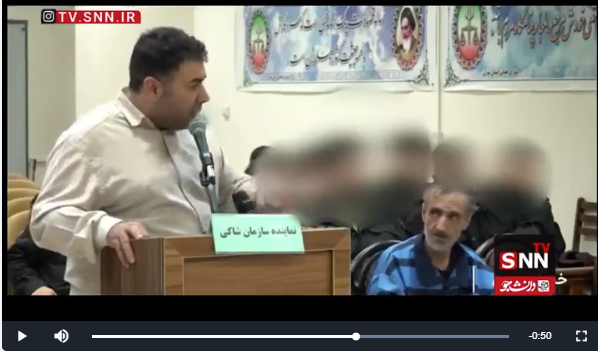
However, as is customary, in a video file released by the same media outlet regarding the protester’s trial, the accused was also charged with “collaboration with the Zionist regime.” This presents a glaring legal contradiction; on one hand, the judicial system labels the execution as “Qisas” (a matter concerning a private plaintiff/retribution), while on the other, it raises the political charge of “collaboration with Israel.” This duality demonstrates that the regime is merely seeking a convenient cover to justify its political executions—a charge that, in itself, clearly illustrates the sham nature of such courts and the subsequent sentences issued by them.
Furthermore, in this video, an individual standing at the podium as the “representative of the plaintiff organization” is seen putting words into the defendant’s mouth. For instance, he says:
“Mr. Judge, we even know exactly where in the square he revealed the weapon.”
Then, turning to Mohammad Abbasi, he asks:
“Mr. Abbasi, can you confirm that until you were near Arghavan Square, the weapon was not visible? Correct, Mr. Abbasi? It was in your pocket. When you crossed the width of the street and charged toward this side, you pulled out the weapon. Correct?”
Abbasi bows his head and quietly replies: “Yes.”
If you observe this file, it is entirely evident from the demeanor of the individual at the podium and Abbasi’s gaze that these statements are not the result of solid evidence, but rather the product of forced confessions under torture.
(Source: https://snn.ir/fa/news/1404096/)
 In its report to justify this inhumane sentence and its implementation, the news agency writes: “Even before committing murder, Mohammad Abbasi was an active participant in riotous gatherings and actions against internal security and was one of the key elements of the Zionist coup in January.” Enough said.
From Arrest to Execution
The Arrest
Mohammad Abbasi (55 years old) was arrested along with his daughter, Fatemeh Abbasi, during the nationwide protests in connection with the death of Shahin Dehghani Kakavandi, a Lieutenant Colonel of the SSF (State Security Force) in Malard. Following his arrest, his case was handled in Branch 15 of the Tehran Revolutionary Court, presided over by Abolghasem Salavati, notoriously known as the “Hanging Judge.”
The judicial system accused him of participation in the murder of a law enforcement officer, collaboration with Israel and the United States, and playing a role in the Malard protests, ultimately issuing a death sentence. The sentencing of the father to death and the long-term 25-year imprisonment of the daughter demonstrates the regime’s strategy for the total destruction of a family and the creation of terror through collective punishment. The proceedings for Mohammad Abbasi’s case were conducted in an entirely securitized and rushed atmosphere, and his trial lacked the standards of fair due process. It needs to be mentioned that many cases related to nationwide protests are reviewed in courts under the direct influence of security agencies.
Prevention of Selected Legal Counsel
After the initial sentence was issued, Ali Sharifzadeh Ardakani, a defense attorney, announced that the case of Mohammad Abbasi and his daughter Fatemeh had been referred to Branch 39 of the Supreme Court following an objection by the court-appointed (public) defender. According to this lawyer, Branch 39 of the Supreme Court prevented him (Ali Sharifzadeh Ardakani) and another independent lawyer from taking the case, citing the Note to Article 48 of the Criminal Procedure Code.
What does the “Note to Article 48” of the Criminal Procedure Code state?
The Note to Article 48 is a restriction created by the legislator regarding the choice of a lawyer during the preliminary investigation stage of certain cases.
Text of the Note (Amended June 14, 2015):
“In crimes against internal or external security, as well as organized crimes where the punishment falls under Article 302 of this law, during the preliminary investigation stage, the parties to the lawsuit shall select their lawyer or lawyers from among official lawyers of the justice system who are approved by the Head of the Judiciary (currently Gholam Hosseim Mohseni Eje’i). The names of said lawyers shall be announced by the Head of the Judiciary.”
This principle negates a fair trial from the very beginning:
- Defendants in certain security and organized crime cases cannot freely choose any lawyer during the interrogation and initial investigation stages.
- They must only select a lawyer from a list approved by the Head of the Judiciary.
- While this restriction is technically for the preliminary investigation stage, in practice, many legal experts state that this limitation is often extended to subsequent stages.
- The most critical stage where a security defendant needs a lawyer they can trust and rely on is the preliminary investigation stage—the very stage where this Note restricts the presence of a chosen lawyer.
Article 302 of the Criminal Procedure Code:
Article 302 lists crimes that fall under the jurisdiction of Criminal Court One; meaning crimes that are significant, heavy, or carry severe punishments.
What does Article 302 say?
Briefly, the following five categories of crime fall under the jurisdiction of Criminal Court One:
- Crimes where the punishment is death (e.g., premeditated murder, certain drug offenses, espionage, Moharebeh, etc.).
- Crimes where the punishment is life imprisonment.
- Crimes where the punishment is amputation or Qisas of a limb.
- Crimes where the punishment is Qisas of the soul (premeditated murder where retribution is possible).
- Ta’zir crimes of the third and fourth degree (e.g., major economic crimes, certain security crimes, large-scale embezzlement, extensive counterfeiting, etc.).
The Connection between Article 302 and the Note to Article 48
The Note to Article 48 states: In security or organized crimes whose punishments are mentioned in Article 302, the defendant, during the preliminary investigation, can only use lawyers approved by the Head of the Judiciary.
This means if a crime is “security-related” and its punishment falls into one of the five categories above, the restriction on choosing a lawyer is applied. An analysis of this article shows that in exactly the types of charges where a defendant requires a strong defense, they are denied their lawyer of choice and forced to use one of the lawyers introduced by the Judiciary. This is a fundamental violation of a fair trial, and it can be said that the outcome of the court is predetermined.
Beyond Domestic Law: Violation of International Obligations
The execution of Mohammad Abbasi is a flagrant violation of the International Covenant on Civil and Political Rights (ICCPR), to which Iran is a state party:
- Violation of the Right to Life (Article 6): Issuing a death sentence for crimes that do not fall under the category of “most serious crimes” and were prosecuted within a purely political context.
- Violation of the Prohibition of Torture (Article 7): The use of physical and psychological torture (including the hostage-taking of his daughter) to extract confessions.
- Violation of the Right to a Fair Trial (Article 14): Deprivation of the right to freely choose a lawyer and the lack of judicial independence, which is the most fundamental legal principle.
Torture and Threats Against the Daughter to Extort a Forced Confession from the Father
Sources close to the Abbasi family state that during his detention, Mohammad Abbasi was subjected to intense physical and mental pressure to accept the confessions dictated by interrogators. An informed source revealed that, in addition to physical torture, interrogators attempted to coerce him into confessing by making threats against his daughter.
According to this report, security agents used threats of sexual violence against Fatemeh Abbasi and used her as a tool of pressure, effectively turning Mohammad Abbasi’s daughter into a hostage of the interrogation process.
Tormenting the Family of the Executed
According to statements from a source close to the family, officials at Qezel Hesar Prison in Karaj requested that Mohammad Abbasi’s family come to the prison for their visit. However, once the family arrived, they were denied the meeting. After leaving the prison, they were informed via a phone call that Mohammad Abbasi’s execution had been carried out.
The prevention of a final visit is not only psychological torture of the family but also an explicit violation of the Executive Regulations of the Prisons Organization and international standards for prisoners’ rights, which emphasize the right to a farewell before the execution of a death sentence.
This inhumane behavior and the deception of the family constitute a clear instance of “Psychological Torture of Survivors” and is criminalized and condemned under the following international standards:
- Violation of Article 7 of the ICCPR: According to the jurisprudence of the UN Human Rights Committee, keeping the time of execution secret and preventing a final farewell constitutes “cruel, inhuman, and degrading treatment” toward the family. In such circumstances, the family of the accused is recognized as a direct victim of torture.
- Violation of the Mandela Rules: Based on Rules 68 and 70 of this global standards, prison authorities are obligated to provide accurate information to the family and respect their human dignity at all stages. Depriving the family of a final visit is a clear violation of these rules.
- Creating an Atmosphere of “Short-term Enforced Disappearance”: Given the secrecy surrounding the time of execution and the ambiguity created for the family, this action—according to the standards of the “International Convention for the Protection of All Persons from Enforced Disappearance”—is a tool for instilling terror in society at large.
The objective of these legal violations goes beyond punishing an individual; it aims to psychologically paralyze society and create a “paralyzing shock” among protesters to suppress the public will for seeking justice.
Ending Impunity: A Call for Global Action
The trial of Mohammad Abbasi has once again proved that the judicial system of the Islamic Republic is not an independent institution for the administration of justice, but rather an instrument for suppression and political revenge. In a situation where independent lawyers are eliminated and confessions extracted under torture and the hostage-taking of family members (Fatemeh Abbasi) form the basis of death sentences, the international community must not settle for mere verbal condemnations.
The duty of international bodies, particularly the UN Human Rights Council and the Special Rapporteur on the situation of human rights in Iran, goes beyond recording statistics; they must exert diplomatic and legal pressure to place the officials responsible for issuing and implementing these sentences—including Revolutionary Court judges—on international sanction lists and subject them to international prosecution.
Silence in the face of executions following the January 2026 (Dey 1404) uprising is equivalent to giving a green light to a killing machine that sacrifices human dignity and the right to life for its own survival. Today, immediate action to save other detainees of this uprising and to secure the release of Fatemeh Abbasi, who is held under a severe sentence, is a moral test for the awakened world.