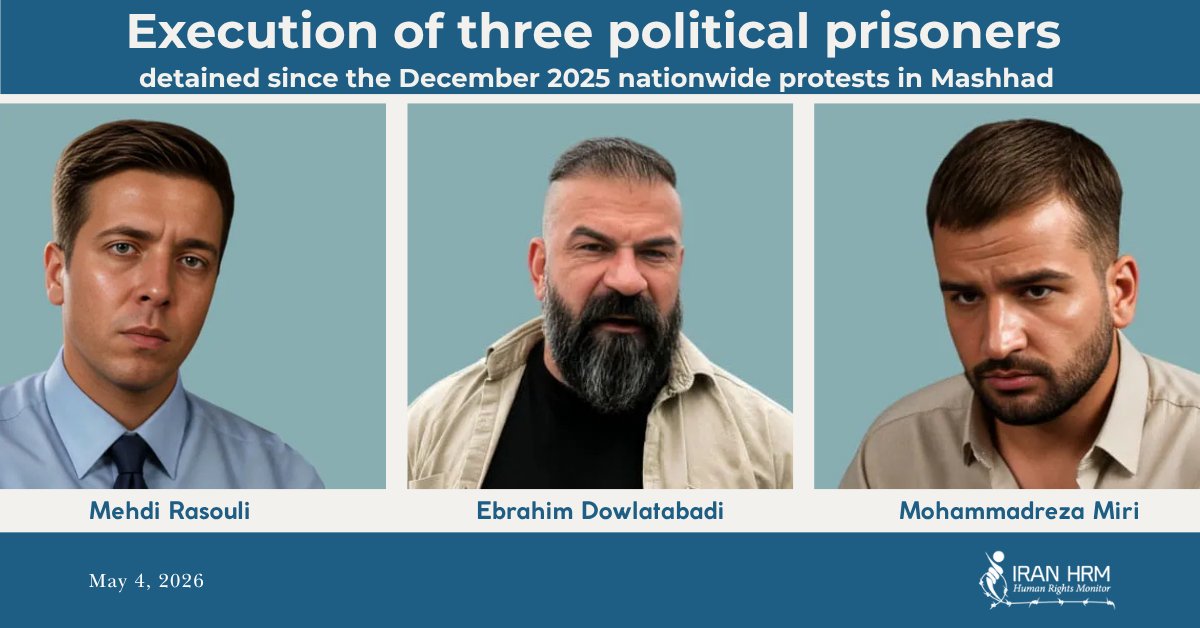
On May 3, 2026, four protesters detained during the nationwide protests of 2022 and December 2025/ January 2026 were hanged by Iran’s Judiciary in Urmia and Mashhad: Mehrab Abdollahzadeh (28) in Urmia (the detainee of 2022 nationwide protests), Mohammad Reza Miri (a 21-year-old laborer), Mehdi Rasouli (a 25-year-old laborer), and Ebrahim Dowlatabadi (a father of two) in Mashhad (detainees of December 2025/ January 2026 nationwide protests).

These executions occur amidst repeated orders by Mohseni Eje’i, the Chief Justice to accelerate the issuance and implementation of death sentences. Furthermore, on May 1, 2026, Mohammad Laeini, the Friday Prayer Leader of Sari, broadcasted on the Tabarestan network stated:
“If the judicial bodies do not strike well… we are arresting them in groups of 10 and 50, but when the trials are ‘drip-fed,’ we don’t see results. How and where should they be dealt with? They must be dealt with.”
Speaking from the Friday Prayer pulpit, a primary platform for communicating the regime’s strategic lines, he explicitly endorsed Eje’i’s commands, calling for death sentences dictated not by law, but by political-religious platforms.
The result of this rhetoric, combined with the lack of effective action from the international community and human rights organizations, is an unprecedented wave of executions of political prisoners and detained protesters in Iran.
The Real Reason for Internet Shutdowns: In the Regime’s Own Words
On April 26, Mehdi Jamshidi, a member of the Islamic Culture and Thought Research Center and a prominent media-intellectual figure close to the “Revolutionary Front,” defended the global internet shutdown on Channel 4. He exposed the regime’s true intent behind this blackout, which has lasted over two months since the start of the recent war:
“We should not leave a young person’s mind to foreign media under the guise of global internet access or ‘free communication.’ Many of our officials take pride in ‘licentiousness,’ and we saw the results in the streets in 2022 and again on January 8 [2026 protests].”
This confirms that internet shutdowns in Iran are not only a tool for regime survival but also a “security shield for criminals” to hide the scale of executions from the world.
The Result of Global Inaction
Mehrab Abdollahzadeh

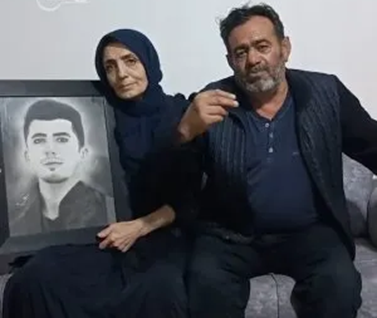
- Mehrab Abdullahzadeh was born on March 15, 1998, in Urmia and was arrested during the 2022 nationwide protests. On October 22, 2022, he was arrested at his workplace by agents of the IRGC Intelligence Organization and transferred to their detention center.
- Held in solitary confinement for 38 days under intense interrogation, psychological pressure, and physical torture to extract a confession for the murder of a Basij member.
- Denied access to a lawyer and family contact during these 38 days.
- The death sentence was based solely on confessions obtained under torture, with no independent or forensic evidence.
- An informed source stated that video footage of the crime scene held by security agencies shows no sign of his presence, yet the court refused to review this evidence. By ignoring exculpatory evidence, the court committed “Premeditated Judicial Murder”.
- The execution was carried out secretly; his parents were denied their right to a final visitation, a flagrant violation even of the Islamic Republic’s internal regulations.
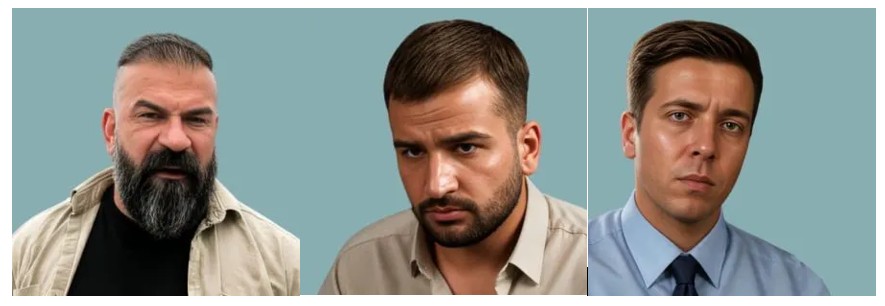
Mehdi Rasouli, Mohammad Reza Miri, and Ebrahim Dowlatabadi
-
- Ebrahim Dowlatabadi (left), Mohammadreza Miri and Mehdi Rasouli
Before the execution of his sentence, Mehdi Rasouli had told his relatives that he was forced to accept the charges following severe beatings and torture. The confessions obtained under torture became the most significant and primary evidence cited in his judicial case.
- A similar pattern existed in the cases of the other executed individuals, and the primary documentation for the files was compiled based on confessions extracted under duress.
- Ebrahim Dowlatabadi was an athlete from Mashhad and a father of two children, aged 9 and 14. He was arrested in late January 2026 and transferred to Vakilabad Prison. His sentence was issued by Judge Gholamreza Akbari Moghadam.
Security Tactics to Prevent International Campaigns
Security and judicial authorities had informed the families of these prisoners that if they refrained from publicizing the cases, there would be a possibility of changing the sentences or stopping the implementation of the executions. Accordingly, the families were prohibited from any public or media reporting regarding the cases. Furthermore, the families were told that the cases were being reviewed by the Pardons Commission and that they must not provide any information about them yet on the morning of Sunday, May 3 (13 Ordibehesht), the families of the executed prisoners were informed of the implementation of the sentences. Subsequently, around 10:00 AM, they were requested to appear at the cemetery to view the bodies of their executed loved ones.
The Continuous Violation of Human Rights
The executions of Mehdi Rasouli, Mohammad Reza Miri, and Ebrahim Dowlatabadi have once again highlighted the issue of using forced confessions, torture, and the deception of families in political cases resulting in the death penalty. The implementation of these sentences, coinciding with the rise in executions of political prisoners, is assessed as a clear sign of the intensifying use of capital punishment to intimidate society and suppress protests.
Violated Rights:
1-Violation of the Right to Life – Article 3 of the Universal Declaration of Human Rights: Everyone has the right to life, liberty, and security of person.
2-Violation of the Prohibition of Torture and Forced Confessions – Article 5 of the Universal Declaration of Human Rights: Extracting confessions under torture for the issuance of a death sentence is a fundamental violation of human rights.
3-Violation of the Right to a Fair Trial – Article 10 of the Universal Declaration of Human Rights: Ignoring evidence of innocence and the lack of impartial proceedings violates the right to a fair trial.
4-Violation of the Presumption of Innocence and the Right to Defense – Article 11 of the Universal Declaration of Human Rights: Everyone charged with a penal offence has the right to be presumed innocent until proved guilty according to law and has the right to all the guarantees necessary for their defense.
5-Violation of the Right to Family Dignity and Transparent Information – Fundamental Principles of Human Rights: Deceiving families regarding the stay of execution and the delayed notification of the implementation of sentences violates human dignity and the fundamental rights of the victims’ families.
List of Perpetrators and Human Rights Violators
The following individuals are identified as directly responsible for these crimes for the purpose of international sanctions and prosecution under “Universal Jurisdiction”:
- Gholamreza Akbari Moghadam (Chief of Mashhad Revolutionary Court): Issued the death sentence for Ebrahim Dowlatabadi; responsible for the judicial murder of an athlete and father through a flawed process.
- Judge Najafzadeh (Head of Branch 1, Urmia Revolutionary Court): Issued the death sentence for Mehrab Abdollahzadeh. When Mehrab stated in court that he was tortured to confess, the judge mockingly replied: “You have all learned to say you were tortured. Our ‘experts’ [interrogators] do not torture anyone; you are all lying.”.
- Mohseni Eje’i (Chief Justice): The primary solicitor who stripped judges of their independence through orders to “accelerate executions,” turning the judiciary into a killing machine.
- Mohammad Laeini (Sari Friday Prayer Leader): Cited for “incitement to murder” and pressuring the judiciary to transition from “drip-fed” trials to mass executions.
Warning: A Gradual Massacre is Underway
Since March 19, 2026, following the execution of three protesters in public in Qom (Mehdi Ghasemi, Saleh Mohammadi, and Saeid Davoodi), there have been 26 political executions as of May 4, 2026. With 50,000 arrests in the January 2026 uprising and hundreds of political prisoners already in custody, the regime is following the precedent of the 1988 Massacre.
If the current rate of political executions continues, Iran will face an average of 17 political executions per month, totaling 204 per year. This does not include the countless executions for drug-related and other charges that are currently hidden behind the global internet blackout.
Time for action without excuses
Is this data not enough to stir the conscience of humanity and to trigger effective, practical actions by the governments of the free and democratic world committed to human rights, as well as human rights organizations, to stop the executions in Iran and to hold the perpetrators accountable?”