This report examines how the ruling regime in Iran has transformed social coexistence into political obedience since 1979.

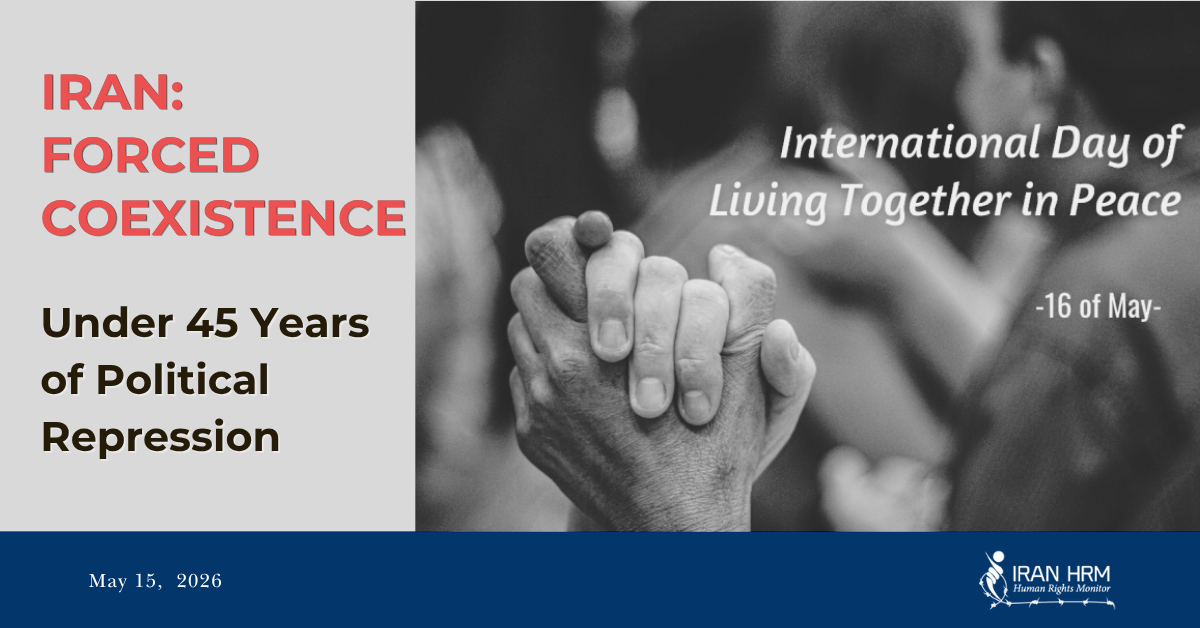
May 16, the International Day of Living Together in Peace, emphasizes tolerance, inclusion, respect for diversity, and coexistence without violence. In Iran, however, social coexistence over the past 45 years has increasingly become a form of “conditional coexistence”; a condition in which citizens are tolerated only so long as they refrain from political dissent, protest, independent organization, demands for justice, and the pursuit of truth.
From its earliest years in power, the ruling regime in Iran defined political and social diversity not as part of public life, but as a threat to its survival. Within this framework, laws, security institutions, Revolutionary Courts, the death penalty, mass arrests, and pressure on families became instruments for imposing silence and obedience.
Law as an Instrument of Restriction
The Constitution of the ruling regime in Iran formally recognizes rights such as freedom of belief, expression, assembly, and association. Article 23 prohibits the investigation of personal beliefs; Article 24 recognizes freedom of the press; Article 26 permits the formation of political parties, associations, and trade organizations; and Article 27 recognizes the right to peaceful assembly without arms.
Yet these same provisions are conditioned on vague concepts such as “Islamic principles,” “public interests,” “national unity,” “national security,” “Islamic criteria,” and “the foundations of the Islamic Republic.” In practice, these ambiguities have enabled security and judicial institutions to interpret virtually any civil, political, labor, student, or media activity as a security threat whenever deemed necessary.
At the criminal level, broadly defined charges such as “propaganda against the state,” “assembly and collusion against national security,” “enmity against God” (moharebeh), “armed rebellion” (baghi), and “corruption on earth” have been widely used against political opponents, civil activists, protesters, journalists, teachers, workers, lawyers, and dissenting citizens.
This structure demonstrates that political repression in Iran is not merely the result of unlawful conduct by security agencies; rather, part of it is embedded within the legislative framework itself, the ambiguity of criminal concepts, and the securitized interpretation of the law.
The 1980s; Consolidation of Organized Repression and Continuing Impunity
During the first decade following the 1979 revolution, political repression became widespread and institutionalized. The elimination of opposition groups, mass arrests, opaque summary trials, widespread executions, and pressure on families established a historical pattern whose consequences continue to the present day.
The mass execution of political prisoners in 1988 was the central event of this pattern. According to the report of former UN Special Rapporteur Professor Javaid Rehman, approximately 30,000 political and ideological prisoners were executed across Iran following a fatwa issued by Ruhollah Khomeini and decisions by so-called “Death Commissions.” Many victims were affiliated with the People’s Mojahedin Organization of Iran (PMOI/MEK), while leftist prisoners were also executed in a subsequent wave. Victims were buried in secret mass graves, and families were denied the right to know the truth, the burial locations, or even to mourn publicly.
On 19 November 2025, the Third Committee of the United Nations General Assembly adopted resolution A/C.3/80/L.30, which for the first time referenced the 1988 executions. Paragraph 29 of the resolution expressed concern over “ongoing enforced disappearances, extrajudicial executions and the destruction of evidence and grave sites,” warning that the lack of accountability enables such violations to recur and persist.
The resolution also expressed concern regarding incitement to violence in state-linked media echoing the summary and arbitrary executions of 1988.
The significance of this development lies in the fact that the 1988 massacre is no longer viewed merely as a closed historical episode. It is now increasingly understood within the framework of ongoing impunity, enforced disappearance, and continuing threats against political prisoners in Iran today.
From Political Repression to Social Control
After the 1980s, the form of repression evolved, but its essence remained unchanged. Widespread physical repression gradually gave way to systematic social control. The closure of newspapers, arrests of journalists, pressure on writers, suppression of students, restrictions on political parties, arrests of labor activists, pressure on lawyers, control over women, repression of ethnic and religious minorities, and the securitization of social protest all became part of this process.
At this stage, “security” became the dominant framework governing the state’s relationship with society. Labor demands, student protests, legal advocacy, media work, and even family-led demands for justice could be transformed into security cases.
The 1999 student protests, the 2009 protests, the economic and social protests of 2017, the November 2019 protests, the 2022 uprising, and subsequent protest waves were all met with a similar pattern: communication blackouts, mass arrests, violence, security-related prosecutions, forced confessions, severe sentences, and pressure on families.
Nationwide Protests; A Security Response to Social Demands
Over the past 45 years, whenever Iranian society has demanded participation, transparency, justice, freedom, or accountability, the ruling regime in Iran has responded not through dialogue, but through security control.
During nationwide protests, security and law enforcement forces have used direct violence, mass arrests, threats against families, internet shutdowns or restrictions, and security-related charges against protesters. This pattern demonstrates that protest in Iran is treated not as a civic right, but as a threat to the survival of the state.
The 2019 protests provided a clear example of this approach. The near-total internet shutdown and the violent suppression of protesters showed that when confronted with social unrest, the ruling regime in Iran first isolates society from the outside world and then carries out repression in conditions lacking public scrutiny.
The 2022 Uprising; From Street Repression to the Execution of Protesters
The nationwide uprising of 2022, following the death of Mahsa Amini in morality police custody, became one of the clearest examples of transforming social demands into security prosecutions in Iran. Human rights networks estimated that more than 750 people were killed during the crackdown, while the identities of more than 600 victims, including women and children, have been verified and published.
The United Nations Fact-Finding Mission on Iran concluded that the repression of the protests involved unnecessary and disproportionate use of force, arbitrary detention, torture and ill-treatment, sexual and gender-based violence, enforced disappearance, and persecution based on gender, ethnicity, religion, or political belief. The Mission stated that many of these violations may amount to crimes against humanity.
According to human rights reports and field sources, at least 71 to 74 children under the age of 18 were killed during the suppression of the protests. Discrepancies in published figures are directly linked to concealment by the ruling regime in Iran, pressure on families, delays or obstruction in returning bodies, and cases of enforced disappearance.
Regarding arrests, the National Council of Resistance of Iran estimated that more than 30,000 people were detained during the protests. At the same time, an official acknowledgment by Judiciary Chief Gholamhossein Mohseni Ejei that more than 22,000 detainees had later been released or pardoned itself reflected the massive scale of the arrests. Independent estimates, including temporary and long-term detentions, place the total number of arrests during the first phase of the uprising at approximately 60,000.
The repression of the 2022 uprising did not end with arrests and street violence. The ruling regime in Iran prosecuted protesters under charges such as “enmity against God,” “armed rebellion,” and “corruption on earth”; charges carrying the death penalty. Amnesty International warned from the earliest executions that protesters such as Mohsen Shekari were executed following proceedings that bore no resemblance to genuine fair trials, and later warned of the risk of further executions connected to the protests.
To date, the executions of nine protesters; Mohsen Shekari, Majidreza Rahnavard, Mohammad Hosseini, Mohammad Mehdi Karami, Saleh Mirhashemi, Saeed Yaghoubi, Majid Kazemi, Milad Zohrevand, and Mohammad Ghobadlou; have been officially carried out. According to resistance sources and warnings issued by international organizations, at least 109 protesters have, at various stages, faced the risk of death sentences or execution.
Execution as an Instrument of Political Control
In Iran, particularly in recent years, the death penalty has increasingly functioned beyond the framework of criminal punishment and has become an instrument of political control, public intimidation, and the elimination of political opponents or security suspects.
Executions in political and security-related cases are frequently accompanied by serious human rights concerns, including detention in security facilities, denial of access to lawyers of choice, prolonged solitary confinement, coerced confessions, closed or summary trials, restricted access to information for families, and executions carried out without effective prior notification.
This pattern has intensified particularly after political crises and protest waves. Whenever the ruling regime in Iran has faced legitimacy crises, social unrest, or security tensions, the use of capital punishment as a deterrent has escalated.
Executions After the Recent War; Expansion of Espionage, Baghi, and Moharebeh Cases
Following the recent war, a new wave of political and security-related executions emerged in Iran. The report A/HRC/61/59 by Mai Sato examined the human rights situation in Iran from January 2025 to February 2026, including developments related to nationwide protests beginning on 28 December 2025.
In the same context, the Office of the United Nations High Commissioner for Human Rights warned about the intensification of executions and security arrests following the war. Reuters, quoting Volker Türk, reported that since the outbreak of the war, authorities of the ruling regime in Iran had executed at least 21 people and arrested more than 4,000 individuals on national security-related charges. According to the report, detainees faced risks including enforced disappearance, torture, staged executions, and coerced confessions, while ethnic and religious minorities faced heightened vulnerability.
According to data collected in human rights reports, 22 political prisoners and protesters connected to the 2025 uprising have so far been executed. In addition, at least 12 people accused of espionage, primarily involving alleged ties to Israel, have been executed.
Alongside these cases, charges such as “baghi,” “moharebeh,” and “corruption on earth” have once again become instruments for imposing death sentences against political prisoners, protesters, and security detainees. These accusations are frequently brought in cases marked by serious concerns regarding judicial transparency, access to legal counsel, judicial independence, the reliability of confessions, and the right to defense.
The increasing use of espionage-related charges following the recent war demonstrates how the ruling regime in Iran has used the wartime security atmosphere and external conflict to intensify domestic repression. In this environment, the line between genuine security cases and politically motivated prosecutions becomes blurred, placing political prisoners and residents of sensitive regions at heightened risk of rapid executions.
According to Amnesty International, at least 70 political prisoners in 2026 face an imminent risk of execution, while more than 100 others are awaiting possible death sentences. This reflects a more dangerous stage in the political use of capital punishment; one in which executions function not merely as punishment, but as instruments of intimidation, social control, and the prevention of renewed protests.
Families; The Second Target of Repression
Political repression in Iran does not end with detainees, prisoners, or those executed. Families themselves are systematically subjected to pressure. Such pressure includes threats, summonses, arrests, restrictions on memorial ceremonies, limitations on public communication, delayed return of bodies, pressure to remain silent, and deprivation of the right to know the truth.
Families of victims from the 1980s remain deprived of knowledge regarding the burial sites of their relatives. Families of those killed during the 2019 and 2022 protests have faced threats, interrogations, and restrictions on mourning ceremonies. Families of political prisoners and death-row inmates are frequently kept uninformed until the final moments before executions are carried out.
This pattern demonstrates that the state seeks not only to suppress protest, but also to control collective memory. Within such a structure, families seeking truth and accountability are treated not as rights-holders, but as obstacles to the official narrative.
Structural Contradiction; Law Versus Practice
The ruling regime in Iran formally speaks of freedom of expression, freedom of assembly, prohibition of torture, the right to counsel, presumption of innocence, and citizens’ rights in its Constitution. In practice, however, these same rights are systematically violated.
The prohibition of torture stands in contradiction to persistent reports of coerced confessions and physical and psychological abuse. The constitutional right to assembly is contradicted by the violent suppression of protests. The right to a fair trial is undermined by security courts, denial of legal representation, and rushed verdicts. The presumption of innocence disappears in the face of security narratives promoted by state-affiliated media before trials even begin.
This contradiction demonstrates that the issue is not merely the violation of law; rather, it is the transformation of law itself into an instrument used first to restrict and then to violate even the minimal rights formally recognized under domestic legislation.
Human Rights Analysis; Peaceful Coexistence Cannot Exist Without Freedom
From a human rights perspective, peaceful coexistence cannot exist without political freedom, the right to dissent, freedom of assembly, freedom of association, public participation, fair trial guarantees, prohibition of torture, and the right to life.
In Iran, political, ideological, social, ethnic, and religious diversity is often framed not as part of society, but as a security threat. As a result, political dissent becomes criminalized; peaceful assembly is treated as a national security threat; families seeking justice are subjected to pressure; and political prisoners face accusations that may lead to death sentences.
Under these conditions, what the ruling regime in Iran describes as “order” is, in practice, an organized form of forced coexistence; one based not on consent, inclusion, trust, and justice, but on fear, silence, exclusion, and security control.
Conclusion and Call to International Mechanisms
In Iran, the absence of peaceful coexistence is not the result of social diversity or political disagreement. It is the result of a structure that, over the course of 45 years, has transformed difference into threat, protest into crime, and demands for justice into security cases.
From the 1980s to the 2022 uprising and the wave of political executions following the recent war, a continuous pattern can be observed: the use of law, courts, prisons, executions, pressure on families, and control over public narratives to eliminate political dissent and impose social obedience.
Under these circumstances, it is essential that the Independent International Fact-Finding Mission on Iran, the UN Special Rapporteur on the situation of human rights in Iran, the Office of the High Commissioner for Human Rights, and international human rights organizations examine the recent wave of political and security-related executions, the cases involving protesters from the 2022 uprising, the pressure exerted on families seeking justice, and the use of charges such as “espionage,” “baghi,” “moharebeh,” and “corruption on earth” as part of a broader structural pattern of political repression in Iran.
These cases require independent documentation, urgent international follow-up, demands for judicial transparency, suspension of executions, access of families to truth and information, and inclusion within international accountability mechanisms.